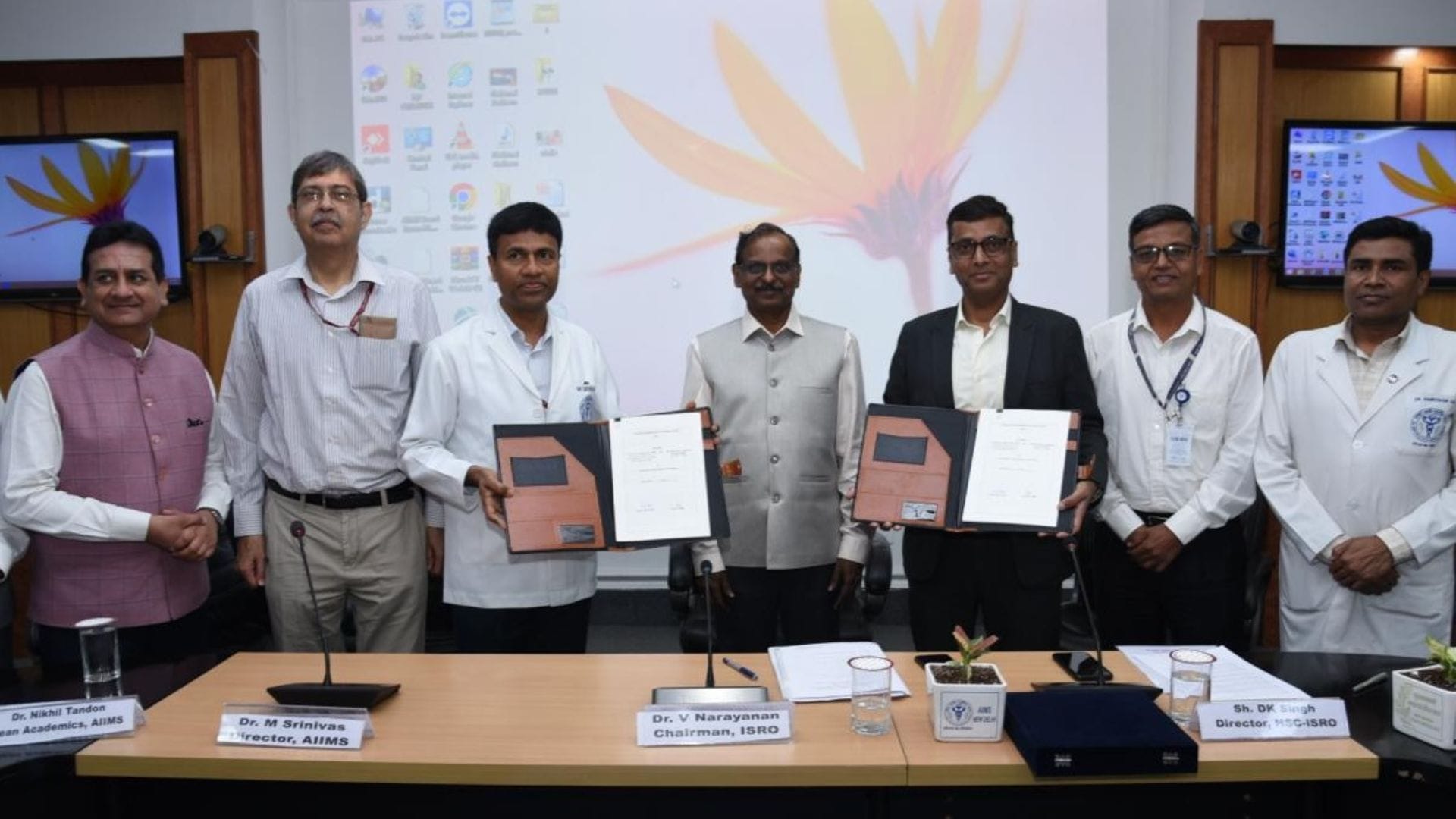
New Delhi: All India Institute Of Medical Sciences (AIIMS), New Delhi has signed a Memorandum of Understanding (MoU) with ISRO’s Human Spaceflight Centre (HSFC) on conducting research in space medicine. The research will include microgravity physiology, genomics and behavioural health in support of India’s human spaceflight missions. Director of AIIMS New Delhi M Srinivas said, “This MoU will give us the escape velocity to venture together into the field of space medicine.” ISRO’s has embarked on the ambitious Gaganyaan Programme to lift humans to Earth orbit and return them safely to the surface using domestic hardware.
ISRO began stacking the Human-Rated Launch Vehicle Mark 3 (LVM3) in December 2024, and announced that the integration activities were nearing completion in December 2025. The launch is supposed to take place by the first quarter of 2026. This uncrewed Gaganyaan G1 flight will have a passenger on board, the robotic platform loaded with sensors called Vyommitra. This humanoid robot will validate the safety of the Gaganyaan crew module for human spaceflight, and is a more humane alternative to chimpanzees and dogs used by other spacefaring nations ahead of human spaceflight. ISRO will follow with two more uncrewed Gaganyaan flights before launching the first crewed Gaganyaan mission.
First Crewed Gaganyaan flight in 2027
At the 23rd National Space Science Symposium (NSSS) in Umiam, Shillong, ISRO Chairman V Narayanan had said, “Compared to any other programme, in spaceflight where humans are involved, safety is very important. We all are working towards that. I am sure in the next couple of months, you will come to know of the first uncrewed mission, in which we are also sending Vyommitra. That mission is targeted very shortly. In a couple of months, it is going to be done. In 2027, we will be sending our own Gaganyatri, using our own human-rated LVM3 launcher, and we are working towards that.”