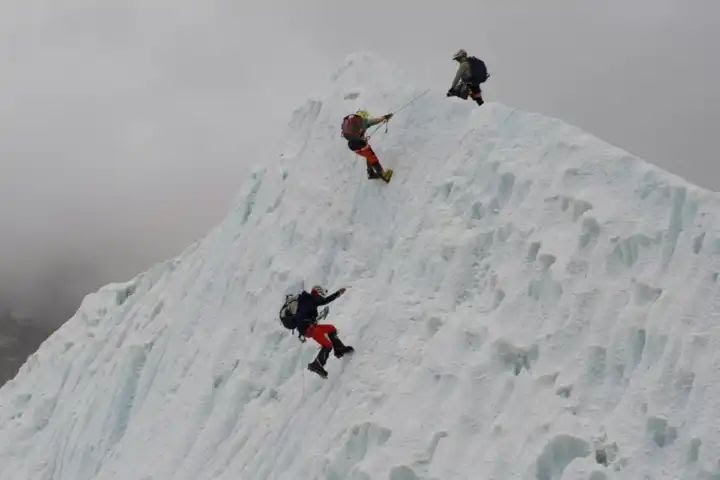
It is more expensive to touch the peak of Everest than it is to bring back the dead body of a climber from there. Every year 5 to 10 climbers on Everest missions die, most of whose bodies are left on Everest itself.
Recently, mountaineer Arun Kumar Tiwari, who was returning after touching the peak of Everest, also died in the death zone. The family has decided to leave his body there. According to the family, this decision has been taken due to their faith in the Himalayas and the difficulties involved in bringing back the body.
It costs more to bring back a dead body than it does to reach Mount Everest. The team of Sherpas goes on a mission specifically to bring back the dead body. Such missions are also considered very dangerous. Mountaineer Arun Kumar Tiwari’s expedition was handled by Pioneer Adventure. According to the company, the cost of bringing back the dead body is approximately $114,000, which is Rs 1.1 crore in Indian rupees. In Assam, this is double the amount spent to climb Everest. Let us try to understand why missions to bring back bodies are dangerous and expensive. What is the compulsion that dead bodies have to be left on Everest itself?
Death zone is above 8000 meters
There is a death zone above 8 thousand meters on Everest. The air pressure which is 1 at sea level is only 0.33 at the top of Everest. According to the report of Science Alert, blood oxygen in the death zone comes down to 50 to 60 percent. This is the stage where emergency treatment is started. In such a situation, two dangers increase in mountaineers, one is high altitude pulmonary edema, in which the lungs get filled with water, making breathing difficult. The second danger is high altitude cerebral edema i.e. swelling in the brain. In this, there is swelling in the brain.
- Heart beat reaches 140 to 160.
- Digestion stops and one cannot sleep.
- Muscles become weak, every step becomes difficult.
- Normal climbers can remain safe in the death zone for 16 to 20 hours.

Why are dead bodies left on Everest?
1- Weight increases: As big a challenge as climbing Everest is, it is equally difficult to get down from there. In such a situation, bringing back the dead body from Everest is also a very dangerous mission. Quoting Sherpa Shiring Jangu of Nepali Army, Outside Magazine has written in its report that it is difficult for two people to lift an 8 kg oxygen cylinder above 8 thousand meters. It is impossible to lift an 80 kg dead body. Secondly, due to accumulation of snow, the weight of the dead body becomes more than 100 kg.
2- Helicopters cannot reach: The air in the death zone is so thin that there is not enough air for the helicopter’s rotor blades. On Everest, helicopters can reach only up to Base-2 Camp.
3- Higher expenses: Bringing back the dead body is a separate mountaineering expedition. Depending on the height, it costs approximately 40 thousand dollars to 2 lakh dollars, i.e. 33 lakh to 1.65 crore. In 2017, the Bengal government had spent approximately Rs 77 lakh in bringing back a dead body. In an interview with CBC, the Colorado climber said it was expensive and dangerous.
4- Sherpas’ lives in danger: In 1984, two rescuers died while trying to retrieve the body of German climber Hannelore. Apart from this, in 2019, during the mission to bring dead body to Makalu Mountain, a Nepali soldier suffered from attitude sickness and had to leave the mission.
5- Bad weather: The favorable season for climbing Everest is very short, the weather remains good only for about 2-3 weeks in May. After this the wind exceeds 160 km per hour and the temperature drops below -40 degrees Celsius.
The world’s highest mountain peak Everest.

5 dead so far including two Indians on Everest mission
The height of Mount Everest is 8849 meters. This is the highest peak in the world, which is every climber’s dream to conquer. 53 year old Arun Kumar Tiwari and 47 year old Sandeep Arey had conquered Everest on 20 and 21 May. However, while landing, both of their health deteriorated and they died. Himal Gautam, director of Nepal’s tourism department, told IANS that while returning, Arun fell ill when he was on the 8790 meter high Hillary Step. Sherpa tried to help him but he did not survive. According to Karki, Managing Director of Pioneer Adventure, he had high altitude pulmonary edema. In this, due to altitude the lungs get filled with water.
Sandeep Hey had reached Everest on 20th May. According to Pioneer Adventure, he suffered snow blindness soon after reaching the peak. That means he could not see anything with his eyes. Five Sherpa guides rescued him from the South Summit and brought him down and he died in Camp-2. Earlier on May 11, 20 year old Phura Gyaljen Sherpa had died due to slipping. On May 10, Bijaya Ghimire fell in the Khumbu Icefall and the first death occurred on May 3 by Lakpa Dende Sherpa, who died while returning to the base camp.
Danger from increasing crowd on Everest
The crowd of people is continuously increasing on Everest. Nepal’s Tourism Department had issued 494 permits to foreign climbers in 2026, which is the highest so far. The cost of each permit is 15,000 dollars i.e. approximately 12 to 13 lakh rupees. Nepal government earned 7.19 million dollars from this. On May 20, 2026, 274 climbers reached the summit of Everest in a single day.
This is a single day record so far. Quoting the General Secretary of the Expedition Operators Association of Nepal, Reuters has written that this is much more than the previous record of 223 which was made on 22 May 2019. Due to the sudden increase in the crowd of climbers on Everest, there were long queues in the death zone. The climbers remained frozen for hours. The risk of running out of oxygen increased. Kami Rita Sherpa, who has climbed Everest 32 times so far, said that the government should not focus on the number of permits but on the quality of climbers.
Then what happens to so many dead bodies?
The temperature of the death zone is always below zero. That is why dead bodies always remain safe here. More than 200 dead bodies are still lying on Everest, among them are the bodies of Green Boots and Sleeping Beauty. According to the IANS report, employees are continuously deployed in the base camp feed office and officially record the information of every death.