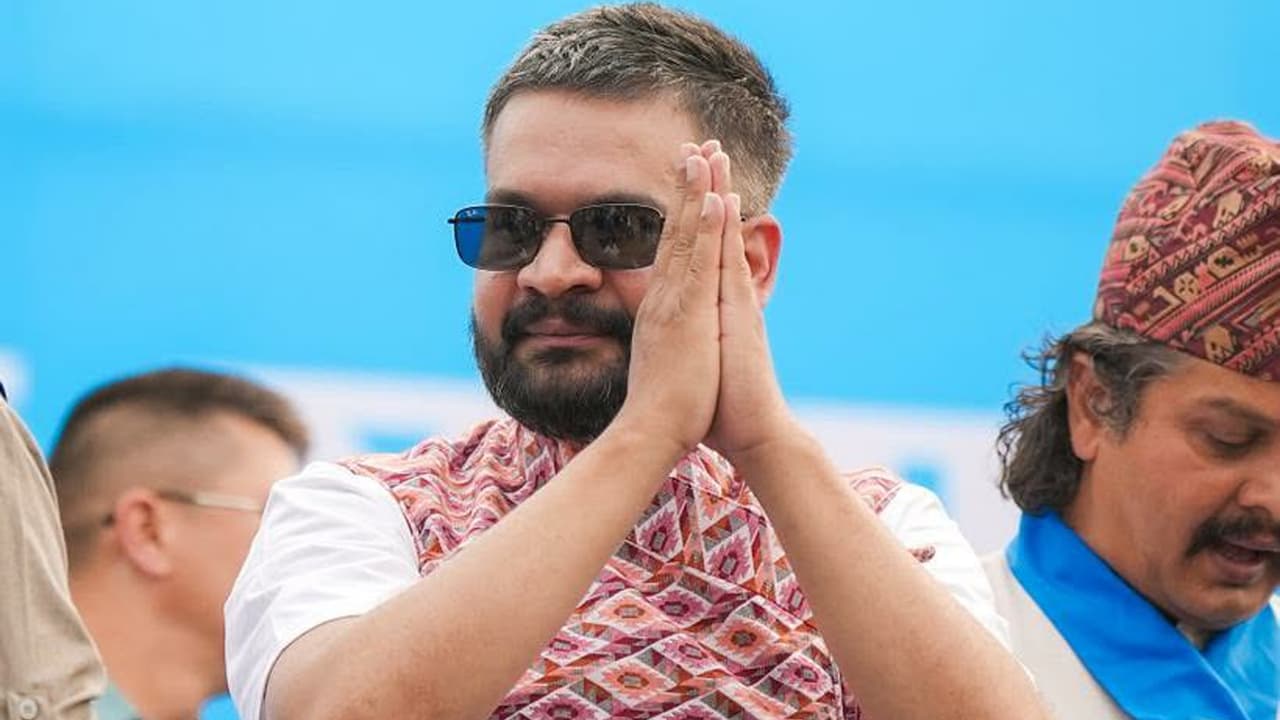
Balendra Shah’s Rashtriya Swatantra Party (RSP) has won an overwhelming majority in the Nepal elections. Shah, educated from Bengaluru, is on his way to becoming the Prime Minister. The RSP won 70 out of 94 seats, while the major old parties were reduced to 6 seats each.
Kathmandu: The results of the general elections held in Nepal are out and Bengaluru-educated Balendra Shah is on his way to becoming the Prime Minister. In the results declared on Monday, his Rashtriya Swatantra Party (RSP) has won an overwhelming majority. K.P. Elections were held on March 5 after the fall of the Oli Sharma government. Out of total 94 seats, RSP has won 70 seats. At the same time, Nepali Congress, CPN-UML and Nepali Communist parties got only 6 seats each.
Balendra Shah was earlier the mayor of Kathmandu city. Before coming into politics, he was famous as a rapper by the name ‘Balen’. In this election, he defeated 4-time Prime Minister K.P. Sharma defeated Oli by a margin of 4842 votes. Shah has done M.Tech from Nitte College affiliated to VTU (Visvesvaraya Technological University) located in Belagavi, Karnataka. He completed his Master of Technology (M.Tech) degree in Structural Engineering from Nitte Meenakshi Institute of Technology (NMIT) under VTU, Belagavi between 2016 and 2018.
The RSP party was founded just four years ago by former journalist Rabi Lamichhane. Whereas, former Prime Minister K.P. Sharma Oli’s party CPN-UML has been able to win only a few seats so far. Voting was 58% in the elections held on March 5, following violent clashes in September last year. The Election Commission has said that efforts will be made to complete the counting of votes by March 9, which may take three to four days.
Two ways to elect MPs in Nepal
Nepal’s electoral system is mixed, that is, MPs are elected in two ways: direct election and on the basis of total votes received by the party.
Direct Election
165 out of 275 seats in Parliament are filled by direct elections. People vote for their candidate on every seat and the candidate who gets the most votes wins. This is somewhat like the Lok Sabha elections of India.
Seats based on vote percentage
The remaining 110 seats are given to the parties on the basis of percentage of votes received. In this, voters do not vote for the candidate but for the party. The party gets seats in the Parliament in proportion to the percentage of votes it gets across the country. The purpose of this system is that small parties and different social groups can also get a place in the Parliament and no one party should completely dominate.
What is the reason behind RSP’s bumper victory?
Due to Nepal’s mixed electoral system, it was generally considered difficult for any one party to win an absolute majority. But RSP seems to be winning almost two-thirds of the seats. This is the first time after the implementation of the Constitution that any one party has won so many seats. Experts believe that the clean image of Balen Shah as the Mayor of Kathmandu is a major reason for this victory.
Political Science Professor Lok Raj Baral said that under the leadership of Gagan Thapa, Nepali Congress tried to come out of its old image, but due to less time, they could not succeed completely. According to Baral, this wave in favor of RSP arose because people were angry and disappointed with the old parties. Previous governments had failed to provide basic amenities to the people and Balen Shah’s popularity further strengthened this wave. However, he also said that such waves do not last if the performance is not good after coming to power.