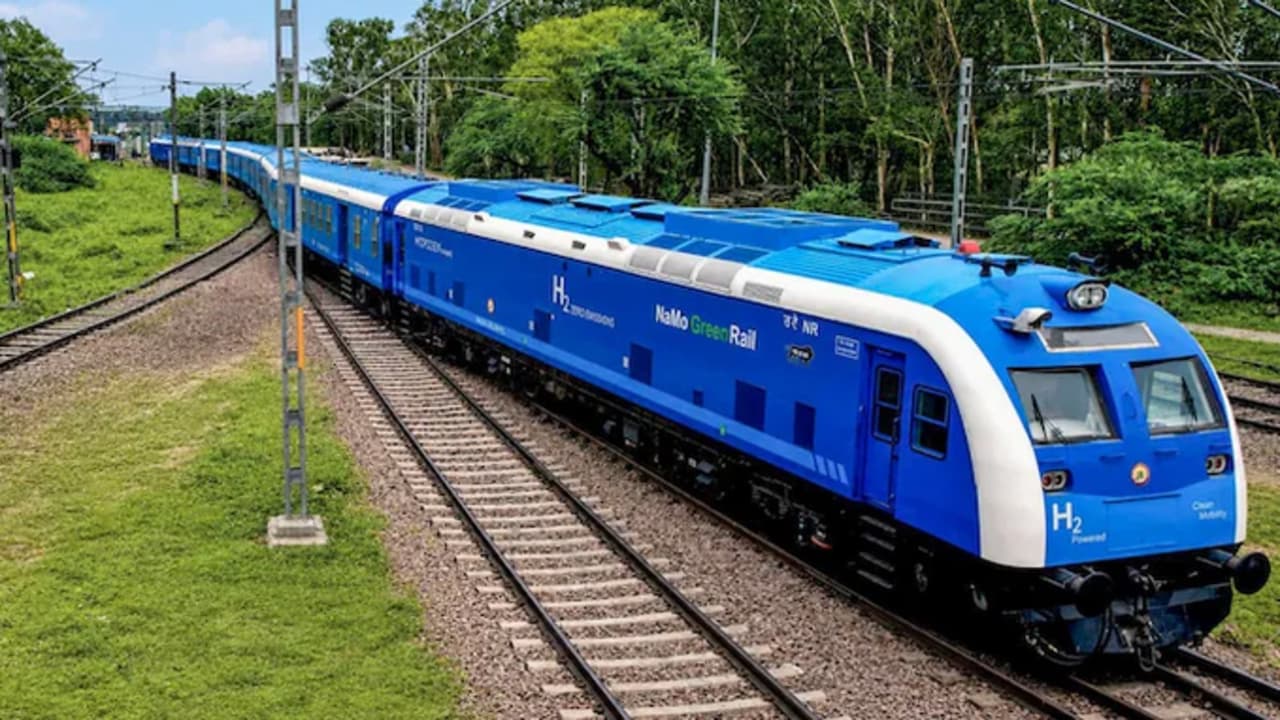
PM Modi flagged off India’s first hydrogen train. How does this train running on Jind-Sonipat route run without diesel and without electric wires? Know the complete story of its technology, route, speed and security.
PM Modi Flags Off Hydrogen Train: This day has been recorded in golden letters in the history of Indian Railways. Prime Minister Narendra Modi flagged off the country’s first and world’s most powerful hydrogen-powered passenger train from Jind railway station in Haryana. This is not just the beginning of a new train, but the beginning of a great revolution that will uproot the empire of diesel and pollution from Indian tracks forever. This train made with indigenous technology is now completely ready to run on the tracks of Haryana. Let us know those things about this amazing and eco-friendly ‘train of the future’, which can surprise anyone.
Scroll to load tweet…
From Jind to Sonipat…why was this route chosen?
At present this train will operate on the 89 km long Jind-Sonipat section of Northern Railway. There are stations on this route like Jind Junction, Jind City, Pandu Pindara Junction, Lalit Kheda Halt, Bhambhewa, Isapur Khedi, Butana, Khandrai, Rabrah, Lath, Mohana, Barwasni Halt, Sonipat New and Sonipat. The initial operating speed of the train is set at 75 kilometers per hour, while it is designed for a maximum speed of 110 kilometers per hour. According to the Railways, this section has been selected to test the safety, reliability and feasibility of hydrogen technology in actual operating conditions.
Scroll to load tweet…
Without diesel, without electric wire…then how does this train run?
The biggest feature of this train is its hydrogen fuel cell technology. Unlike trains that run on conventional diesel or overhead electric wires, this train generates its own electricity. Inside the Proton Exchange Membrane (PEM) fuel cell installed in the train, a chemical process takes place between high-pressure hydrogen and oxygen present in the air. This reaction produces electricity, which drives traction motors. The entire process releases only water steam and heat, with almost no smoke or direct carbon emissions.
In simple words:
Hydrogen + Oxygen = Electricity + Water Steam
This technology makes it extremely friendly to the environment.
Scroll to load tweet…
10 coaches, 2 power cars and 3,200 horsepower…what is its real power?
This train has two Hydrogen Driving Power Cars (DPC) at both ends and eight passenger coaches in the middle. Each power car generates 1,200 kilowatts or approximately 1,600 horsepower of energy. Both together provide the necessary power to the train. Hydrogen fuel cells, lithium iron phosphate (LFP) batteries and high-pressure hydrogen storage cylinders are installed in each power car. The batteries work together with the fuel cells to manage energy, keeping the train running smoothly under various operating conditions.
Read this also…WATCH: The great negligence of Railways which took away the breath of innocent people, the truth of Murshidabad accident came out!
3,000 kg hydrogen stock…Jind becomes the country’s first big hydrogen hub
- For this ambitious project, Indian Railways has set up the country’s largest railway hydrogen refueling facility in Jind.
- Here hydrogen is prepared from water through electrolysis technique. The hydrogen is then stored in special tanks at 500 bar pressure.
- During refueling of the train, it is filled simultaneously in both the power cars through two separate dispensers at 350 bar pressure, which significantly reduces the refueling time.
- The facility has the capacity to store approximately 3,000 kg of hydrogen and also has Petroleum and Explosives Safety Organization (PESO) approval.
Scroll to load tweet…
Hydrogen is there…but there is no compromise on safety
- Hydrogen is considered a highly flammable gas, hence Indian Railways has adopted a multi-layered safety system in this project.
- Hydrogen leak detectors, flame detectors, heat and smoke sensors, continuous ventilation systems, automatic shutdown and hydrogen isolation systems are installed in trains and refueling stations.
- Real-time monitoring facility is also available in the driver’s cabin.
- Additionally, Germany’s independent agency TÜV SÜD has conducted a safety assessment of the entire hydrogen ecosystem.
- The train also went through several technical tests like electrical load test, radio-frequency compatibility, oscillation test and emergency braking before being rolled out for passengers.
Is the picture of Indian Railways going to change?
More than 99 percent of India’s broad-gauge rail network is already electrified. In such a situation, hydrogen fuel cell train is a sign of the next phase, where clean, modern and sustainable rail services will be possible even without overhead power lines and without diesel engines. This project is not just the launch of a new train, but also the foundation of India’s first integrated hydrogen railway ecosystem, in which hydrogen production, storage, refueling and train operation—all processes have been developed under a single system. If this project is successful, it could also pave the way for the introduction of hydrogen-based trains on many non-electrified routes of Indian Railways in the coming years.
Read this also…VIDEO: Dirty act with a woman on the road, ‘Lady Singham’ dragged her by the collar for 400 meters!