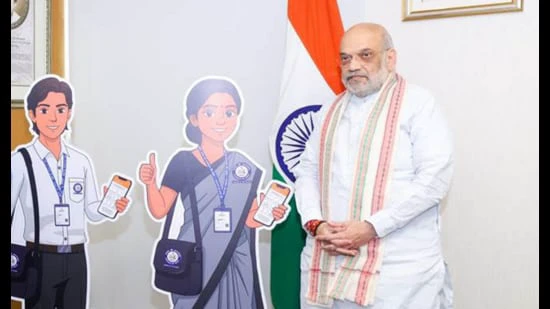
Union home minister Amit Shah on Thursday unveiled the enumerator mascots Pragati (female) and Vikas (male) and four digital tools for the 2027 Census, whose first phase, or house listings, will begin from April 1. The Centre for Development of Advanced Computing has developed the digital tools to facilitate enumeration operations.
“The mascots ‘Pragati’ (female enumerator) and ‘Vikas’ (male enumerator) were unveiled to serve as friendly, relatable faces of the Census 2027. These mascots also symbolise the equal participation of women and men in fulfilling the resolve to make India a developed nation by 2047. Through these mascots, information, objectives, and key messages related to Census 2027 will be disseminated in an effective and citizen-friendly manner across diverse sections of society,” the home ministry said in a statement.
Census 2027 is the first decadal exercise being conducted using digital tools. The first tool, the Houselisting Block Creator, is a web map that will enable digital creation of blocks using satellite imagery, ensuring standardised geographic coverage. The second tool is a secure offline mobile application for enumerators to collect and upload housing listing data.
“Only enumerators registered on the CMMS (Census Management and Monitoring System) portal can access the application. The app enables direct field-to-server data transmission, eliminating traditional paperwork. All housing listing data will be collected through this app, which can only be operated using registered mobile numbers. The application is compatible with Android and iOS platforms, and it can be operated in 16 regional languages,” the statement said.
The ministry noted the self-enumeration has been introduced for the first time. It added a secure web-based facility will allow eligible respondents within a household to submit their information online before field operations.
“Upon successful submission, a unique Self-Enumeration ID (SE ID) will be generated.” The ministry said this self-enumeration ID will be shared with the enumerator, based on which the enumerator will be able to verify the information.
The fourth tool, the Census Management and Monitoring System (CMMS) Portal, is a centralised, web-based digital platform designed to plan, manage, execute, and monitor all related activities across administrative levels. “Officers at sub-district, district, and state levels can track enumeration progress, field performance, and operational readiness in real-time through an integrated dashboard.”
The ministry said data will be collected using secure mobile applications door-to-door, and complete coverage will be ensured. It added over three million enumerators, supervisors, and other officials who will be engaged across the country. “This calibrated adoption of technology combines innovation with inclusivity, ensuring that Census 2027 remains accurate, secure, and comprehensive.”
The 16th Census, which will include caste enumeration, was announced last year. It will be conducted in two phases and is expected to be completed by March 1, 2027.
In the first phase, housing conditions, assets, and amenities of each household will be collected from April 1, 2026. Subsequently, the demographic, socio-economic, cultural, and other details of every person in each household will be collected from February 1, 2027, in the second phase.
The Registrar General of India last week issued detailed guidelines outlining the process for the formation of housing blocks, including ideal size, counting in villages, house numbering, finalisation of geospatial database, use of dedicated portal, etc.