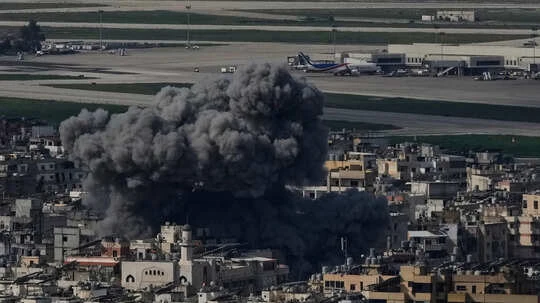
BEIRUT (AP) – On Wednesday, Israel’s military directed residents of numerous border villages in southern Lebanon to evacuate immediately as airstrikes on Beirut’s suburbs escalated, with Hezbollah announcing further attacks.
The conflict in Lebanon, which began on Monday, escalated following U.S.-Israeli strikes on Iran. The Iranian-backed Hezbollah group retaliated by launching rockets and drones into northern Israel, provoking Israeli airstrikes that resulted in over 50 fatalities and approximately 300 injuries across the region.
Immediate Evacuations Ordered
The Israeli military released a statement on Wednesday urging residents of border villages in southern Lebanon to evacuate north of the Litani River without delay.
The Arabic spokesperson for the Israeli army warned on social media that remaining south of the river poses a significant risk to their lives.
Geographically, the area south of the Litani River constitutes about 8% of Lebanon’s total land area and primarily borders Israel. The Lebanese government claims it has cleared Hezbollah’s military presence from this region in recent months.
Recent Airstrikes and Casualties
This evacuation order followed a series of airstrikes that targeted the predominantly Christian suburb of Hazmieh, where a hotel was struck. Other airstrikes hit the towns of Aramoun and Saadiyat, located just south of Beirut’s international airport, resulting in six deaths and eight injuries. Additionally, a strike on Baalbek in eastern Lebanon killed six individuals and injured 15, as reported by state media.
Security officials, who requested anonymity due to regulations, indicated that the airstrikes were executed without prior warnings, a tactic often associated with targeted assassinations. The individual targeted in Hazmieh was identified as a local official from the suburb of Ghobeiri.
“We live in a country where a missile can fall on your head at any moment,” stated Maggie Shibli, whose family owns the hotel that was hit.
Abbas Najdeh, displaced from Tyre and staying at the hotel, described the moment of the strike: “We were sleeping, then suddenly my children, my wife, and I were thrown away.”
Hezbollah’s Counterattacks
On the same day, the Israeli military issued additional warnings for residents to evacuate from buildings in Beirut’s southern suburbs, which were subsequently targeted.
Hezbollah confirmed its involvement in multiple attacks against Israel, claiming to have utilized precision-guided missiles in two of these operations.
Concerns Over Ground Invasion
The evacuation order was issued shortly after Israel deployed troops into southern Lebanon, marking its first military action in the region since a cease-fire concluded a 14-month conflict with Hezbollah in November 2024.
It remains unclear whether Israel is preparing for a ground invasion. Lebanon’s state-run National News Agency reported Israeli artillery shelling targeting various Lebanese villages, including Aid al-Shaab and Beit Lif.
In eastern Lebanon, the main border crossing with Syria was temporarily closed after officials received a warning of a potential Israeli strike, which was later determined to be a false alarm. Other false alarms across Beirut and Lebanon have heightened residents’ anxieties.
This conflict is not unprecedented; Hezbollah’s hostilities towards Israel resumed the day after the October 7, 2023, Hamas-led attack on southern Israel, which ignited the ongoing war in Gaza. Following months of sporadic fighting, a full-scale war began in September 2024, leading to Israel’s ground invasion of Lebanon.
Although Israeli forces withdrew from most of southern Lebanon after a U.S.-brokered ceasefire in late 2024, they continue to occupy five locations on the Lebanese side of the border, maintaining regular airstrikes in southern Lebanon, citing Hezbollah’s efforts to re-establish military positions.