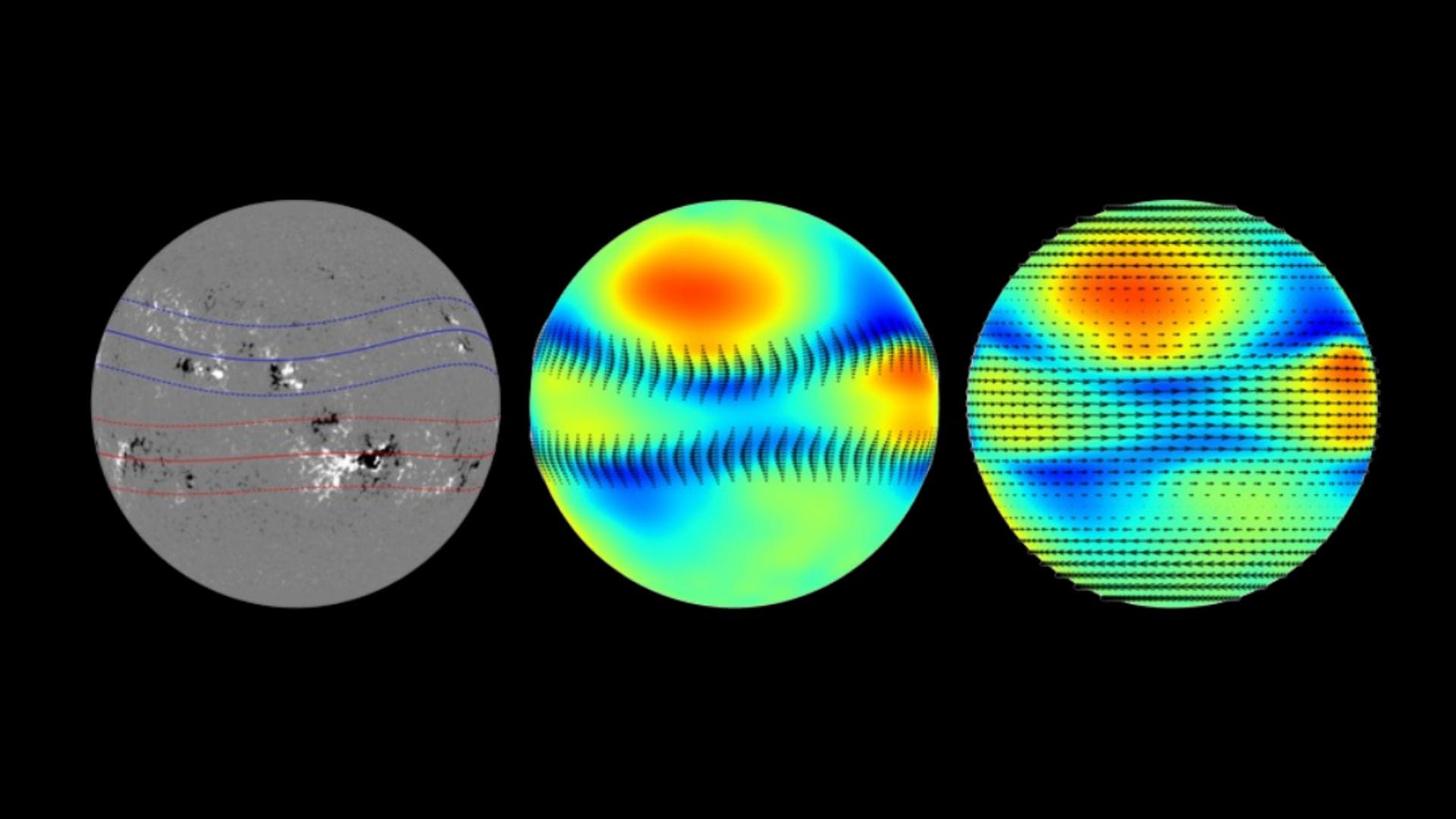
New Delhi: Scientists have developed a new tool that paves the way towards forecasting space weather weeks in advance, rather than the few hours of early warning today. The capability can help agencies and industries reduce risks to satellites, power grids, astronaut safety, GPS systems, communications infrastructure and human spaceflight. Predicting when and where large solar flare-producing active regions emerge on the Sun has been a persistent challenge in heliophysics. These regions feature tangled, twisted magnetic fields that can suddenly reconfigure, resulting in explosive events such as solar flares, filament eruptions and coronal mass ejections. These outbursts can result in hazardous space weather.
The active regions on the Sun do not appear randomly, byt cluster along large-scale, warped magnetic toroidal bands. The researchers used magnetic measurements from the Helioseismic and Magnetic Imager on the Solar Dynamics Observatory (SDO) to demonstrate that the surface patterns can be inverted to reconstruct the states of the subsurface. The current forecasting methods depend on small-scale magnetic signatures that only become predictive hours before eruptions occur. The new tool is called PINNBARDS, for Physics-Informed Neural Network-Based Active Region Distribution Simulator, that links surface observations of active regions on the sun to deep magnetic dynamics in the tachocline of the Sun, which is a thin transition layer between the uniformly rotating radiative interior and the turbulent outer convection zone.
Physics-informed AI and global magnetic information
The PINNBARDS tech bridges surface data with subsurface processes. The reconstructed subsurface states are then used to supply the initial conditions for forward simulations of solar magnetic evolution. This approach enables predictions of the locations and timings of large, flare-producing active regions weeks in advance. The latitude and longitude of emerging regions are essential, as they determine weather the ejected particles will impact the Earth. A paper describing the research has been published in the Astrophysical Journal.