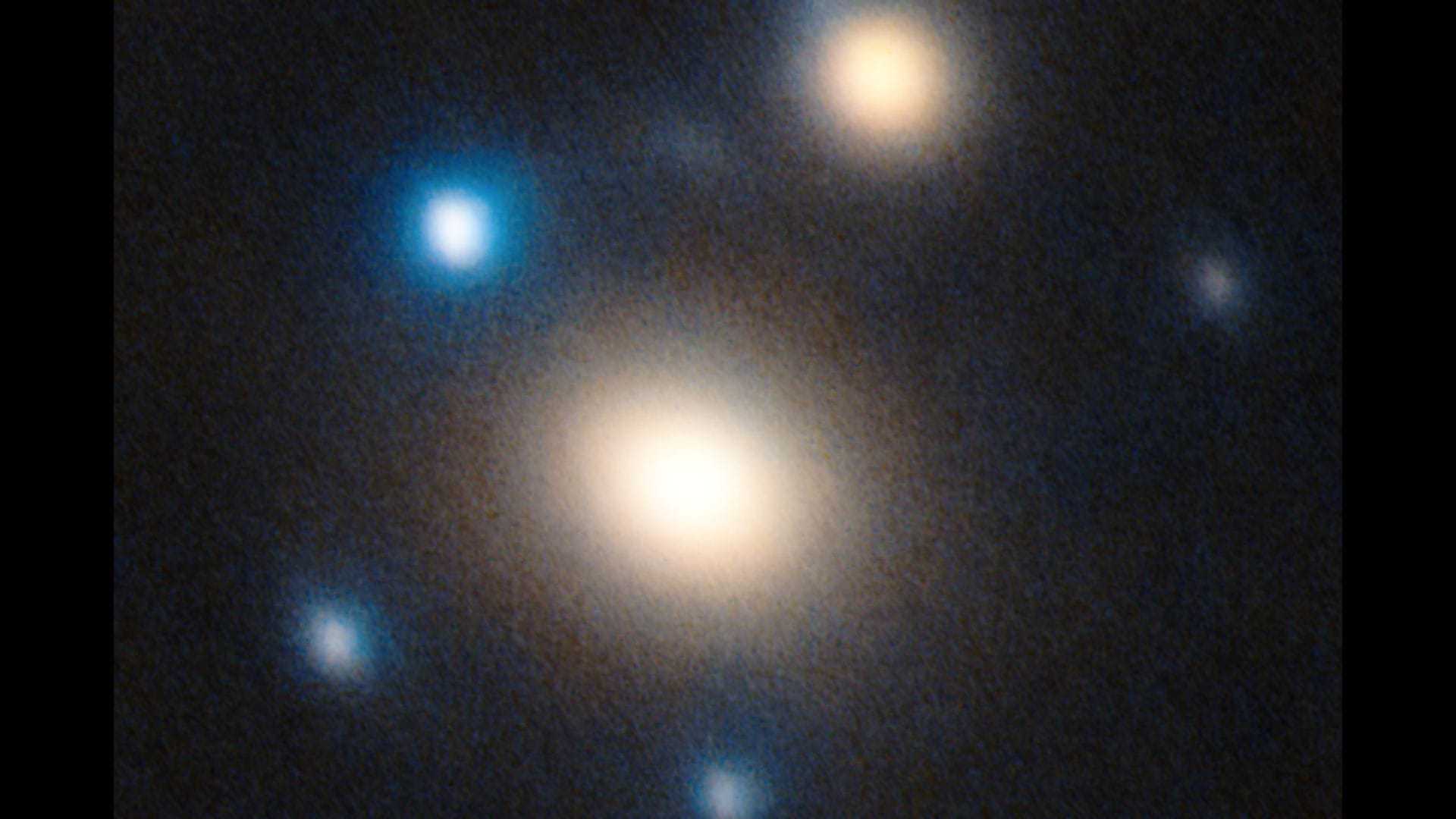
New Delhi: The rate at which the universe is expanding remains a hotly debated subject, with measurements of the distant and local universe yielding different results, known as the Hubble Tension. A team of astronomers have used a rare superluminous supernova that appears in five lensed images for a high-precision, one-step measurement at the rate at which the universe is expanding. This measurements anchors a new, independent method to measure the accelerating expansion of the universe. The superluminous supernova is at a distance of 10 billion lightyears away, and is far brighter than typical supernovae.
Two foreground galaxies force the light from the supernova to take different paths, resulting in five images that arrive at different times. By measuring the time delays between the multiple images of the supernova, researchers can determine the Hubble Constant. The official designation of the supernova, which is the year followed by a random string, is SN 2025wny, which has been nicknamed ‘Winny’ by astronomers. The gravitational lensing is a chance alignment, with less than one in a million chance of appearing. The scientists spent six years searching for such an event by compiling a list of promising gravitational lenses, with the explosion in August 2025 matching one of these shortlisted gravitational lenses.
Resolving the Hubble Tension
For accurate measurements it was necessary to understand the mass of the lensing galaxies, which determines how strongly the light from the supernova is bent. Gravitational lenses typically produce only two or four copies, with five copies being quite rare. Most lensed supernovae are caused by more massive clusters of galaxies, but this one was caused by only a pair of galaxies. Despite their relative proximity, the two galaxies have not yet collided. The simplicity of the system allows for a highly accurate measurement of the Hubble Constant. The observations may help resolve the Hubble Tension.