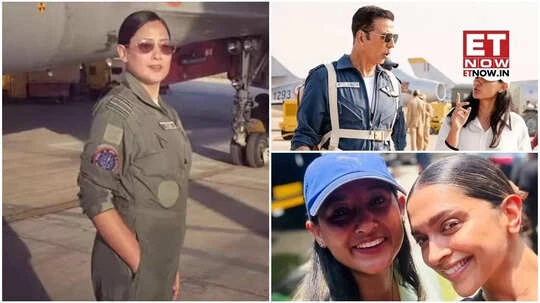
Meet Varlin Panwar: Every now and then, you come across a life story that feels too layered to belong to just one profession. Varlin Panwar ‘s journey is exactly that kind of story.
It begins in military cantonments, moves through high-pressure air force operations, and unexpectedly lands on film sets where actors rehearse scenes under bright studio lights. At first glance, the transition sounds unlikely. An Indian Air Force officer guiding Bollywood actors? But when you hear her story, the shift makes perfect sense. Because for Panwar, the uniform was never just a job. It was a way of thinking, a way of living. And even after she left active service, that mindset never really left her.
Today, she works quietly behind the scenes, helping filmmakers portray military life realistically. Actors learn how to stand, salute, speak and even pause correctly under her guidance. Yet long before cinema entered the picture, she spent nearly a decade helping safeguard India’s skies as a squadron leader. Her career did not change direction overnight. It unfolded slowly, shaped by childhood memories, difficult decisions and the courage to start again.
Varlin Panwar: Growing Up Where Packing Bags Was Normal
Children from defence families learn one lesson early: nothing stays permanent for long. New schools, new friends and new cities arrived every few years in Varlin Panwar’s childhood. Her father served in the Armed Forces, and transfers were simply part of life. While other children grew up in one neighbourhood, she grew up across many.
At the time, constant relocation felt exhausting. Just when friendships settled, it was time to move again. But looking back, she often credits those years for teaching her adaptability. Life at home followed a quiet discipline. Mornings began early. Time mattered. Responsibility was expected, not negotiated.
Some memories stayed with her more than others:
- Watching her father prepare for duty with absolute focus
- Learning routines that never changed regardless of city
- Understanding respect for service without anyone explaining it directly
Sunday jogs with her father became small rituals. Somewhere between running laps and catching their breath, he would share stories from his years in uniform. Those conversations did something subtle. They made service feel meaningful, not intimidating.
Slowly, the idea of wearing a uniform herself stopped feeling distant.
Did you know?
Many defence children say adaptability becomes their biggest strength later in life because constant change teaches emotional resilience early on.
NCC: The Phase That Tested Everything
After Class 12, Panwar joined the NCC’s 11th Girls Battalion in Dehradun. What began as curiosity quickly turned serious.
NCC training was far tougher than she had imagined. Long drills under harsh weather, strict schedules and physically draining camps pushed cadets beyond comfort. There were days when exhaustion felt overwhelming, but quitting never crossed her mind.
Instead, something clicked. The structure suited her.
Her NCC experience included:
- Early morning drills regardless of weather
- Training camps that demanded mental toughness
- Competitive evaluations among cadets
- Balancing graduation studies alongside rigorous practice
At 17, she earned the title of Best Cadet at a national-level camp. The recognition felt like validation. For the first time, a career in defence services felt achievable rather than aspirational.
Soon after graduating, she applied to the Indian Air Force and cleared the selection process.
Varlin Panwar: The First Time She Wore The Uniform
Every officer remembers the moment they first wear their uniform. For Panwar, it was overwhelming.
Commissioned as a fighter controller, she entered one of the Air Force’s most demanding operational roles. Unlike pilots, fighter controllers work behind radar systems, tracking aircraft and making real-time decisions that directly affect missions. Before informing anyone else, she called her father. She later shared that she could barely speak through tears. His reply was simple but unforgettable: “Don’t just wear your rank. Earn it.”
That sentence stayed with her throughout her service years.
Her responsibilities included:
- Monitoring radar systems and airspace movement
- Coordinating fighter aircraft during operations
- Responding instantly to unidentified aerial activity
- Supporting mission-critical decisions under pressure
One of her toughest moments came in 2018 at a frontline base during Republic Day flypast preparations. Minutes before aircraft were scheduled to take off, she noticed an unidentified object approaching Indian airspace. There was no time for hesitation. She ordered aircraft to scramble. Decisions like these happen within seconds, but their consequences can be enormous. The situation was handled successfully, yet moments like that reveal the invisible pressure officers carry every day.
Did you know?
Fighter Controllers rarely appear in public discussions about air defence, yet pilots rely heavily on their guidance during operations.
Varlin Panwar: Walking Away From The Uniform
After nearly ten years in service, Panwar made a decision that many officers find emotionally difficult. She chose to retire from the Indian Air Force in 2018. Leaving meant stepping away from an identity she had built for years. The structure, camaraderie and sense of purpose were hard to replace. But she did not want her skills to fade outside the forces. Instead, she began exploring where her training could be useful in civilian life.
Her next phase included:
- Working in technology security operations linked to the Indian Premier League (IPL)
- Advising teams on operational safety and risk planning
- Expanding into aviation consultancy
The transition was not instant or easy. Like many veterans, she had to rediscover who she was outside uniformed service.
Varlin Panwar: An Unexpected Turn Towards Bollywood
The entry into cinema happened almost accidentally. As defence-themed films became more common, filmmakers began searching for professionals who could bring authenticity to military storytelling. Someone eventually connected Panwar to a project, and her expertise stood out immediately.
Soon, she was consulting on major productions including:
- Fighter
- Operation Valentine
- Sky Force
Her job goes far beyond technical advice. She helps actors understand the mindset of officers. On film sets, she corrects small details most viewers might never consciously notice:
- How an officer walks into a room
- The difference between a casual and formal salute
- The tone used while giving commands
- The quiet confidence that comes from training
These nuances transform performances from dramatic imitation into believable portrayals.
Varlin Panwar: Mentoring, Conversations And A New Kind Of Service
If you ask Panwar what gives her the most satisfaction today, the answer is not films. It is mentoring. She frequently speaks to young women considering careers in defence services or fields that feel unconventional. Many approach her with doubts about capability or fear of failure. Her response is usually straightforward: courage is not about feeling fearless. It is about moving forward anyway.
She often reminds aspiring candidates:
- Careers do not have to follow a straight line
- Discipline learned early becomes a lifelong advantage
- Reinvention is not failure, it is growth
Did you know?
Women’s participation in India’s armed forces has steadily increased, with expanding opportunities across operational and leadership roles.
Varlin Panwar: More Than One Life In A Lifetime
What makes Varlin Panwar’s journey compelling is not just the shift from Air Force bases to film studios. It is the continuity beneath the change. The uniform may no longer be part of her daily routine, but its influence shows up everywhere. In the way she works. In the precision she expects. In the respect she brings to stories about the armed forces. Some people retire and begin a second career. Panwar, in many ways, carried her first one forward into a different world. And perhaps that is the real takeaway from her story. Service does not always end with a farewell parade. Sometimes, it simply finds a new audience, a new purpose and a new stage.