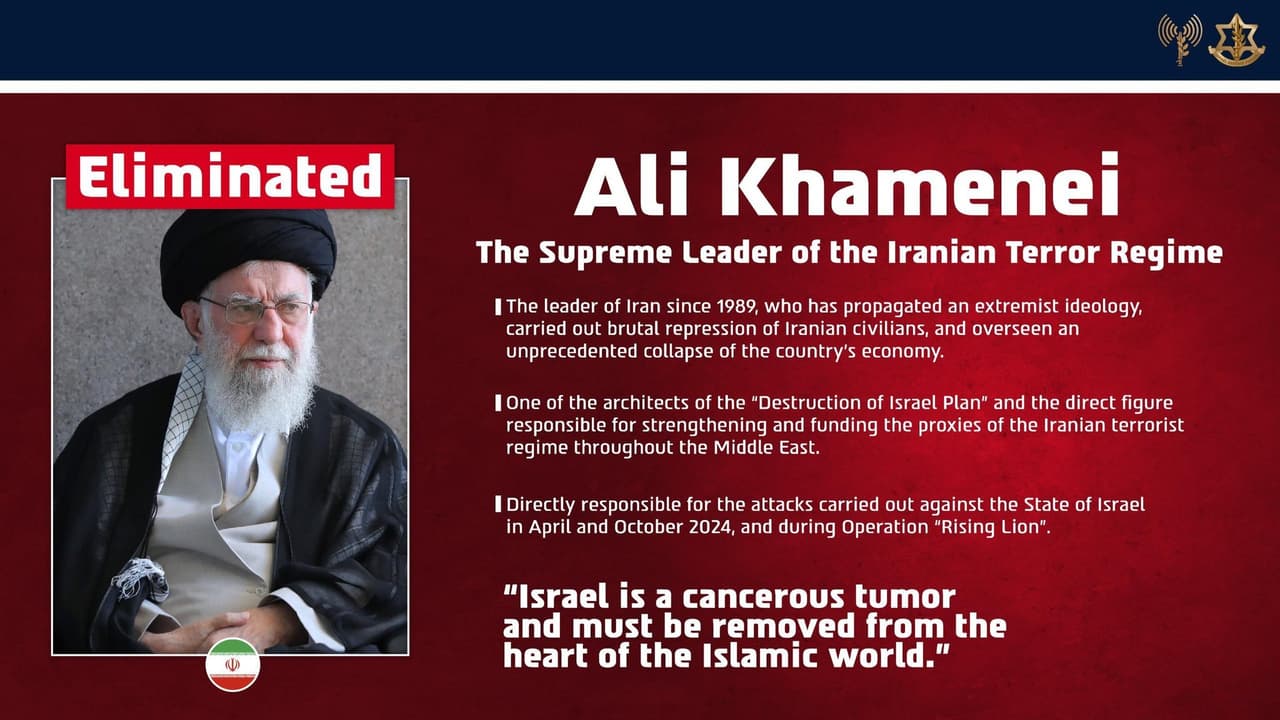
After Iran’s Supreme Leader Ayatollah Ali Khamenei was killed, the Israel Defense Forces fired a sharp jibe on X saying “the only thing annihilated was you.”
A sharp message from the Israel Defense Forces on X has drawn global attention after Iran’s Supreme Leader Ayatollah Ali Khamenei was killed during joint US–Israeli strikes on Iran on Saturday.
Referencing an old post attributed to Khamenei from October 7, 2014, the Israeli military wrote:
“The only thing annihilated was you…”
The remark was a direct response to a message Khamenei had posted years earlier that read:
“Day-by-Day the Israeli regime has moved closer to implosion and annihilation.”
The exchange has quickly become one of the most widely discussed moments online since news of the Iranian leader’s death began circulating.
Scroll to load tweet…
IDF Statement on Elimination of Khamenei
In another post on X, the Israeli military issued a formal announcement declaring that the Iranian leader had been killed.
The IDF statement read:
The IDF has eliminated Ali Khamenei, leader of the Iranian terror regime
IDF Spokesman announces that yesterday, February 28, 2026, 11th of Adar 5786, the IDF eliminated Ali Khamenei, leader of the Iranian terror regime. The Air Force, guided by precise intelligence from Military Intelligence and in coordination with Mossad, struck the leadership compound in the heart of Tehran where he was located along with other senior officials.
Khamenei served as the leader of the Iranian terror regime since 1989 and promoted an extremist ideology against the State of Israel and the entire West, and was directly responsible for the violent suppression of Iranian citizens for many years. Khamenei was the architect of the plan to destroy the State of Israel, the “head of the Iranian octopus,” which extended its tentacles across the Middle East and to the borders of the State of Israel, led by the terror organization Hezbollah. The regime’s leader was responsible for terror attacks against the State of Israel, and on his hands is the blood of many citizens from around the world.
The IDF has closed a historic circle with the elimination of the leader of the Iranian terror axis. The closing of this circle joins a series of eliminations of senior terror axis officials, whom the IDF eliminated in the war.
The elimination of Khamenei embodies the promise between the IDF and the citizens of the State of Israel – to strike and thwart any entity that attempts to harm the State of Israel anywhere and at any time.
Scroll to load tweet…
Scroll to load tweet…
Iranian State Media Confirms Death
Hours after US President Donald Trump claimed Khamenei had been killed, Iranian state television confirmed the death early Sunday. Broadcasts carried archive footage of the longtime leader alongside a black mourning banner.
Iranian media also reported that members of Khamenei’s family — his daughter, son-in-law and granddaughter — were killed in the strikes.
Trump reacted strongly on his Truth Social platform, writing: “Khamenei, one of the most evil people in History, is dead.”
He also warned Tehran against escalating the conflict further, adding: “Heavy and pinpoint bombing… will continue, uninterrupted throughout the week or, as long as necessary to achieve our objective of PEACE THROUGHOUT THE MIDDLE EAST.”
In another message, Trump cautioned Iran over possible retaliation: “THEY BETTER NOT DO THAT, HOWEVER, BECAUSE IF THEY DO, WE WILL HIT THEM WITH A FORCE THAT HAS NEVER BEEN SEEN BEFORE!”
Iranian state television later announced a 40‑day mourning period and seven public holidays.
Senior Iranian Commanders Also Killed
Iran’s judiciary confirmed that senior figures were among those killed in the strikes. These included Mohammad Pakpour, chief of Iran’s Revolutionary Guards, and Ali Shamkhani, a senior security adviser.
Officials described them as having been “martyred” in the attacks.
Meanwhile, Pentagon chief Pete Hegseth said the military campaign was meant to send a message: “We will hunt you down and we will kill you.”
From outside Iran, Reza Pahlavi, son of the country’s last shah, said the Islamic Republic was entering the “dustbin of history.”
Strikes, Retaliation and Rising Regional Tensions
The escalation began when the United States and Israel launched waves of strikes on Iranian targets Saturday. Israeli officials said the attacks were pre‑emptive and aimed at eliminating imminent threats.
Israeli Prime Minister Benjamin Netanyahu said senior Iranian officials were among those killed and warned that more targets could be struck in the coming days. According to Israel’s military, around 200 fighter jets took part in the operation, hitting more than 500 targets.
Soon after, Iran retaliated with missile and drone attacks on Israeli territory and American military positions in the region.
Israel’s emergency service reported that a woman was killed and at least 21 people were injured in the Tel Aviv area following falling projectiles.
Across the Gulf, residents reported explosions and missile interceptions in multiple cities. Iran’s Revolutionary Guards said they had targeted the US Fifth Fleet in Bahrain and other American bases.
Explosions Across the Gulf and Oil Route Shock
The fallout spread rapidly across the region. Blasts were heard in cities including Dubai, Doha and Manama, while smoke was seen rising near southern parts of the Qatari capital.
Authorities in the United Arab Emirates reported that two people were killed in Abu Dhabi, including a Pakistani civilian. Officials said 137 missiles and 209 drones had been fired toward the country.
Witnesses in Dubai described seeing missiles streaking across the sky before an explosion near The Palm island development. Four people were reported injured.
Meanwhile, Iran’s Revolutionary Guards moved to close the Strait of Hormuz, a key global shipping lane for oil and gas, raising fears of a wider economic shock.
Global Alarm and Emergency Diplomacy
The rapidly escalating conflict triggered urgent diplomatic moves worldwide. The United Nations Security Council convened an emergency meeting after the strikes.
UN Secretary‑General Antonio Guterres warned that military escalation in the Middle East risked triggering events beyond anyone’s control.
Russia condemned the US‑Israeli operation as a dangerous move that could lead to a regional catastrophe, while the European Union called developments “perilous.” Gulf states, meanwhile, condemned Iran’s retaliatory strikes.
Lebanon’s Hezbollah also issued a statement calling for resistance against Israel and the United States.
Airspace Shutdowns and Regional Disruption
As tensions soared, multiple countries moved to shut their skies. Iran, Iraq, Kuwait, Syria, the United Arab Emirates and Israel all closed their airspace, at least partially, to civilian traffic.
Airlines across the world began cancelling flights to the region, while Russia suspended commercial flights to both Iran and Israel until further notice.
For now, the focus remains on the fallout from the Israeli military’s pointed message online — and the dramatic shift in Middle East geopolitics following the reported death of one of the region’s most powerful figures.