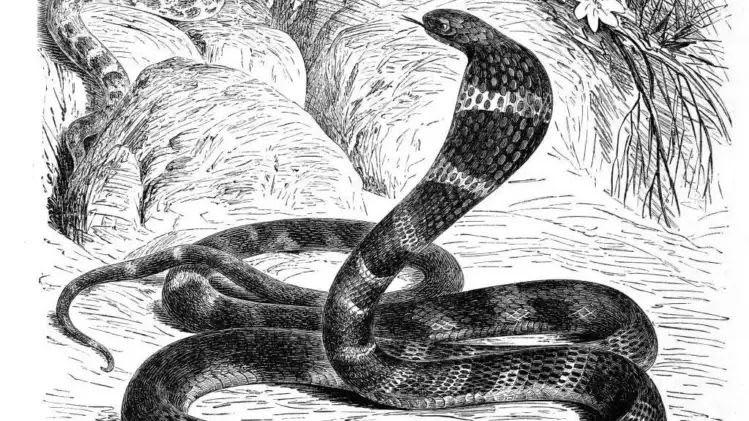
The dense forests of the Western Ghats of India are the natural habitat of the King Cobra. King cobra usually lives in forests because it finds prey, water and safe place there.
However, a study has come to light which is raising questions on the conservation of King Cobras living in the forests.
Surat scientist and reptile expert Dikansh Parmar has done a unique research. Their study has revealed that King Cobras are probably traveling in trains in India.
How are King Cobras living in the wild reaching railway tracks or trains?
Many railway lines going to Goa pass through dense forests. Scientists believe that king cobras sometimes come near tracks or trains in search of prey or shelter. In this way they reach areas away from nature where there is no food or safe shelter for them.
His research has also been published in the prestigious journal ‘Biotropica’, which covers research on the ecology of the Americas and its conservation and management topics.
Research published in this journal suggests that the world’s longest venomous snake, the king cobra (Ophiophagus kalinga), may be unknowingly traveling on long-distance trains.
It is important for scientists to get their research published in this journal, because the success rate of getting research published in it is only 36 percent.
This study shows that changes occurring in the king cobra’s range are posing a challenge to the safety, conservation and public safety of this snake species.
Dikansh Parmar, along with a team of international scientists, studied 47 locations of king cobras in Goa, most of which are located in the remote forests of the Western Ghats.
For this he also took help from the Animal Rescue Squad based in Goa. This squad has been working to save wild animals including snakes for many years.
King cobra found near five railway stations in Goa

Dikansh Parmar studied 47 places rescued by Goa’s animal rescue groups. Of these, 18 places were in North Goa and 29 places were in South Goa.
Giving information about his study, Dikansh Parmar told BBC Gujarati, “King Cobra is considered the national reptile of India. Its species was considered the same throughout India, although the pattern of its stripes was different, still it was not considered a separate species. “
“Scientists suspected that there would be other species as well. Therefore, he recognized the cobra found here, especially in the Western Ghats, as Ophiophagus kalinga. This snake comes under protected category.”
It is said that ‘if this snake bites a person, it does not ask for water and dies almost immediately.’
This study found that all these places were either near the railway station or near the railway line.
“The Goa-based animal rescue group rescued a total of 120 king cobra snakes from 2002 to 2024. When we studied all the locations, we found that 47 of them were around railway tracks. One snake was found near the tracks of a railway station in Goa,” he said.

Amrit Singh, head of the animal rescue team in Goa, told BBC Gujarati, “There is a railway station named Chandor in South Goa. From there we got information about the presence of a king cobra and we rescued it and handed it over to the forest department. It was injured. This is a place where such snakes are not usually seen.”
According to the details of this research published in the famous American magazine ‘Biotropica’, “The case of the King Cobra found at Chandor Railway Station inspired us to carefully investigate how this snake could have reached such an ecologically unsuitable place.”
This type of king cobra is found in Castle Rock and Dandeli Tiger Reserve of Karnataka.
Now when these trains enter Goa, the snakes stop in this area. In September 2021, Goa Animal Rescue Team rescued a cobra near Vasco-da-Gama.
It was found just 200 meters away from the railway station. Three other cobras were also found around Lolim, Palolem and Pedane railway stations.
According to Dikansh, all these five places were not the natural habitat of King Cobra, due to which scientists were able to see this ‘surprising relationship’ between the snake and the rail.
‘This king cobra must have come here by train only’

Dikansh Parmar, the lead researcher and scientist of this research, told BBC Gujarati, “We investigated how the snake reached the railway station. Trains from Karnataka to Goa mostly pass through Castle Rock in Karnataka. These areas have dense forests and king cobras are widely seen here.”
Dikansh Parmar says, “Based on the research, our team has proposed a new Railway Dispersal Hypothesis. It suggests that king cobras sometimes board freight trains or passenger trains while hunting rats or other insects in wild hilly railway yards, and unknowingly end up several kilometers away, in completely unsuitable conditions.”
Dikansh claims that this research has been supported by social media reports and news reports from across the country. According to this, snakes including King Cobra are seen around trains or railway stations.
Dikansh Parmar says, “In the place where we did the research, snakes generally do not live but these snake species are found in the forests near Karnataka. The king cobras we saw were almost around the railway stations. Therefore, it can be concluded that for some reason they must have reached around Goa through the railways.”
Earlier, around 2017, Dikansh Parmar had similarly rescued a snake from Surat railway station.
Was the ‘snake’s journey’ an accident or a search for food?
The team of researchers says that the reason for the appearance of King Cobra snakes around the railway tracks could also be practical.
Rats gather around railway tracks due to scattered grains, fruits or other packaged food items.
Rats make their home there and start living there. This is the food that snakes get.
They can also take shelter in trains to get safe shelter in case of floods during rainy season.
Dr. Heinrich Kaiser, professor of biology at Victor Valley College, California, and Dr. Dennis Roeder, associate professor at the Leibniz Institute for the Analysis of Biodiversity Change (LIB) in Bonn, Germany, were also involved in this research.
“We usually think of roads and railways as obstacles or death traps for wildlife, but this research shows that these fast corridors may unwittingly serve as their movement routes,” Dr Heinrich told BBC Gujarati.
He says that “This king cobra might have accidentally come inside the train or might have come near the railway line in search of food or for some other reason.”
“This research shows how this man-made structure can inadvertently influence the activities of this predator,” Associate Professor Dr Dennis Roeder told BBC Gujarati.
He says that this is scientific research and based on evidence. He says, “Facts and logic have been presented together with evidence.”
Why is this research done on snakes so important?
Answering this question, Dr. Roeder says, “Conservation of King Cobras is very important. If they move from one place to another through goods trains or passenger trains, then it is dangerous for human life and themselves.”
“Therefore, public awareness should be created through this research so that human life can be protected from threats and at the same time the King Cobra can be conserved.”
Dikansh Parmar says, “King Cobra is a very poisonous snake. That is why people kill it on sight. Also, if it makes its home in a human settlement, it becomes dangerous for human life. Therefore, its conservation is necessary to maintain balance in the forest and for biodiversity. This research emphasizes this.”
The researchers emphasize that trains should not be stopped unnecessarily in forest areas. Leftover food should not be kept in train compartments as it may attract rats.
Also, destruction of forests should be stopped so that wild animals like snakes are not forced to come on the railway tracks.
“Even if they pass near such human settlements via trains or other routes, their chances of survival reduce. Therefore, they should be protected,” says Dikansh.
According to him, the presence of king cobras in human settlements increases the possibility of human-snake conflict. Snakes reaching such places are at risk of hunger, stress and death.
Dr. Roeder says, “This research is not only an interesting ecological story, but also a warning for wildlife conservation and public safety. If venomous snakes of this class are making a base in trains, then there is a need for awareness and clear guidelines in this matter.”