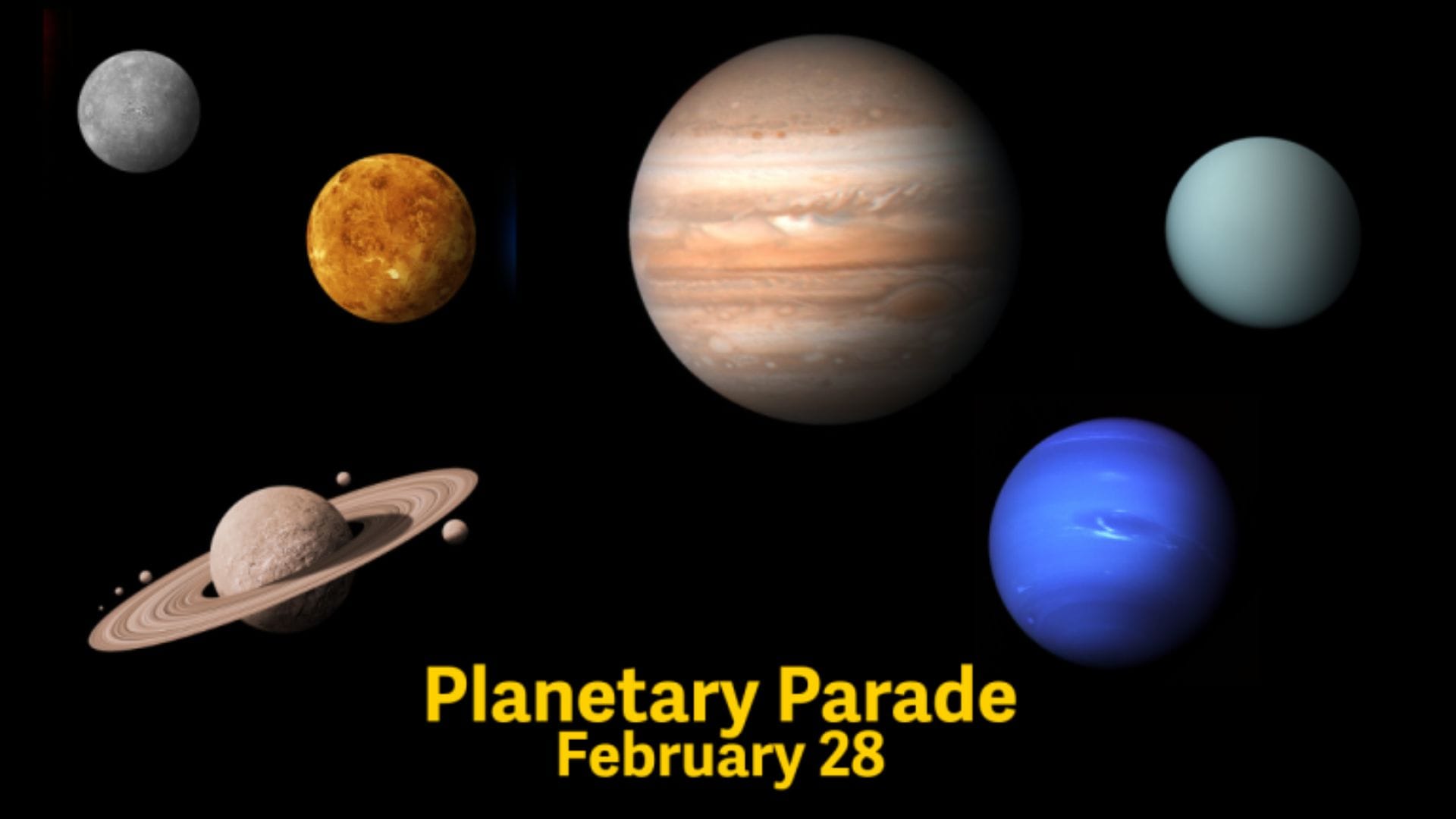
New Delhi: On 28 February, six planets will appear in the sky shortly after sunset, Mercury, Venus, Jupiter, Saturn, Uranus and Neptune. Four of these planets will be visible to the naked eye, but binoculars or a telescope is required for spotting Neptune and Uranus. Mercury may be on the fainter side as well. Saturn started dropping down towards the horizon around Mid-February, with Venus and Mercury both climbing upwards. Jupiter is positioned high in the sky. Neptune will appear close to Saturn, while Uranus will be in between Jupiter and the planets close to the horizon.

The planets as they will appear on 28 February. (Image Credit: NASA/JPL-Caltech).
The planets will appear strung out along a more or less straight line, because they were all assembled in the leftover material from the formation of the Sun. As this infalling material was a flat disk, the planets are all positioned along the same plane, known as the ecliptic plane. Whenever the planets appear in the sky, they are all in more or less a straight line. The parade occurs when multiple planets are visible in the sky at the same time. The planetary parade will be visible soon after sunset throughout the month of February, but they will be best aligned on 28 February.
Short window to catch planetary parade
There is a short window of opportunity for spotting the planets, for roughly 50 minutes after sunset. This is because Venus will set 53 minutes after sunset, with Mercury, Neptune and Saturn all following within 1 hour and 44 minutes after sunset. The Sun will set at around 18:18 hours IST. Mercury, which is close to the Sun, will be visible soon after the sunset. Around 12 August, a six-planet parade will be visible in the morning, just before sunrise. The next planetary parade with seven planets lined up will not be visible till 2040.