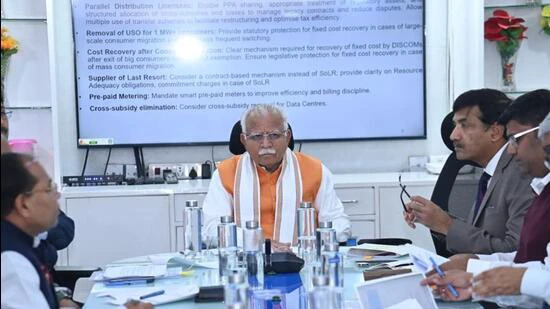
Union minister for housing and urban affairs Manohar Lal Khattar on Wednesday said that how to develop temple towns and tourism hubs further as part of a broader push to shape India’s cities as safe, smart and sustainable growth centres will be discussed in the “chintan shivir” by the ministry to be held in the next couple of months.
Khattar said cities such as Varanasi, Ayodhya and Amritsar are being developed as temple towns, while cities such as Jaipur is being positioned as a tourism hub in his address at the 18th Muncipalika event held in the national capital. The three-day exhibition and conference will host urban practitioners, policymakers and private sector participants to deliberate on mobility, housing, climate action, digital governance and municipal finance.
Khattar said urbanisation in India has increased from 20% five decades ago to about 37% today, covering 40-45 crore people. By 2047, nearly 50% of India’s population-around 80 crore people-is expected to live in urban areas. He said to address this shift, the Centre has announced an Urban Challenge Fund of ₹1 lakh crore for five years. The fund will cover 25% of project costs, with states arranging 25% and the remaining 50% coming from financial institutions. He said cities generate 70% of India’s GDP and 90% of tax revenue, making them central to economic growth.
Speaking on the UCF, MOHUA additional secretary D Thara said the focus is now shifting from funding and capacity creation to “quality and efficiency”.
“One lakh crore has been earmarked… that is 25% of the funding for projects which will be transformative,” she said. “We are looking at retrofitting and repairing existing cities as we build new cities. We are looking at a regional approach to urbanisation, shortened by distances.”
She added that India will add another 400 million people to its urban population in the next 20 years, calling it an “unprecedented wave” that requires rethinking how and where cities expand.
Anacláudia Rossbach, executive director of UN-Habitat, said with 70% of the global population expected to live in cities in the coming decades-including an additional 400 million people in India-the task of managing urban growth is immense. She added a severe global housing crisis affecting both the Global North and South, characterised by homelessness and affordability gaps.
She said SDGs will not be achieved at an abstract level; they will be won or lost “on the ground” at the city level, where services like health and education connect. She added India being a key contributor to the new urban populations in the coming decades will be crucial to the global success story.