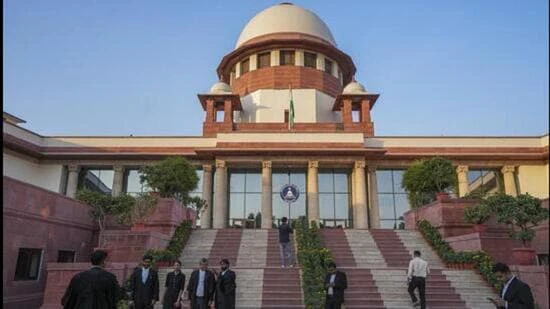
The Supreme Court on Wednesday refused to entertain a petition challenging the provisions of the Bharatiya Nagarik Suraksha Sanhita, 2023, (BNSS) that permits serving or retired judicial officers to assume senior posts in the prosecution department, terming the plea “misconceived” and lacking any “legal foundation”.
A bench headed by Chief Justice of India Surya Kant, however, clarified that the provision in question only lays down an eligibility criterion. It observed that the law clearly prohibits a person from acting as a prosecutor and a judge at the same time, and that the clause merely allows a person who “is or has been a Sessions Judge” to be considered eligible for appointment to posts in the prosecution wing.
The petition, filed by advocate PS Subeesh, challenged Section 20 subclauses (2)(a) and (2)(b) of the BNSS, which allow the appointment of serving or retired judicial officers as directors of prosecution, and serving judicial officers as deputy directors and assistant directors of prosecution.
While acknowledging that the provision was intended to strengthen the prosecution system, the petition contended that “in effect, it subjects it (the judiciary) to executive control and disrupts the constitutional balance between the judiciary, executive, and prosecution.”
Subeesh, who has been practising criminal law for over two decades, argued that “by permitting serving or retired judicial officers to occupy prosecutorial leadership roles, the provision erodes prosecutorial autonomy and revives an impermissible fusion of powers.”
Appearing for the petitioner, advocate MS Suvidutt submitted that the provision violated the doctrine of separation of powers, pointing out that Article 50 of the Constitution requires the State to ensure that the judiciary is kept separate from the executive in public services. He argued that judicial postings must remain functionally autonomous and that a serving judicial officer, or one who has previously held judicial office, should not head the prosecution department.
He further contended that the provision weakened institutional safeguards, compromised prosecutorial independence and undermined the integrity of the criminal justice system.
The bench, also comprising justices Joymalya Bagchi and Vipul M Pancholi, disagreed. “What is wrong if a person who has been a sessions judge is considered eligible? He is better qualified than a lawyer with 15 years of experience,” the court observed.
Refusing to entertain the challenge, the bench said, “The misconceived challenge to Section 20(2)(a) that it violates fundamental rights has no legal foundation and is dismissed.”
The court read out the provision, which states: “A person shall be eligible to be appointed – (a) as a Director of Prosecution or a Deputy Director of Prosecution, if he has been in practice as an advocate for not less than fifteen years or is or has been a Sessions Judge; (b) as an Assistant Director of Prosecution, if he has been in practice as an advocate for not less than seven years or has been a Magistrate of the first class.”
Clarifying its interpretation, the court said, “The words ‘is or has been’ are to be read as an eligibility condition and not to mean that a serving sessions judge is to hold the position. The only requirement of law is that he should not be the prosecutor and judge at the same time.”
The provision envisages the establishment of a directorate of prosecution in all states. The petition had argued that traditionally, investigation falls within the domain of the police, prosecution lies with independent public prosecutors, and adjudication rests exclusively with the judiciary. By enabling judicial officers to exercise, supervise or influence prosecutorial functions, the provision was said to blur the constitutionally mandated functional demarcation among the three organs of the State.