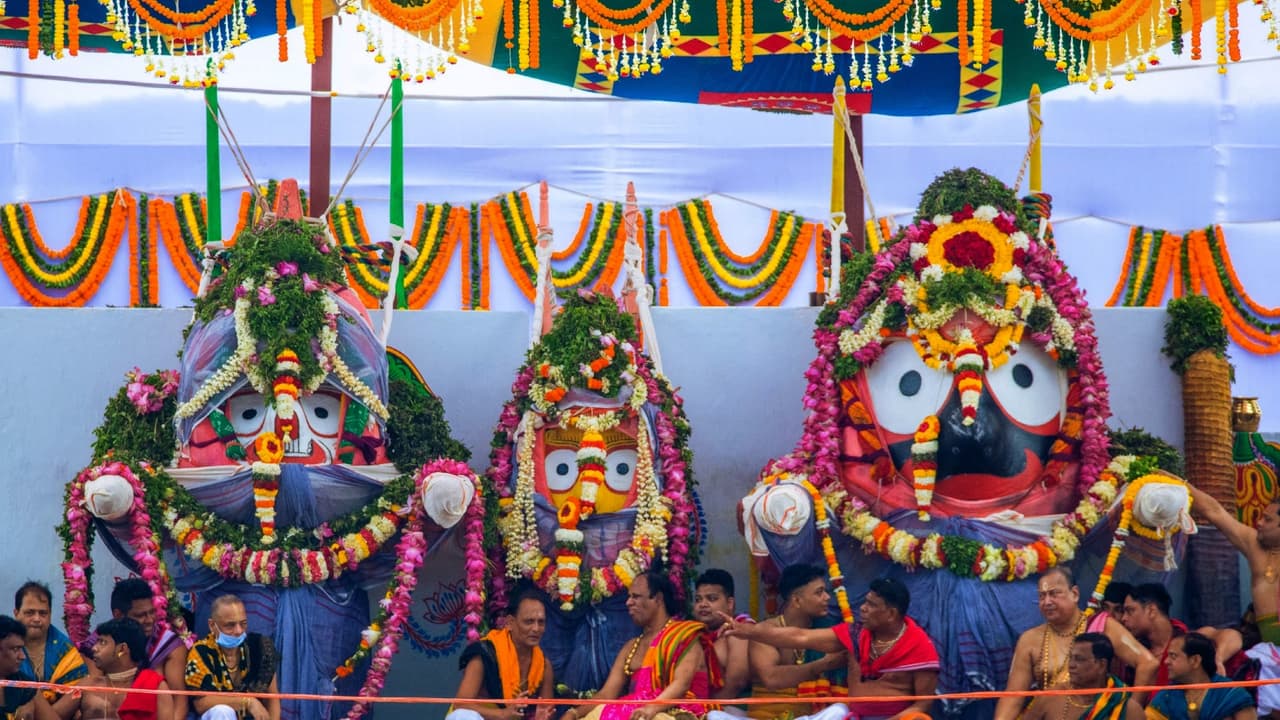
Jagannath Idol Mystery: Why is the idol of Lord Jagannath incomplete? Learn about the story of King Indradyumna, Vishwakarma, the spiritual message and the Navakalevar tradition of the Puri temple.
Puri Jagannath Temple History: The form of Lord Jagannath is different from all others. The hands and legs of his statue are not fully formed. Therefore, the question that comes in the minds of people who visit for the first time is why the idol of Lord Jagannath is incomplete? Behind this, a story related to King Indradyumna and Devshilpi Vishwakarma is heard.
Who was King Indradyumna?
According to beliefs, King Indradyumna of Malwa was a great devotee of Lord Vishnu. One day he heard about Neelamadhav (a colossal form of Lord Vishnu) and expressed his desire to visit him. Even after a lot of searching, Neelmadhav could not be seen. Then the king performed severe penance. Pleased with his devotion, Lord Vishnu appeared to him in his dream. God said- His idol should be made from the divine liquor (sacred wood) found on the beach and established.
divine wood found from the sea
After some time, a huge log of divine wood washed up on the beach of Puri. It was called Daru Brahma. It is believed that the divine form of God was present in this sacred wood. King Indradyumna resolved to make idols of Lord Jagannath, Balabhadra and Goddess Subhadra from that wood.
Read this also- Why are Lord Jagannath’s eyes so big?
Vishwakarma placed a condition
According to the story, then an elderly carpenter came to the king. He himself was Vishwakarma, the architect of the gods. He told the king that he should be given the responsibility of making the statue, but kept a condition. The condition was that they should be locked in a room and allowed to work continuously for 21 days. During this time no one will open the door, no one will disturb. If someone opens the door in between, the work will be left incomplete. The King accepted this condition.
Queen’s concern became the reason
For many days, sounds of wood carving kept coming from inside the room. After some time the sound stopped coming from inside. Queen Gundicha (Gundicha) became upset. He wondered whether something untoward had happened to the old carpenter. He requested the king to open the door. Initially the king refused, but seeing the queen’s legitimate concern, he got the door opened before 21 days.
Read this also- Why does the king use a broom in the Rath Yatra of Lord Jagannath?
The idol of God remained incomplete
As soon as the door was opened, the mysterious carpenter disappeared from there. The idols of Lord Jagannath, Balabhadra and Subhadra were present in the room, but their hands and legs were not completely formed. King Indradyumna regretted his mistake. Then a voice came from the sky that God wants this. Only these idols should be worshipped. From then till today this form of Lord Jagannath is worshiped in Puri.
Is it just a legend?
Historians say that the form of Jagannath may also be linked to the ancient tribal worship traditions of Odisha, where simple and symbolic wooden idols were worshipped.
spiritual message of the incomplete statue
The incomplete form of Lord Jagannath gives many messages. In which-
- God is not limited to any one form. His form is beyond our imagination.
- Faith is more important than external beauty. God’s love does not depend on shape or size.
- Incompleteness can also be a symbol of completeness. God tells us through this very form that true perfection lies in the mind and devotion.
- Every person is equal before God. The unique form of Jagannath ji gives the message of equally accepting people of all castes, classes and societies.
This tradition is still followed today
The tradition of Navakalevar is performed at an interval of approximately 12 to 19 years in the Jagannath temple of Puri. In this, new idols of Lord Jagannath, Balabhadra, Subhadra and Sudarshan are made from special Neem (Daru) wood. New sculptures are also made in the same traditional form, in which the hands and legs are not fully developed. The centuries old tradition is still alive.
Content Source: Based on Skanda Purana (Utkal Khand), Brahma Purana, Narada Purana, Shri Jagannath Temple Administration Puri, Odisha Review, Government of Odisha, Jagannath tradition.