
Ethereum co-founder Vitalik Buterin has sold more than 10,0000 ETH tokens in February after pledging to fund open-source projects.
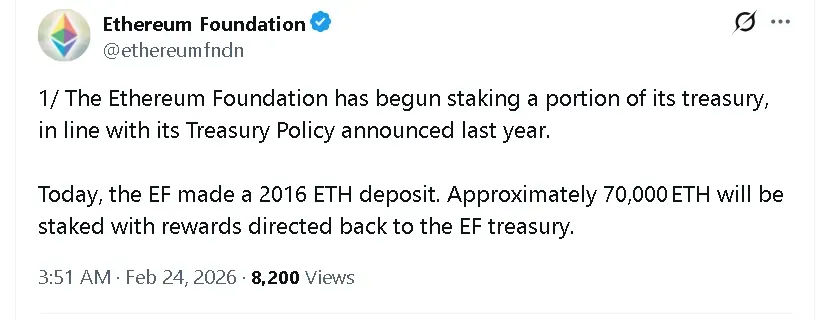
- The Ethereum Foundation said its first deposit of 2,016 ETH has already been made using open-source infrastructure tools.
- Staking rewards will be returned to the foundation’s treasury to generate on-chain yield.
- Ethereum’s price has been under pressure amid the current crypto rout, unable to regain $2,000 since last week.
The Ethereum Foundation said Tuesday it has begun staking Ethereum (ETH) under its updated treasury policy and plans to stake a total of 70,000 ETH, with rewards directed back into its treasury.
The move comes amid Ethereum co-founder Vitalik Buterin offloading his Ethereum holdings this month after pledging to fund open-source projects. Buterin has sold around 10,723 ETH since February 2, according to data from Onchain Lens. Arkham Intelligence showed he had sold nearly $2.5 million worth of Ethereum between Monday and Tuesday as per the altcoin’s current price.
Ethereum Price Struggles Below $2,000
Ethereum’s price has dropped nearly 5% in the last 24 hours to around $1,826 as of Tuesday morning. On Stocktwits, retail sentiment around ETH remained in ‘extremely bearish’ territory over the past day.

Ethereum-linked equities were also in the red in early morning trade on Tuesday. Tom Lee-backed Bitmine Immersion Technologies (BMNR) and SharpLink Gaming (SBET) slipped as much as 1.7% each in pre-market trade.
The drop in Ethereum’s price comes amid a broader decline in the cryptocurrency market, with Bitcoin (BTC) trying to stay above $63,000 after a brief decline on Monday night to around $62,900. The slump comes after IBM’s stock saw its worst-ever single-day decline in 25 years, following Anthropic’s claim that Claude could do what “armies of consultants” at IBM take years to implement.
Treasury Strategy Shifts Toward Staking
The Ethereum Foundation made its first deposit of 2,016 Ethereum tokens on Tuesday. It said the effort is being conducted using open-source software options, including Dirk and Vouch by Attestant IO, after reviewing multiple platforms.
Dirk functions as a distributed signer, allowing validator operations to be coordinated across multiple jurisdictions and reducing the risk of a single point of failure. Vouch supports multiple client pairings and incorporates strategies to mitigate client diversity risks, the foundation said.
The setup relies on minority clients and a mix of hosted infrastructure and self-managed hardware across several jurisdictions. The approach is intended to balance operational resilience with decentralization goals, according to the foundation.
Read also: Bitcoin’s Price Drops Below $63K After IBM’s Worst Day In 25 Years – Triggers $370 Million Liquidation Wave
For updates and corrections, email newsroom[at]stocktwits[dot]com.<