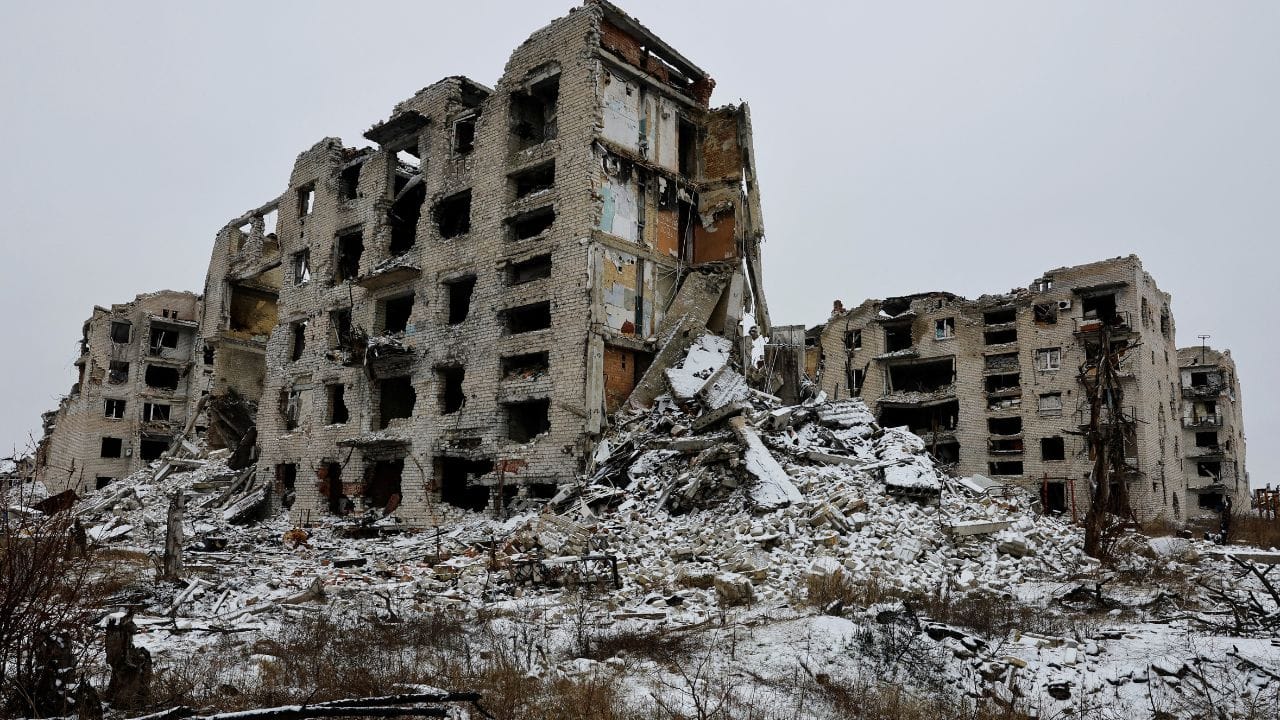
New Delhi: The Russia–Ukraine war has now entered its fifth year. As a journalist, I had the opportunity to visit almost every major front of this conflict. When I first reached the battlefield in 2022, at the very beginning of the war, I had no idea that it would turn into such a prolonged and exhausting struggle. At this moment, I am in Tel Aviv, Israel, but my mind keeps wandering back to the battlefields of Russia and Ukraine.
The most dangerous early front was Mariupol. A city of nearly 1.5 million people, it was strategically vital because of Europe’s two major steel plants-Azovstal and Illich. The area became one of the bloodiest battlegrounds of the war. When we were reporting there, there was hardly a single corner left in the city where one could sit and have a cup of coffee. Every building, every wall bore the scars of destruction. The headquarters of Ukraine’s aggressive Azov Battalion was also located there, which fell into Russian hands in May 2022.
From Kherson, we traveled to the Kakhovka dam, which was later destroyed in an explosion. The world was stunned when Russian forces withdrew from Kherson and retreated across the Dnipro River. I traveled multiple times from Donbas to Crimea-by train, road, boat, and even helicopter. Each time, the grandeur of the Crimean Bridge left me amazed, but in October 2022, I saw it again-this time damaged by a bomb explosion.
Sevastopol is home to the headquarters of Russia’s Black Sea Fleet. In this war, sea drones emerged as a new and effective weapon. Several Russian warships were targeted in Ukrainian attacks. Despite being a superpower, Russia faced significant setbacks. From Moscow to the distant Engels airbase, Ukrainian drone strikes made their presence felt. Drones reaching the Kremlin complex sent a clear message: the lines of war were no longer confined to the front.
There were also reports of multiple assassination attempts against President Vladimir Putin. Several top Russian military commanders were killed in car bomb explosions. This war did not only target soldiers but also ideological figures. When I met Professor Alexander Dugin in Moscow-often described as Putin’s ideological guide-he appeared shattered by personal tragedy. He survived a car bombing, but his only daughter, Daria Dugina, was killed. The shadow of war extended far beyond the battlefield.
Whenever Iran’s Supreme Leader speaks of sinking an American aircraft carrier, the world is reminded of the sea drones and precision strikes witnessed in the Ukraine war. This conflict has become a laboratory for future military strategies.
At the beginning, there was a visible surge of patriotism. But as time passed, realities changed. In Ukraine, controversies arose over forced military conscription. Officials faced accusations, and protests broke out in several places. The clash between strategy and politics further complicated the situation. The battle of Bakhmut is one example. President Volodymyr Zelenskyy had declared before the U.S. Congress that Ukraine would hold Bakhmut at any cost, while the then army chief Valerii Zaluzhnyi was reportedly of a different view. The result was heavy losses for Ukrainian forces. Zaluzhnyi was later removed and appointed ambassador to London.
The war did not remain confined to the frontline. Railway stations, power plants, hotels, and hospitals were all targeted. I had visited Vyborg, the starting point of the Nord Stream gas pipeline connecting Russia and Europe. Soon after, the explosion in the Baltic Sea opened a new chapter in the energy dimension of the war.
Two incidents from Donbas still haunt me. In Donetsk, amid continuous shelling, I was moving from one location to another for live coverage when a rocket struck a minibus driving just ahead of my car. Eight people were burned alive before my eyes, including a young child. Even two years later, the memory and even the imagined smell of burning-lingers vividly.
On another occasion, near the frontlines of Avdiivka, we had breakfast with soldiers at a post. When we returned a few hours later, the entire position had been destroyed. Not one of the soldiers we had shared that meal with was alive.
In war, there is rarely a true winner. The only difference is that one side suffers more than the other. Both countries have avoided releasing full official casualty figures, but the real cost of the war is evident in every affected family.
During World War II, the Soviet Union lost millions of lives. Today’s conflict is reopening that historical wound.
A bitter truth of this prolonged war is that while ordinary people, soldiers, and families are paying the price, the arms industry continues to thrive. Defense budgets in the United States, Europe, and Russia have reached record levels. Companies manufacturing missiles, drones, air defense systems, and ammunition are seeing soaring valuations. The war has strengthened a vast military-industrial complex for which the longer the conflict lasts, the greater the profit. The game continues: soldiers fight on the battlefield, while deals are made in boardrooms.
A famous song from the Indian film Border about the India-Pakistan war says, “Wars last a few days, but life weeps for years.” In the case of the Russia–Ukraine war, it is no longer a matter of days or months. Five years have passed, and the end is still nowhere in sight.