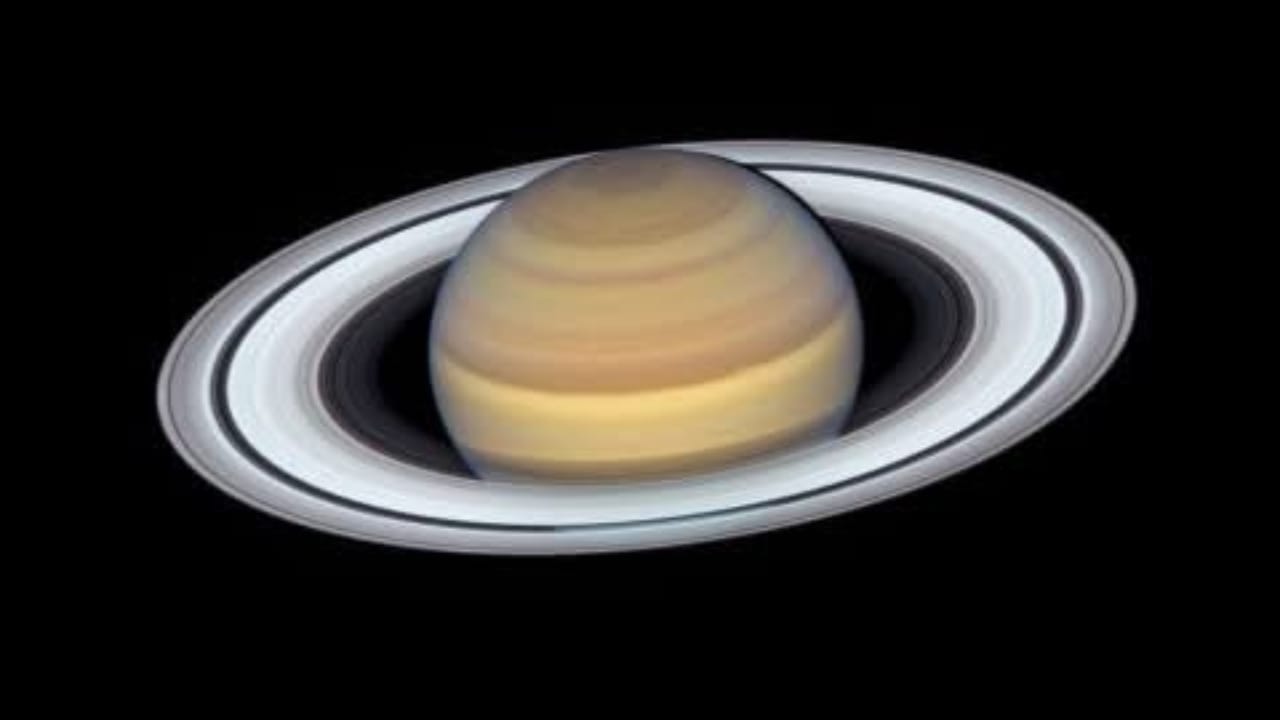
Nainital: Saturn, the second largest planet in our solar system, has always fascinated scientists and sky-watchers with its dazzling rings. These bright, icy bands make Saturn appear like a jewel in the night sky. But how did these rings form? Recent research has finally provided an answer.
A joint study by scientists from the Southwest Research Institute (SWRI) in the United States, California Institute of Technology (Caltech), and France’s Observatoire de Paris has revealed that Saturn’s rings originated from a violent collision between two of its moons—Titan and Proto Hyperion.
Saturn’s rings are relatively young compared to the planet itself
According to the findings, the collision was so powerful that Proto Hyperion was completely destroyed. The shattered debris spread around Saturn, forming its rings. Some of the material also fused with Titan, making it larger than before. Today, Titan is Saturn’s biggest moon, and this ancient impact played a role in shaping its size and surface.
Dr. Shashi Bhushan Pandey, senior astronomer at Aryabhatta Research Institute of Observational Sciences (ARIES), explained that Saturn’s rings are relatively young compared to the planet itself. They are estimated to be about 100 million years old. He described them as a “silver sheet” that enhances Saturn’s beauty.
The collision also affected Saturn’s tilt. The planet’s axis now leans at 26.7 degrees, slightly more than Earth’s tilt of 23.5 degrees. This tilt influences Saturn’s seasons and the way its rings appear from Earth.
Rings are made mostly of ice
Saturn’s rings are enormous in size. Their diameter stretches to nearly 270,000 kilometers, though their thickness is surprisingly small—ranging from 10 to 100 meters, with some parts possibly reaching up to a kilometer. The rings are made mostly of ice, mixed with dust, particles, and organic matter.
However, scientists warn that Saturn’s rings are not permanent. They are slowly falling onto the planet as “ring rain.” Over time, this process could cause the rings to disappear, leaving Saturn without its most famous feature.
Titan has faced other massive impacts in the past
Researchers also believe Titan has faced other massive impacts in the past. Evidence suggests that large craters once existed on its surface, which later filled in, helping the moon grow bigger. These ancient collisions highlight the violent history of Saturn’s system and the dynamic forces that shaped it.
The discovery of the rings’ origin is a major breakthrough in planetary science. It not only ex
plains Saturn’s beauty but also deepens our understanding of how celestial bodies evolve through collisions. For now, Saturn continues to shine with its icy crown, a reminder of cosmic events that took place millions of years ago.