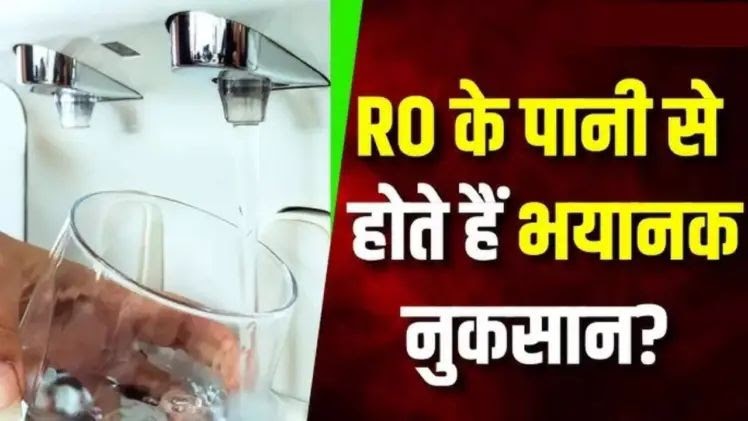
RO Water Purifier Is Dangerous: Today’s era is of “purity”. The passion to purify everything – water, air, food – has increased among people. In this race, RO water purifier quickly became a part of every household.
Everyone believes that RO water is the safest. But now the World Health Organization (WHO) and other scientific organizations have exposed a bitter truth that, “extremely pure water can become a slow poison for the body.”
RO water, which has very low TDS (total dissolved solids), also removes essential minerals. This can lead to electrolyte imbalance in the body, metabolic disturbances and many long-term diseases. So the question arises, is RO technology a boon for our health or is it gradually becoming an invisible threat? Whereas its use in foreign countries is very limited. Let us know how RO water purifier is harming health, what diseases it can cause and what advice experts give on this.
RO Water Purifier: Working Method
In RO technology, water is passed through a semi-permeable membrane, which removes 90-99% of dissolved solids (TDS – Total Dissolved Solids), minerals, salts and impurities present in the water.

RO Water Purifier Is Dangerous (Image Credit-Social Media)
But the problem starts from here. Water removes not only harmful elements but also essential minerals like calcium, magnesium, potassium and essential micronutrients, which are essential for health.
WHO warning: Mineral-free water is dangerous
The World Health Organization (WHO) has clarified in its report that, “A minimum of 100 mg/L (milligrams per liter) of TDS in water is essential for health.” WHO says that continuous consumption of water with low mineral content can lead to diseases like electrolyte imbalance, metabolic problems and weakening of bones in the body.
WHO also clearly wrote in its 2017 and 2020 reports: “Extremely low-mineral content water can have adverse effects on homeostasis mechanisms and body mineral balance.”
WHO report: dangers of mineral-free water
key points: :
– Water with TDS less than 30 mg/L is considered “highly purified”, which is harmful to health.
– Continuously drinking such water can cause deficiency of calcium and magnesium in the body. WHO has advised countries to strictly control the use of RO water purifiers.

RO Water Purifier Is Dangerous (Image Credit-Social Media)
Possible diseases caused by RO water purifier
1. Mineral Deficiency Disorder
Constantly drinking mineral-free water can lead to deficiency of essential elements like calcium, magnesium, potassium. Due to this the bones can become weak. The problem of muscle cramps and fatigue and weakness persists.
2. Gastrointestinal problems
RO water is extremely clean, which can upset the balance of bacteria needed for digestion in the stomach. This can increase problems like indigestion, constipation, stomach pain.
3. Risk of heart diseases
Several scientific studies have indicated that magnesium deficiency can increase the risk of heart attack and hypertension.
4. Effect on kidneys
Electrolyte imbalance puts extra pressure on the kidneys, which can lead to kidney problems.
5. Skin and hair problems
Due to lack of essential minerals in the body, the skin can become dry, cracked and hair starts falling.
Expert view

RO Water Purifier Is Dangerous (Image Credit-Social Media)
Dr. S.K. Panda (Senior Nephrologist, AIIMS New Delhi)
“RO water destroys many minerals essential for the body. Regular consumption of water without balanced TDS can cause ‘hidden mineral deficiency’ inside the body in the long run. Its effects can be more serious, especially in children and the elderly.”
Pro. Leonardos Van Brugh (WHO, water quality expert)
“Water should not be purified merely to remove impurities; it should be purified while retaining essential life-sustaining elements. Water with a very low TDS does not meet the body’s natural mineral demands.”
Situation in India: What BIS standards say
The Bureau of Indian Standards (BIS) recommends TDS up to 500 mg/L for drinking water, and considers water with a minimum TDS of 150 mg/L as ideal. RO systems generally maintain TDS between 30 to 50 mg/L, which is well below both BIS and WHO standards. In 2019, the Government of India had ordered RO manufacturing companies to sell RO only if the TDS of the input water is more than 500 mg/L.
Need for rules regarding RO water purifier

RO Water Purifier Is Dangerous (Image Credit-Social Media)
Experts agree that:
- RO should be used only in those areas where water is highly contaminated.
- Otherwise, it is safer to purify water with UV (Ultra Violet) or UF (Ultra Filtration) technologies.
- RO water purifiers must have a “Mineral Cartridge” or “TDS Controller” to add back some of the essential minerals.
What to do? solutions and suggestions
1. Check TDS level of water
Before installing RO, test the water with a TDS meter. If TDS is less than 500 mg/L, RO is not required.
2. Choose mineral rich water
Select ‘Mineral Added RO’ system to supply essential calcium and magnesium in water.
3. Follow government standards
Purify water as per the standards specified by BIS and get the RO settings adjusted.
4. Use natural sources
Wherever possible, it is more beneficial to boil or filter water from natural sources like wells, springs etc.
Is the era of RO water purifier about to end?
- The indiscriminate popularity of RO water purifier is now in the dock. Depletion of essential nutrients from water in the name of purity can lead to a serious health crisis.
- WHO’s warning and expert opinion indicate that it is time we reconsider the use of RO water heaters purifiers. It is important that we make water safe and nutritious without destroying its natural properties. Because there is no bigger compromise than health.
- Mindset regarding the use of RO water purifier in foreign countries
1. Europe (Germany, France, UK etc.)
According to the report of European Union Drinking Water Directive (EU Directive 2020)
In these countries, RO is rarely used in domestic use. In Europe, tap water is generally safe to drink. Governments already set strict standards for drinking water. People are confident that their tap water is safe.
There, RO is considered as ‘over-purification’, which can also be harmful for health, this belief is quite popular. RO is used only in certain circumstances (such as areas with heavy metal contamination), but even in that, remineralization is taken care of.
2. America
Even in America, RO is not as common at the domestic level as it is in India. Point-of-Use filters (like Carbon filters, UV filters) are more popular there. RO is mostly used in those areas where
There is a risk of arsenic or nitrate in the water, or where well water (underground water) is used. Both the US EPA (Environmental Protection Agency) and CDC (Centers for Disease Control) recommend that if the TDS or mineral levels of water are good, there is no need for RO.
Mindset:
“Use RO only when needed, do not spoil normal water with RO unnecessarily.”
3. Singapore, Japan, South Korea
Very high-tech filtration systems are used here. In Singapore, PUB (Public Utilities Board) purifies tap water so much that it can be drunk directly without any filter. Remineralization is mandatory where RO based systems are installed. And there are often smart systems that monitor the mineral balance themselves. The mentality of the conscious people here is, “Remove the dirt from the water, but do not remove the nutrition (minerals).”
4. Australia and New Zealand
Here also the tap water is of very high quality. RO is used only in areas where water purity is less than m borewells or in remote areas. The governments of these countries recommend that the natural mineral balance of this water be maintained.
Main points (in brief):
The quality of tap water is better than before. Health awareness is high. People there know that essential minerals also enter the body through water. These governments invest heavily in water treatment, eliminating the need for individual RO purifiers.
The rules there give priority to keeping the minerals intact.
difference between india and abroad
In many areas in India, Fluoride, Arsenic and TDS were present in the water, hence the trend of RO increased. But now even in urban areas (where even tap water is clean), RO is being used unnecessarily, which can become a threat to your health. People in foreign countries choose the right treatment as per their need and do not apply RO indiscriminately.