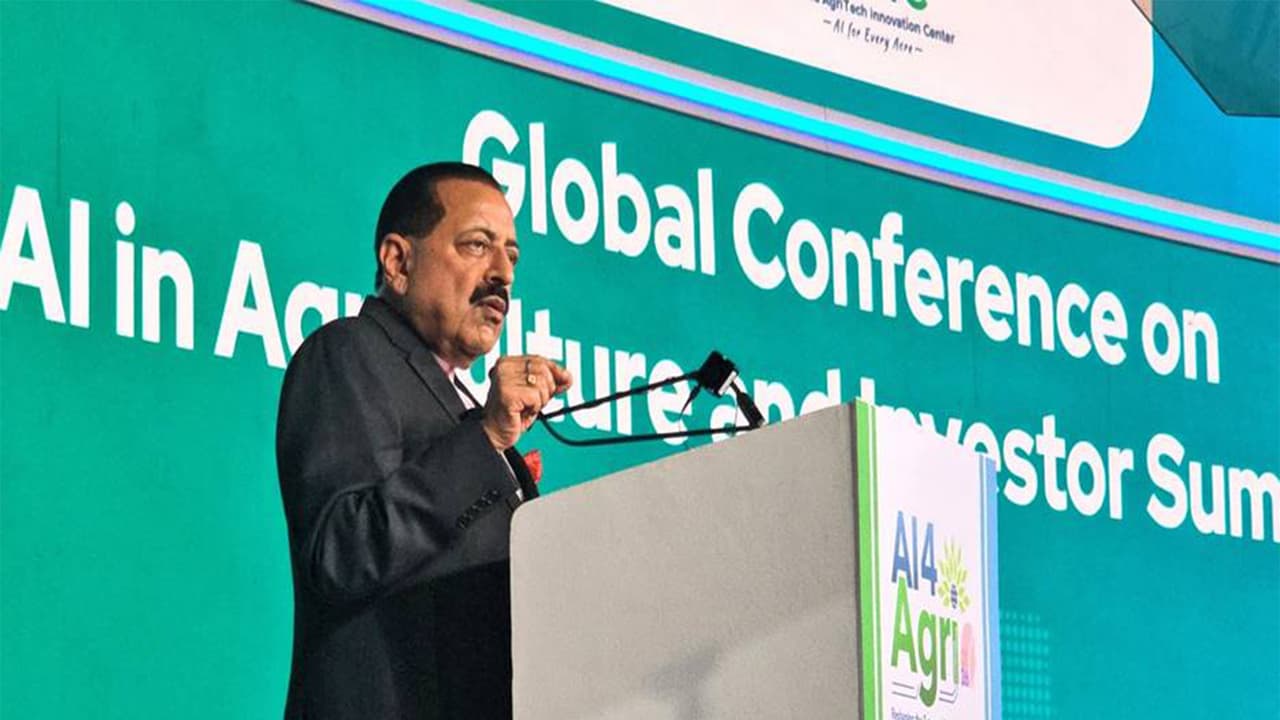
Union Minister Jitendra Singh stated that AI will lead India’s next agricultural revolution, offering scalable solutions to boost farm productivity. He highlighted its potential for poverty reduction and its role as a central pillar of farm policy.
India’s next agricultural revolution will be driven by artificial intelligence, Union Minister of Science and Technology and Earth Sciences, Jitendra Singh, said on Sunday, positioning AI as the central pillar of farm policy, research and investment architecture at the AI4Agri 2026 Summit in Mumbai.
According to a press release, addressing the inaugural session of the ‘Global Conference on AI in Agriculture and Investor Summit 2026’ here, the minister said AI offers, for the first time, scalable solutions to structural challenges that have long constrained farm productivity – erratic weather, information asymmetry and fragmented markets. “What AI offers is not a new diagnosis. It offers, finally, a prescription that can scale,” he said, noting that even a 10 per cent productivity gain for the 600 million farmers across the Global South would amount to what he described as the single largest poverty-reduction opportunity of the century.
India’s National AI Push
Framing agriculture as a strategic sector rather than a legacy one, Jitendra Singh linked the AI push to the Rs 10,372-crore India AI Mission, which is building sovereign compute capacity, datasets and startup infrastructure at scale. He highlighted BharatGen, India’s government-owned large language model ecosystem, which has already released “Agri Param”, a domain-specific agriculture model operating in 22 Indian languages, enabling farmers to access advisory support in their own language.
“This is AI that speaks to a farmer in Marathi, Bhojpuri or Kannada,” he said, underscoring the importance of linguistic inclusion. The minister said the Department of Science and Technology (DST) is supporting an open, interoperable India AI Open Stack to ensure that agri-AI solutions developed anywhere in the country can plug into a national framework.
The Anusandhan National Research Foundation is funding deep-tech and AI research in collaboration with IITs, IISc and ICAR, including agriculture applications.
AI-Powered Applications in Farming
Jitendra Singh pointed to drone and satellite mapping that is already strengthening Soil Health Cards and the Swamitva Mission by providing verified land and soil data, and to investments in climate intelligence where Earth Sciences and AI are being integrated into early warning systems to help farmers “plan, not panic”.
The role of biotechnology, he said, would be critical in developing resilient and disease-resistant crops, including early asymptomatic detection of pests and plant diseases, and in advancing a circular crop economy.
Economic Opportunity and Implementation
Highlighting the scale of opportunity, Jitendra Singh said India’s 140 million farm holdings, most of them small and marginal, could together generate an estimated Rs 70,000 crore in annual value if AI-enabled advisories help each farmer save even Rs 5,000 a year through better input timing, pest prediction and market linkage. He cited Maharashtra’s Rs 500-crore MahaAgri-AI Policy 2025-29 as a model, adding that the Centre would align and amplify such state-level initiatives.
The Union Budget 2026-27 has proposed ‘Bharat-VISTAAR’, a multilingual AI tool integrating AgriStack portals and ICAR’s agricultural practices package with AI systems, to provide customised advisory support and reduce farm risk, he noted. The focus, he said, is on small, purpose-built AI models trained on Indian soil types, climate zones and crop varieties, deployable even in low-connectivity rural areas through mobile phones and farm equipment.
A Call for Federated Architecture and Investment
Calling for a federated national architecture, Jitendra Singh said agri digital public infrastructures such as MahaAgriX should evolve into a national Agri Data Commons. He invited stakeholders to contribute to a proposed National Agri-AI Research Network, a collaboration between DST, state governments, ICRISAT, ICAR and global institutions, to build India-specific foundational datasets for crops, soil and climate, the press release said.
The Minister also made a direct appeal to investors, describing agri-AI as “the largest untapped productivity market in the world,” and urged patient capital to back scalable platforms rather than isolated pilots. The success of the conference, he said, would not be measured by presentations but by how many pilots become platforms and how many farmers make better decisions a year from now because of commitments made here.
“The farmer does not need AI simply for the sake of it. He needs it to be useful. Let that be our compass,” he said, concluding with a call for collaborative delivery and reiterating India’s intent to act not as a recipient but as a co-architect of global agri-AI frameworks, the press release said. (ANI)
(Except for the headline, this story has not been edited by Asianet Newsable English staff and is published from a syndicated feed.)