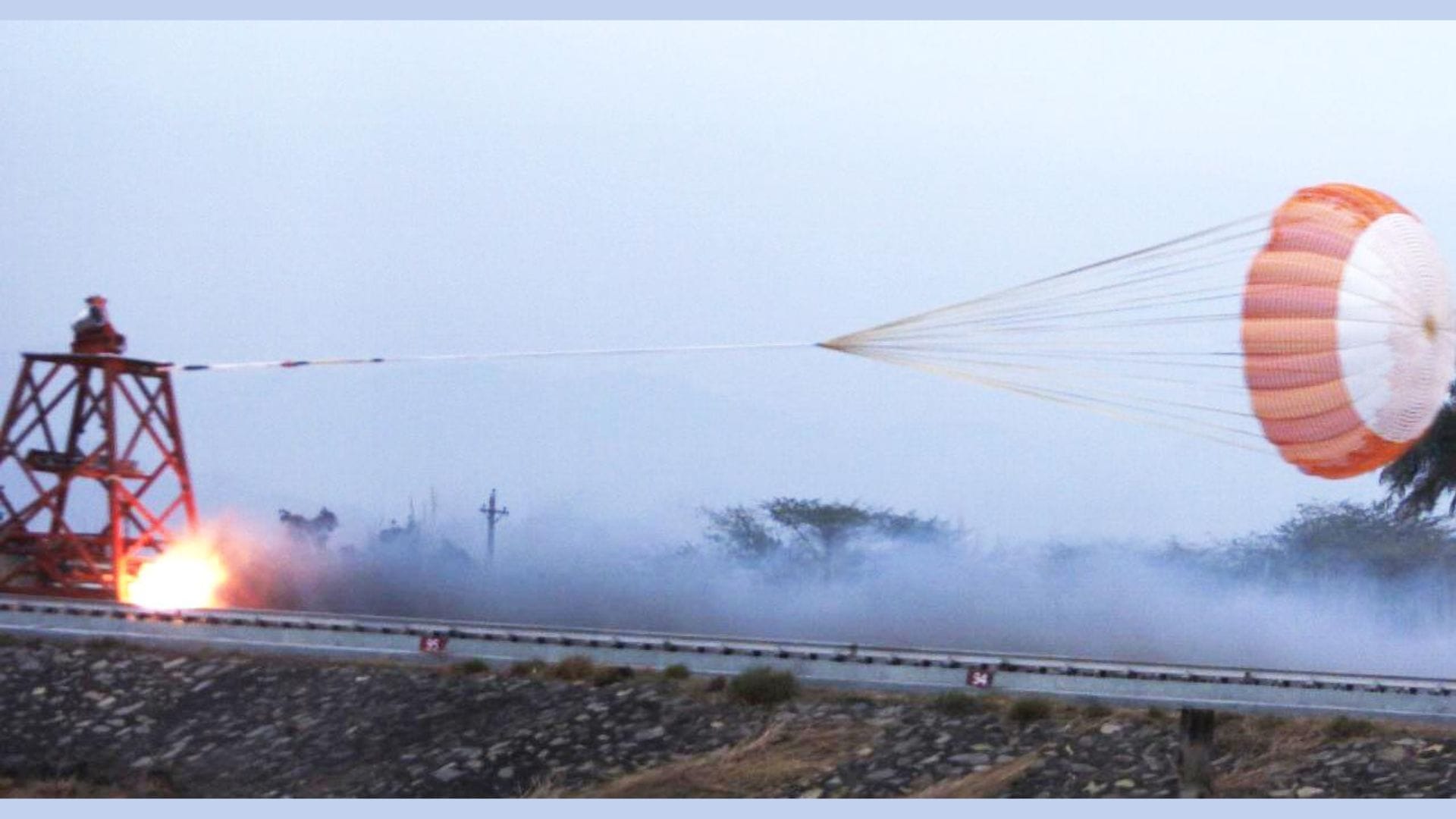
New Delhi: DRDO has successfully conducted a qualification level load test for the drogue parachutes to be used by the Gaganyaan programme at the Rail Track Rocket Sled (RTRS) facility at the Terminal Ballistics Research Laboratory (TBRL) in Chandigarh. The test was conducted on 18 February, 2026 along with the Vikram Sarabhai Space Centre, the Aerial Delivery Research and Development Establishment, and ISRO. The qualification level loads are higher than the maximum flight loads, which demonstrates the additional design safety margin in the parachute.
The test demonstrates India’s expertise in designing and manufacturing of high strength ribbon parachutes. The RTRS is a specialised dynamic test facility that is used for high speed aerodynamic and ballistic evaluation using a rocket propelled sled on a rail track. The same facility was previously used in August 2023 to evaluate the drogue parachutes in a reefed or partially deployed configuration, and then again in February 2025 to evaluate the performance of the parachutes at the angle of attack expected by the returning Gaganyaan crew module. The successful test marks a key milestone in the exhaustive testing and qualifications necessary to develop the complex parachute system for use in India’s human spaceflight programme.
The complex Gaganyaan parachute system
In the Gaganyaan missions, one or two Gaganyatris will orbit the Earth after being launched by the human-rated Launch Vehicle Mark 3 (HR-LVM3). At the end of the mission, the Gaganyaan crew module will reenter the atmosphere. The first to deploy will be a pair of apex cover parachutes, that will pull out the protective casing for the parachutes. The drogue parachutes will be deployed next, which are designed to work at tremendous velocities, and will stabilise the crew module, and pull out three pilot parachutes, that will shed the velocity further. The three pilot parachutes will then pull out the three main parachutes, that will use advanced two-stage reefing to ensure a safe splashdown in the ocean.