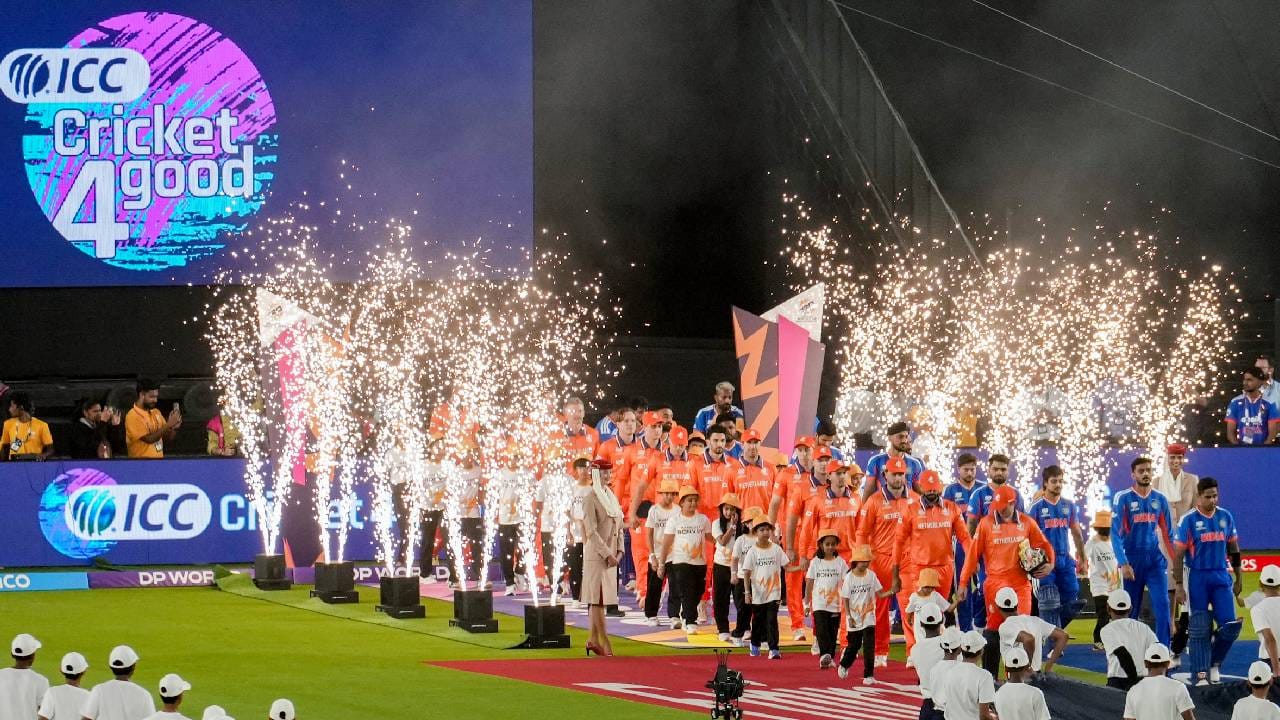
New Delhi: The UNICEF and the International Cricket Council (ICC) have united to promote children’s empowerment and their right to play at the ongoing men’s T20 World Cup 2026. At the start of the India vs Netherlands clash in Ahmedabad’s Narendra Modi Stadium on Wednesday, Soledad Herrero, chief of field services, UNICEF India, along with two young athletes did a trophy walkout to promote the idea of inclusion and children empowerment.
Two upcoming sportspersons from the Ahmedabad city – 15-year-old Rangi Niyati Mohanlal and 14-year-old Ray Ankit Umashankarbhai – were part of the trophy walk. While Rangi has brought glory for the state in various national and international competitions, Ankit happens to be a promising young cricketer.
Soledad, while interacting with media before the trophy walkout said that cricket as a game is a powerful unifier for equity reminding all that every child deserves a fair chance of playing at least once. The chief of the field services further said that UNICEF is proud to partner with the ICC during the T20 spectacle with just one objective of enhancing children’s rights to play.
UNICEF promotes children empowerment
She further said that play powers stronger generations tomorrow and the best way in which children learn, explore and understand the world is through sports. Soledad also said that play is also an entry gate through which kids develop critical thinking, problem-solving, interpersonal skills while boosting confidence emotional regulation.
Stressing the importance of safe spaces for children, she pointed that ‘feeling safe allows children to explore, to try, to fail, and try again. When there is play without fear, there is learning without anxiety, and a space to nurture confidence and sense of belonging.’
UNICEF and the ICC have been working together for more than a decade now through the Cricket for Good initiative, using the reach of the sport to support children’s rights and well-being.
(With PTI inputs)