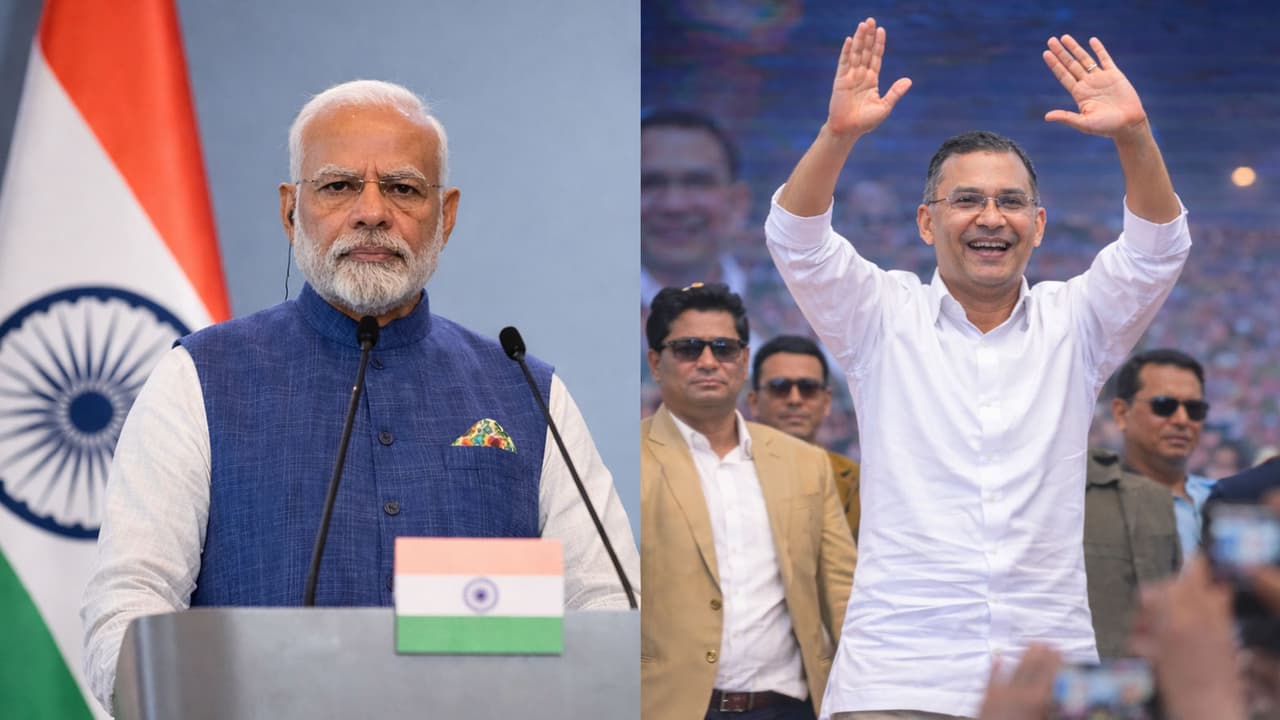
Tarique Rahman inherits a fragile economy, strained institutions and sensitive ties with India as Bangladesh’s new Prime Minister. He will be tested by inflation, unrest, and balancing India, China and Pakistan while resetting bilateral cooperation.
Tarique Rahman was sworn in as Bangladesh’s new Prime Minister today, inheriting a country marked by economic fragility, institutional weakness and a complex relationship with India. The Bangladesh Nationalist Party’s landslide victory on February 12 ended 18 months of interim rule and returned competitive politics to a nation of 170 million.
Rahman, 60, son of former Prime Minister Khaleda Zia and former President Ziaur Rahman, returned to Dhaka in December 2025 after 17 years in exile. Within weeks, he led his party to a 212‑seat majority in the 300‑member Parliament. The opposition bloc led by Jamaat‑e‑Islami secured 77 seats. Sheikh Hasina’s Awami League was barred from contesting after her conviction and remains in exile in India.
Rahman acknowledged the challenges ahead. “We are about to begin our journey in a situation marked by a fragile economy left behind by the authoritarian regime, weakened constitutional and statutory institutions, and a deteriorating law and order situation,” he said.
Economic Strain And Domestic Challenges
Bangladesh’s inflation accelerated to 8.58% in January 2026, driven by food prices, while unemployment stands at 2.7 million, nearly a million of them university graduates. The garment industry, the world’s second‑largest exporter after China, has faced supply‑chain disruptions and shaken investor confidence. Rahman has proposed a $10 billion social welfare programme prioritising female heads of households, allowances for educated youth and expanded farmer support.
External relief has been limited. The White House announced a tariff cut on Bangladeshi goods to 19% from 20%, with exemptions for certain textiles. Yet the structural challenge remains: an economy heavily dependent on garments and vulnerable to global demand shifts.
Youth expectations loom large. Roughly 40% of Bangladeshis are under 25. The 2024 uprising was fuelled by young people angered by unemployment and the abolition of a job‑quota system. Converting protest energy into governance will be a defining test.
Resetting Strategic Ties With India
For India, Rahman’s premiership carries strategic weight. The Siliguri Corridor — a narrow strip of land linking mainland India to its northeast — makes stability in Dhaka a necessity. Past BNP governments allowed Indian insurgent groups to operate from Bangladeshi soil, while Hasina cemented security cooperation by handing over militants in 2009. Analysts suggest a full BNP majority is easier for New Delhi to manage than a fragile coalition, but the test will be practical: counterterrorism cooperation, transit rights and border restraint.
Transit rights remain sensitive. Past BNP governments refused India’s requests for overland access to its northeast, invoking nationalist arguments. The Awami League granted transit, earning royalties. Whether Rahman maintains or recalibrates these arrangements will signal his orientation.
Rahman’s foreign policy doctrine is framed as “Bangladesh First,” with an economy‑based approach emphasising mutual trust and benefit. Balancing India, China and Pakistan will be complex. China is Bangladesh’s largest arms supplier and a major investor in infrastructure. Pakistan has revived defence contacts and direct trade. India’s leverage rests on security cooperation and deep economic integration, including electricity imports and garment supply chains.
Trade between India and Bangladesh stood at $11.24 billion in FY25, down from a peak of $15.68 billion in FY22. Bangladesh’s exports to India rose to $1.77 billion, while imports climbed to $9.44 billion, leaving India with a significant surplus. Shared rivers add another layer of strain. The 1996 Ganges Water Treaty expires in December 2026, while the Teesta dispute remains unresolved. Water management could eclipse trade as the central irritant if not carefully negotiated.
India has signalled readiness to work with Rahman. Prime Minister Narendra Modi congratulated him and expressed hope for strengthened cooperation. The BNP welcomed the gesture. Rahman’s premiership will be judged less by symbolism than by sequencing: stabilising prices, reassuring investors, managing constitutional reform and balancing external ties.
He inherits the Siliguri Corridor as a live pressure point, a garment‑dependent economy as a constraint, and institutions weakened by confrontation. His challenge is to reset ties with India while keeping space open with China and Pakistan, all under the watchful eyes of a restless youth population.