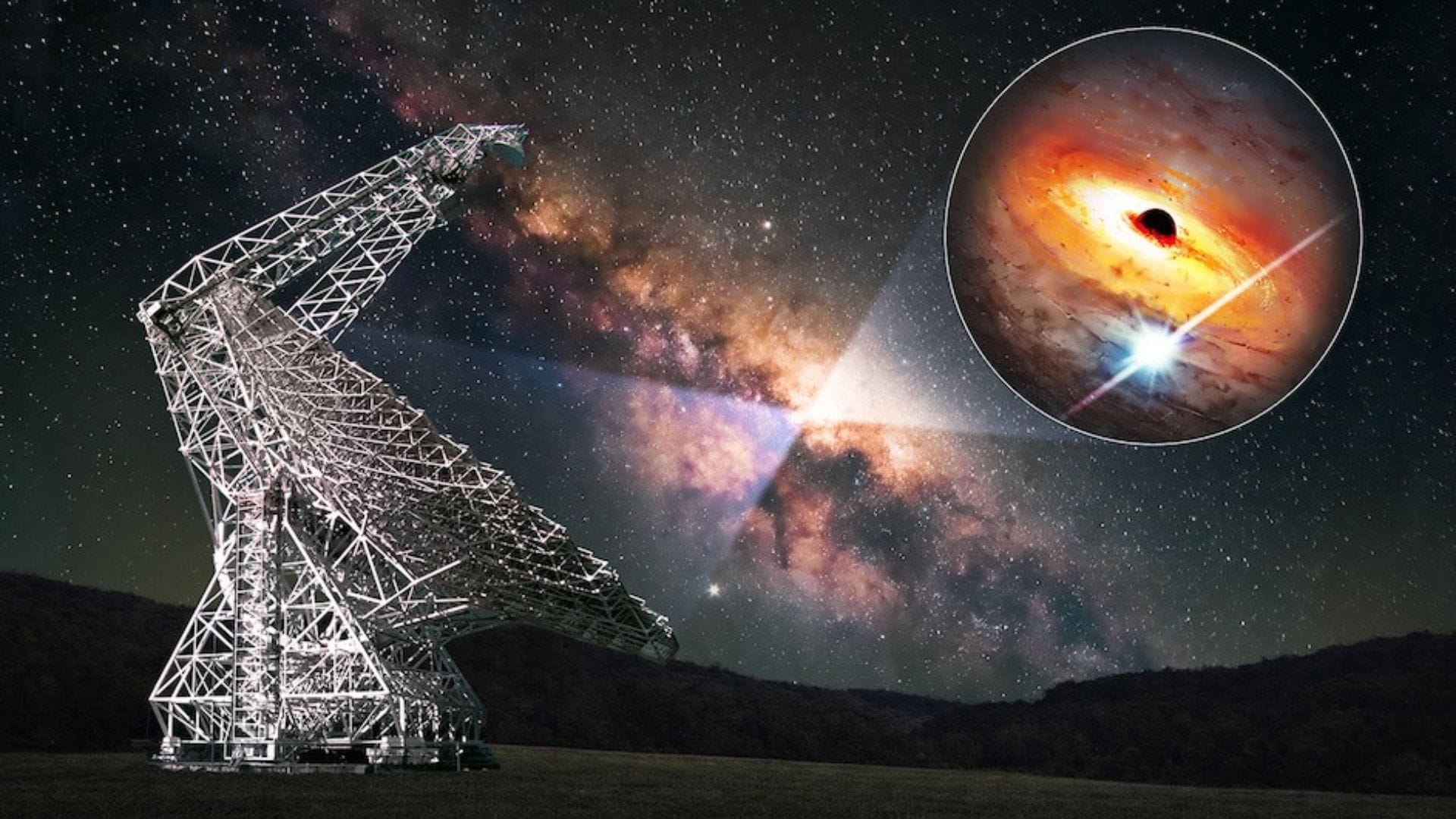
New Delhi: Researchers from Columbia University and a scientific collaboration aimed at finding evidence of civilisations beyond Earth, Breakthrough Listen, have published new results from one of the most sensitive radio searchers ever conducted for pulsars, called the Breakthrough Listen Galactic Centre Survey. The survey focused on the complex central region of the Milky Way, which is busy and occupied by the central supermassive black hole, Sagittarius A*. The researchers identified an intriguing 8.19 millisecond pulsar candidate in the vicinity of the central supermassive black hole. The results of the survey have been published in The Astrophysical Journal.
Detecting, confirming and carefully measuring the arrival of a pulses in this crowded region of the Milky Way will allow for unprecedented tests of General Relativity, including precision measurements of the spacetime around the supermassive black hole. Pulsars are rapidly spinning, highly magnetised neutron stars that emit beams of radio waves that sweep across the Earth, similar to cosmic lighthouses. The timings of pulsars are exquisitely precise, and are sufficiently reliable to use for timing and positioning purposes in space. In the absence of external influences, the pulses from a pulsar arrive at telescopes with extraordinary regularity, so they can be thought of as very accurate clocks with highly predictable behaviour.
The pulsar is a natural probe for extreme physics
Millisecond pulsars in particular exhibit extremely stable clock-like behaviour due to their rapid rotation. In the galaxy centre though, the immense gravitational influence of massive objects can influence a pulsar, which can be precisely measured and modelled. The pulses travelling near the supermassive black hole may be deflected and experience time delays due to the warping of spacetime, which is a prediction of Einstein’s General Theory of Relativity. Breakthrough Listen has released the observations publicly to maximise community impact. Extensive follow-up observations are underway given the implications of the discovery.