The year 2026 is set to be a significant one for skywatchers and those who follow celestial events, with a total of four eclipses—two solar and two lunar—occurring over the next twelve months. For enthusiasts in India, however, the viewing opportunities will be mixed. While the first solar eclipse of the year will pass India by, the following lunar eclipse will offer a spectacular view of a “Blood Moon” right in time for the Holi festival. Understanding the dates, visibility, and the traditional significance of the Sutak period is essential for those wishing to observe these astronomical phenomena.
First Solar Eclipse 2026: The February 17 ‘Ring of Fire’
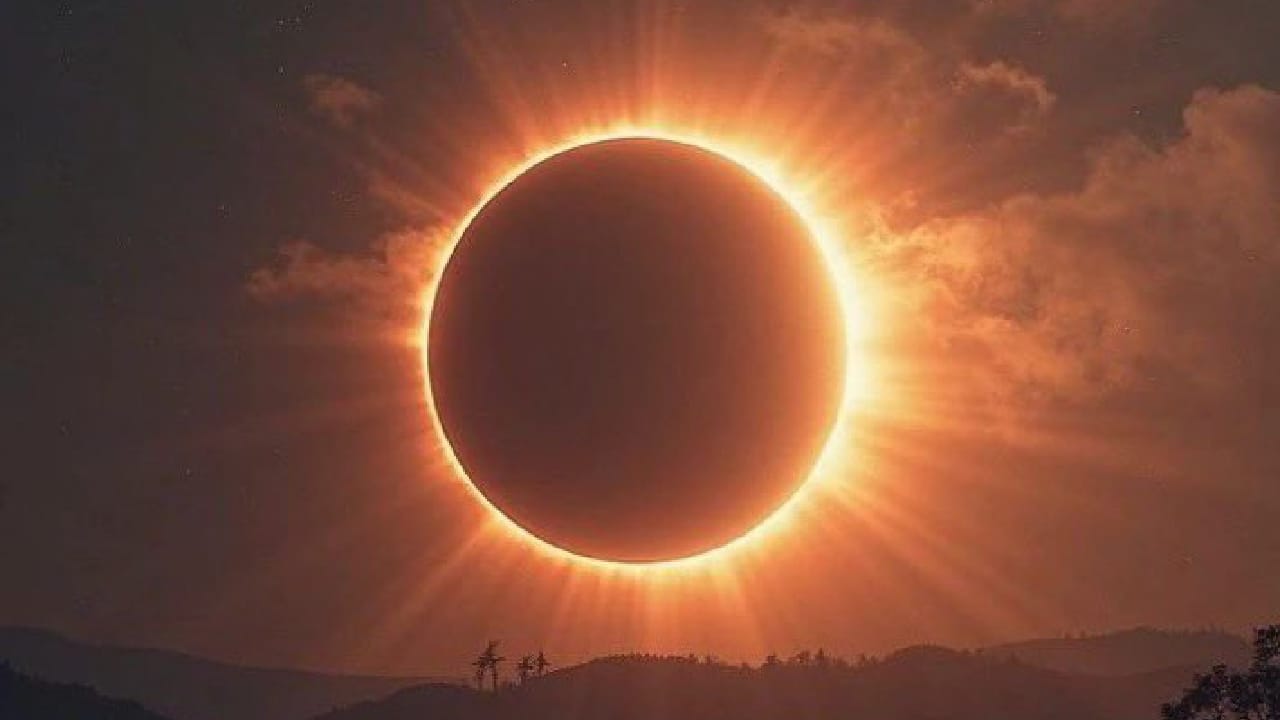
The first Surya Grahan of 2026 will occur on February 17, and it is set to be an annular solar eclipse, a breath taking event commonly known as the “Ring of Fire” . This phenomenon happens when the Moon passes directly between the Earth and the Sun but is at a point in its orbit where it appears slightly smaller than the Sun. As a result, the Moon does not completely cover the solar disk, leaving a brilliant, fiery ring of sunlight visible around its dark silhouette .
Understanding the Sutak Period and Religious Significance
In Hindu tradition and astrology, the period leading up to an eclipse is considered highly significant. Known as the ‘Sutak’ period, it begins nine hours before a solar eclipse or a lunar eclipse that is visible in a given location . This time is regarded as inauspicious, during which it is believed that the Earth’s atmosphere becomes polluted. As a result, extra precautions are advised to avoid harmful side effects. No auspicious activities, religious rituals, or new ventures are started during the Sutak, and the doors of temples are typically closed.
The restrictions are lifted only after the eclipse concludes, often followed by acts of charity or a holy bath, which are considered highly meritorious . A key rule is that the Sutak period is only considered valid if the eclipse is actually visible in that geographical region. Therefore, since the February 17 solar eclipse is not visible in India, its Sutak period will not be observed here .
First Lunar Eclipse 2026: A Total ‘Blood Moon’ Visible in India
Exactly two weeks after the first solar eclipse, the celestial bodies will align again, this time for a total lunar eclipse on March 3, 2026 . This event is particularly special for India, as it will be the only eclipse of the year that is fully visible from the country . A lunar eclipse occurs when the Earth comes between the Sun and the Moon, casting its shadow on the lunar surface. During a total eclipse, the Moon does not disappear from view but instead takes on a deep, coppery-red hue, earning it the popular nickname “Blood Moon” . This coloration is caused by sunlight filtering through Earth’s atmosphere, which scatters blue light while bending and refracting red light onto the Moon.
This particular lunar eclipse falls on the full moon day of the Hindu month of Falgun, which is closely associated with the Holi festival . In India, the eclipse will begin in the afternoon, but the visible spectacle will commence as the Moon rises in the east during the evening. The best time to witness the Blood Moon in India will be between 6:25 PM and 6:45 PM IST . It will be a relatively brief total eclipse, with totality lasting for approximately 58 minutes to one hour . According to astronomy experts, this will be the last total lunar eclipse visible until 2029, making it a must-see event . Because this eclipse is visible in India, the Sutak period will be in effect. It will begin nine hours prior, at 6:20 AM on March 3, and will last until the eclipse concludes, during which time all religious activities should be avoided .
Second Solar Eclipse 2026: Annular Event in July
The third eclipse of the year will be another solar event, taking place on August 12, 2026 . This will be a total solar eclipse, different from February’s annular event, meaning the Moon will completely cover the Sun for viewers within the narrow path of totality. This path will offer a dramatic view across Greenland, Iceland, and Spain, where the eclipsed Sun will appear low on the western horizon, providing unique photographic opportunities .
Final Lunar Eclipse 2026: A Partial Eclipse to Close the Year
The final eclipse of 2026 will be a partial lunar eclipse occurring on August 28, 2026 . Although technically a partial eclipse, it will be quite dramatic, with Earth’s dark umbral shadow covering a staggering 93% of the Moon’s surface. For all practical purposes, this will make the Moon appear almost fully eclipsed, with only a small, bright sliver remaining along one edge . This event will be perfectly positioned for observers across the Americas, as well as parts of Europe and Africa. In North America, for instance, the entire umbral phase will be visible on the evening of August 27 . Unfortunately for skywatchers in India, this eclipse will occur during daytime hours and will not be visible at all. As a result, the Sutak period will not be applicable here.