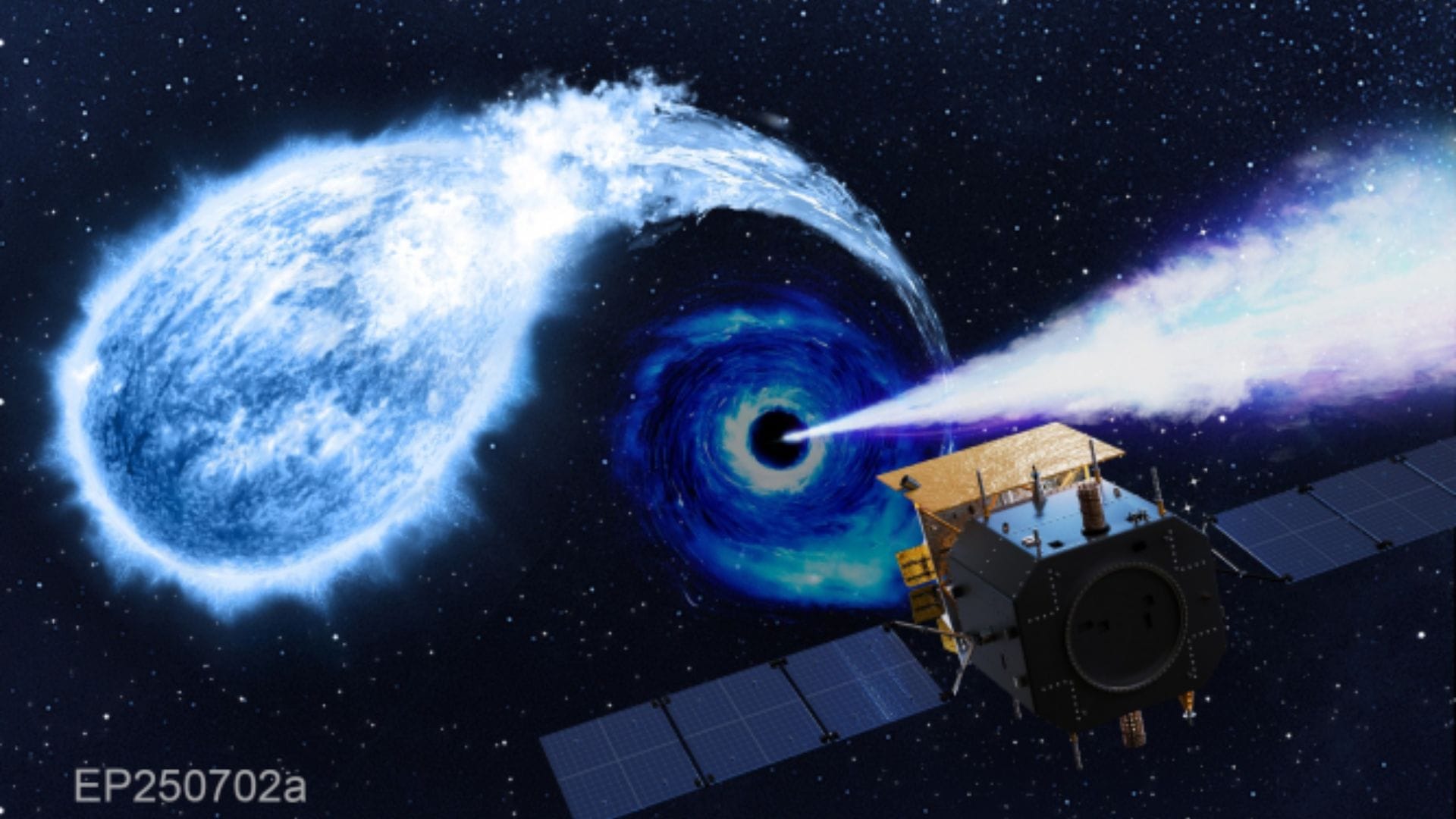
New Delhi: On 2 July, 2025 the Einstein Probe space telescope detected an exceptionally bright X-ray source during a routine sky survey. The source showed rapid variations in luminosity, which distinguished it from typical cosmic objects and prompted immediate worldwide follow-up observations. The Wide-field X-ray telescope on the mission identified the transient object, designated as EP250702a. This was a tidal disruption event. NASA’s Fermi Gamma-ray Space Telescope recorded gamma-ray burst from the region at the same time, designated as GRB 250702B. An analysis of prior data revealed persistent X-ray emissions from the location for about a day before the gamma-ray burst, which is an unusual sequence for high-energy explosions.
About 15 hours after the initial detection, the source produced intense X-rays, peaking in luminosity. It was among the brightest X-ray bursts observed. The original X-ray signal itself indicated that this was not a standard gamma-ray burst. Precise coordinates from the Einstein Probe, as well as ground and space-based astronomical instruments confirmed that the object was located at the outskirts of a distant galaxy. The evolution of the system was monitored, showing a decline in luminosity by over a hundred thousand times over 20 days, with the X-ray emissions shifting from the hard to soft states.
The extreme physics of a tortured dead star
The standard models cannot explain the pre-gamma-ray X-ray emissions, the extreme luminosity, the fast time scales and off-centre location with relation to the galaxy. Among the scenarios evaluated, the best fit is an elusive intermediate-mass black hole tearing up a white dwarf star, the remnant core of a Sun-like star that has died a violent death. If confirmed, this is the first direct evidence of an intermediate-mass black hole disrupting a white dwarf and generating a relativistic jet. The magnetic fields of the accretion disk channel some of the infalling material from the torn up stellar corpse into polar jets. Over 30 scientists from 40 institutions around the world were involved in the research. A paper describing the research has been published in Science Bulletin.