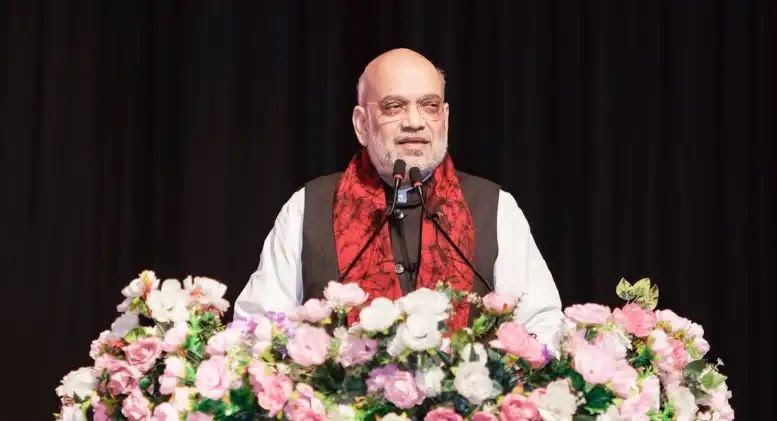
The central government has adopted a strict stance regarding the rapidly increasing cyber crime and online fraud in India. Home and Cooperation Minister Amit Shah clearly said that cyber security is no longer just a matter of loss of money, but it has become an issue directly related to the internal and national security of the country.
He was addressing the CBI’s national conference “Tackling Cyber-Enabled Frauds & Dismantling the Ecosystem” in Delhi, where he stressed the need for technology-based policing and inter-agency coordination.
CBI’s new cyber crime branch: Investigation will get hi-tech base
during the conference Home Minister Amit Shah Formally launched the new Cyber Crime Branch of CBI. The focus of this special branch is complex cyber crimes The investigation will focus on inter-state and international online fraud, tracking of digital money-trail and dismantling of organized cyber networks with documentary evidence and forensic tools. Along with this, he also launched the State Support to States (S4C) dashboard of I4C. A common platform where real-time information, resources and technical assistance related to cyber crime will be available to the states at a single click.
Digital India’s leap: impact of users, broadband and cheap data
Giving details of the achievements of 11 years of Digital India, Amit Shah said that in 2014, there were about 25 crore internet users in the country, today this number has crossed 100 crore. During this period, broadband connections have increased manifold and mobile data prices have decreased by about 97%. Through BharatNet, internet connectivity has reached from Parliament to Gram Panchayat, thereby providing government services. Has become fast and transparent in direct-to-citizen mode.
: Amit Shah’s big meeting on security and infrastructure in Chhattisgarh, said – Now Naxalism is counting its last breaths.
World’s largest digital payment ecosystem based on UPI
India is today a global leader in digital payments. More than 181 billion digital transactions took place in the year 2024, with a total value of approximately ₹233 trillion. The minister said that every second digital transaction in the world is taking place in India. In such a situation, cyber security is no longer just a technical issue but is also an issue related to economic stability and citizens’ trust.
Financial Inclusion: Jan Dhan, DBT and Debit Card Network
There are 57 crore+ Jan Dhan accounts active in the country and 40 crore+ debit cards in circulation. So far, ₹48 lakh crore has been transferred directly to the accounts of beneficiaries through Direct Benefit Transfer (DBT). While digital platforms have increased transparency, they have also opened up new attack vectors for cyber criminals. That is why the government is emphasizing on making the digital transactions of citizens end-to-end secure.
Scary picture: Every 37 seconds a cyber crime, fraud worth thousands of crores
According to the Home Minister, on an average one person is becoming a victim of cyber crime every 37 seconds in the country and so far around ₹ 20,000 crore has been defrauded. However, due to prompt and coordinated action, ₹8,189 crore has been either frozen or returned to the victims. The joint role of I4C, CBI, Bank, State Police and other agencies has been decisive in this.
1930 Cyber Helpline: ‘Speed of response’ is the biggest weapon
Amit Shah gave instructions to make 1930 cyber fraud helpline more effective. He said that adequate number of trained call-handlers should be deployed and most importantly the call response time should be minimum. If the victim’s call is not attended on time, in many cases the amount is withdrawn immediately, and later recovery becomes extremely difficult. Therefore, speed of first response is the main tool to fight cyber crime.
Mule Account Hunter: A direct attack on the ‘money trail’ of fraud
Mule accounts are the biggest link in cyber fraud. From these, the fraudulent money is diverted/hidden through many accounts. To stop this, the Central Government and RBI have jointly developed Mule Account Hunter software. The Home Minister directed all government, private and cooperative banks to implement it immediately and clearly said that until the Mule accounts are eliminated, complete control of cyber crime is not possible.
Strict action on SIM, mobile and IMEI; arrests intensified
In the latest action till December 2025, 12 lakh+ suspicious SIMs were cancelled, 3 lakh mobile IMEIs blocked, 20,853 cyber criminals arrested. This comprehensive action has been possible with the coordination of states and central agencies and there are plans to make it more aggressive in future.
Scale-up of I4C as national ‘cyber security platform’
So far, 795+ institutions (banks, fintech, NBFC, e-commerce etc.) have been connected to the Indian Cyber Crime Coordination Center (I4C). The goal is to have all banks and financial institutions fully integrated with I4C by December 2026. This will enable faster real-time monitoring, data-sharing, rapid interdiction and recovery – all in a single pipeline.
Message of common fight: Government, banks, tech and citizens – everyone’s role
At the end of his address, Amit Shah made it clear that cyber crime will not be stopped by any one agency. For this, central-state governments, banking/financial institutions, tech companies and common citizens will all have to work with a united strategy. The government’s roadmap rests on four pillars. New institutional framework + faster response + data-driven intelligence + strict enforcement. With their help the wall of cyber security will be strengthened.