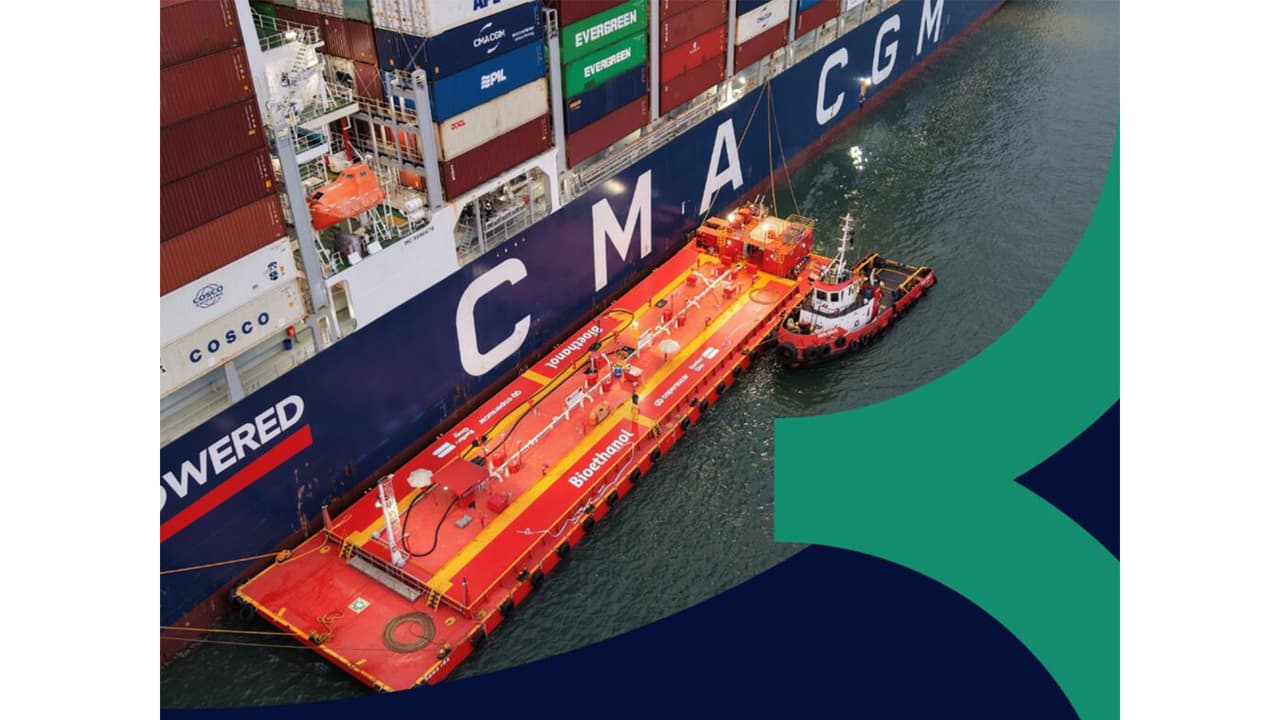
Brazil has completed the first bioethanol bunkering for a container ship at the port of Santos. This is a historic step towards the use of renewable fuels in maritime transport and strengthening the country’s position in low-carbon shipping.
New Delhi [भारत]July 14 (ANI): Brazil has completed its first bioethanol bunkering operation for a container ship. This is a major milestone in the use of renewable fuels for maritime transport and strengthens the country’s position in the global low-carbon shipping transition.
The operation was successfully carried out at the port of Santos, according to a statement from Coppersucre, a major Brazilian sugar trading company. It is the world’s first 13,000 TEU containership equipped with tri-fuel certified engines and can run on bioethanol.
The operation was carried out in partnership with CMA CGM Group, Agio Terminas, Santos Brasil and Bunker One. This is the first time a container ship has been supplied with Brazilian-made bioethanol fuel for maritime operations.
Highlights of the historic operation
Kopersukr said this pioneering operation adds Brazil to the list of countries capable of undertaking bioethanol bunkering. At the same time, it solidifies bioethanol as a readily available solution to help reduce greenhouse gas emissions from the global shipping industry.
“The bioethanol bunkering operation was successfully completed for CMA CGM Iron, the first 13,000 TEU tri-fuel certified engined containership at the Port of Santos,” the company said.
Sustainability and source of bioethanol
The company said the bioethanol supplied to the operation came through its certified supply chain. The company also said sugarcane cultivation in Brazil expands primarily on degraded pasture land, while the country’s RenovaBio program sets strict requirements for sustainability and zero-deforestation. CopperSugar is a giant Brazilian agri-business and energy company that is the world’s largest producer and trader of sugarcane and one of the largest marketers of ethanol.
A viable fuel for the future
According to the statement, the bunkering operation required extensive coordination across the supply chain, including transportation of bioethanol to the port of Santos, storage in dedicated infrastructure and transfer of the fuel to the ship via a specialized barge while adhering to international safety and operational standards.
Kopersuker said the project provides practical proof that bioethanol can play an important role in decarbonizing maritime transport. In addition to reducing greenhouse gas emissions, bioethanol offers immediate commercial-scale availability, established production infrastructure in Brazil, and competitive economics, making it a viable alternative marine fuel.
South America’s new low-carbon hub
In addition to this performance, the port of Santos and Santos Brasil are positioning themselves as the future low-carbon marine fuel hub for South America, the company said. As the continent’s largest port, Santos has the potential to link Brazil’s renewable energy resources to the growing global demand for sustainable shipping fuels.
CMA CGM’s Net Zero Carbon Commitment
CMA CGM said the initiative is part of its commitment to achieve net zero carbon by 2050. The group expects to operate around 200 containerships by 2031 that will be able to use low-carbon energy. CMA CGM IRON, delivered in 2025, is the first ship in a series of twelve 13,000 TEU containerships equipped with the world’s first tri-fuel engine certified to run on bioethanol. (ANI)
(Except for the headline, this story has not been edited by Asianetnews Editorial staff and is published from a syndicated feed.)