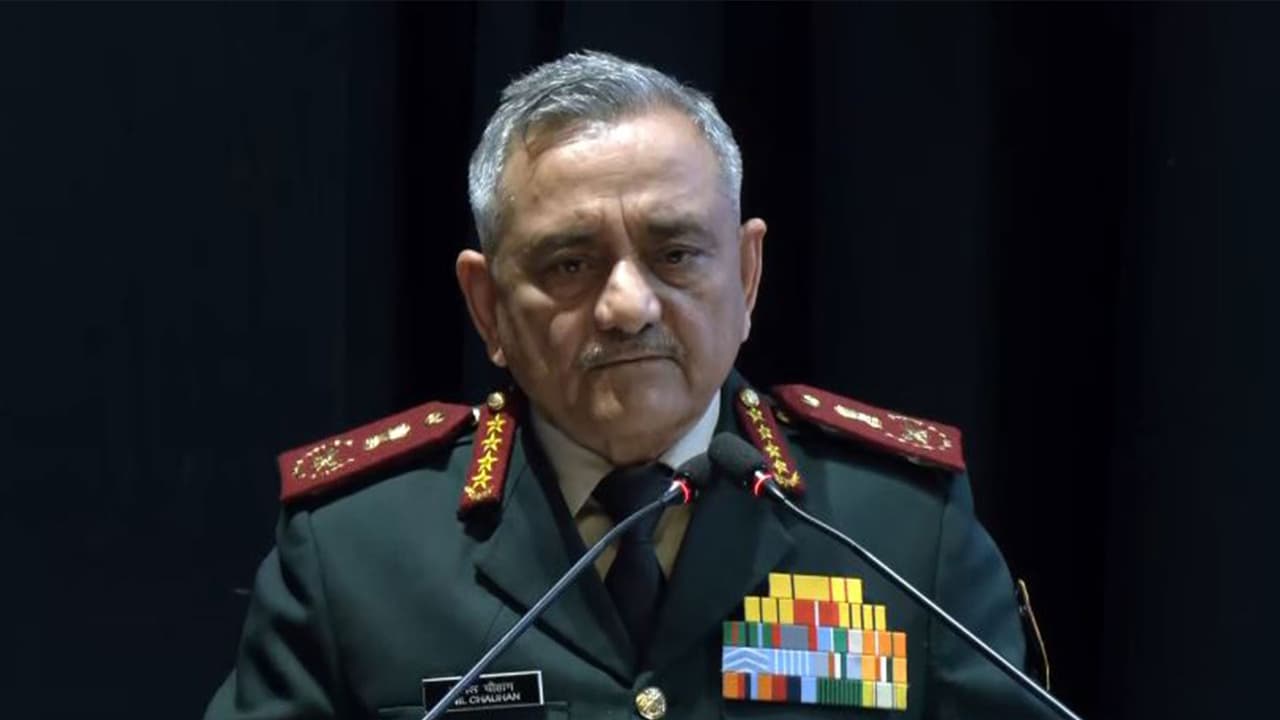
CDS Gen Anil Chauhan said the 1954 Panchsheel Agreement, where India recognised Tibet as part of China, was aimed at stability. He also distinguished between borders and frontiers, calling Uttarakhand a crucial frontline state for India.
Historical Context of Panchsheel Agreement
Chief of Defence Staff General Anil Chauhan on Friday reflected on India-China relations after independence, saying that the Panchsheel Agreement of 1954, which included India’s recognition of Tibet as part of China was aimed at maintaining stability and fostering a cooperative relationship between the two nations.
“On independence, the British left, and it was for India actually to decide where a front is. Nehru probably knew that we had something, as the McMahon Line in the east, and we had some kind of a claim in the Ladakh area, but it was not here. So that’s why he wanted to go in for a Panchsheel agreement, probably,” the CDS said.
General Chauhan said, “And for the Chinese also. When they had kind of liberated Tibet, they had moved into Lhasa. they had moved into Xinjiang. This particular area was extreme at both ends.”
“So this area assumed some kind of priority. So they wanted stability, probably in this particular region… Independent India was keen to build a good relationship with China… In 1954, India recognised Tibet as part of China. Both countries signed the Panchsheel Agreement,” he said.
“With this, India assumed that it had settled its border, the northern border, the only area which we assumed that was not settled, through a formal kind of a treaty,” he said.
Borders vs. Frontiers: A Strategic Distinction
The CDS was delivering the keynote address at the Bharat Himalayan Strategy Forum at Lok Bhavan in Dehradun focusing on the concepts of frontiers, borders, and the historical connectivity of the “Middle Sector.”
Furthermore, General Chauhan explained the distinction between borders and frontiers, noting that while borders are clearly defined political and legal boundaries between nations, frontiers are broader, rugged zones shaped by customs, traditions, and historical interactions among civilisations.
“Borders are identified by a line on a particular map as well as on the ground, whereas a frontier is an area or a zone that is diffused and generic in nature… A border is a concept that separates two nation-states, whereas the frontier is a meeting point of two civilisations. Borders define the political and legal limits of a nation,” the CDS said.
“A frontier may be based on political factors. Borders, being political entities, are well guarded; they are well defended. Whereas frontiers, because of the ruggedness, may not be well guarded. A border is agreed to between two nation-states through formal documentation. A frontier is generally through customs, traditions, and usage,” he said.
Uttarakhand’s Strategic Importance
“Uttarakhand is a frontline state. Sometimes we forget this particular aspect because the border over here is peaceful as compared to what is there in say Ladakh, in say Sikkim, or in Arunachal Pradesh. But then I think most of us forget that the initial dispute between us and China on the border actually germinated over here. That was even before we signed the Panchsheel agreement and immediately after the Panchsheel agreement. So this particular border is as important as other borders,” General Chauhan said. (ANI)
(Except for the headline, this story has not been edited by Asianet Newsable English staff and is published from a syndicated feed.)