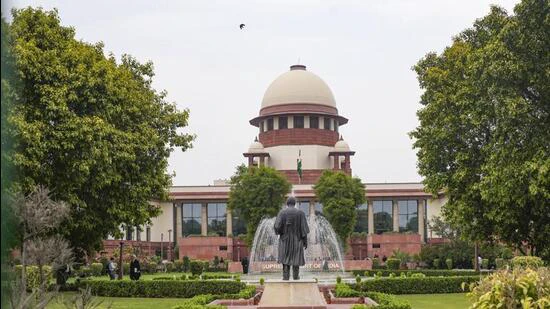
The Supreme Court on Thursday asked lawyers challenging its decision upholding the Centre’s ex-post facto grant of environmental clearance (EC) for development projects to act as “responsible citizens” and consider the consequences for the nation, while posting the matter for hearing on Monday.
Following its November 18, 2025, judgment reviving the Centre’s 2017 and 2021 notifications that grant environmental clearance to projects after they have commenced operations, the court had listed the original petitions challenging these notifications along with applications filed by project developers seeking relief under the November ruling.
A bench headed by Chief Justice of India (CJI) Surya Kant said, “We will take up these matters on Monday,” indicating that it would first decide the applications seeking the benefit of the top court’s judgment that upheld the 2017 and 2021 notifications.
However, NGO Vanashakti, the original petitioner challenging the notifications, argued that the November 18 order was delivered by a three-judge bench by a 2:1 majority on a review petition against a May 16, 2025 judgment of a two-judge bench which had set aside the same notifications. The May ruling had held that ex-post facto EC was contrary to environmental jurisprudence.
Senior advocate Gopal Sankaranarayanan, appearing for Vanashakti, said, “The order by the three-judge bench requires consideration. Perhaps mistakenly, the order gives a finding on merits on the underlying issues leaving nothing to be argued in this petition on merits.”
He contended that the review petition filed by CREDAI, an umbrella body of real estate developers, was limited to examining whether the May 2025 judgment had correctly interpreted the law in light of past precedents. “The order has come on merits that if the judgment is allowed to operate, it will lead to demolition of structures, which cannot be allowed,” he said.
The bench, also comprising Justices Joymalya Bagchi and Vipul M Pancholi, observed, “When the review stands allowed, the earlier order stands effaced.” Solicitor General Tushar Mehta, appearing for certain public projects seeking revival under the 2017 and 2021 notifications, said, “What he is seeking is a review of a review order. This cannot be possible.”
The bench remarked, “You are not only officers of this court but responsible citizens of this country. Let us see the consequences that the nation will suffer.” Addressing concerns raised against the November judgment, it added, “There should not be a view that there is no predictability in judgments passed by us or courts are passing inconsistent orders.”
At the same time, the court cautioned, “Standing before the highest court of the country, we must also minimize the scope of committing any mistake that will have a chilling effect on the environmental law laid down by us.”
Mehta submitted that irrespective of the differing judgments, the applications filed by states and public and private entities seeking revival of projects must be considered. He said the three-judge bench had concluded that the May 2025 ruling did not lay down the correct law and had overlooked earlier precedents upholding the validity of ex-post facto EC.
Appearing for the Tamil Nadu government, senior advocate P Wilson urged the court to consider public interest, stating that an 11,000-bed hospital in the state remained stalled after ex-post facto ECs were put on hold and later quashed by the May judgment, which has now been revived.
The majority view in the November ruling, delivered by then CJI BR Gavai and Justice K Vinod Chandran, restored the March 2017 and July 2021 notifications. It noted that public infrastructure projects, including hospitals, airports and effluent treatment plants, worth ₹20,000 crore would have to be demolished if the review was not allowed. Justice Bhuyan dissented with a separate opinion, supporting the earlier May ruling.
The majority further observed that the 2021 notification was issued after the National Green Tribunal directed the Centre to frame a standard operating procedure for projects that had failed to apply for EC under the 2017 notification. It pointed to the “serious consequences” flowing from the May 2025 judgment, noting that the 2017 and 2021 notifications provided for the imposition of substantial penalties. However, it added that if the May ruling were allowed to stand, “thousands of crores of rupees would go to waste.”