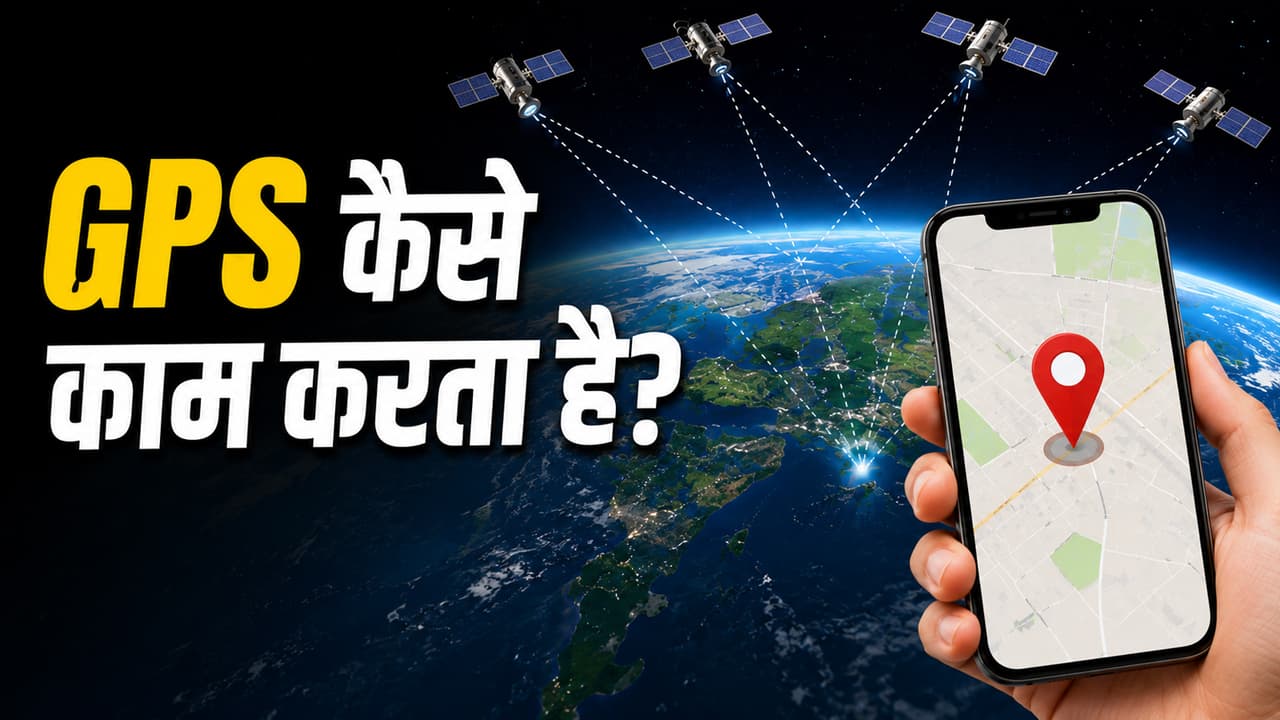
The mobile tells your exact location through signals received from GPS satellites. Know how GPS works, when internet is necessary and what is its accuracy.
How GPS Works: We use GPS to search for directions, book a cab, order food or know the location of a friend. Do you know how the mobile knows where you are at the moment? The answer is- GPS (Global Positioning System). This is a satellite-based technology that can tell the location of any place on earth.
How does GPS work?
1. First sends satellite signal
Many GPS satellites are continuously revolving around the Earth. These satellites keep sending radio signals continuously. Every satellite sends a message in its signal about where it is at the moment and when it sent the signal.
2. Your phone picks up those signals
When GPS is on in your phone, it receives signals from nearby GPS satellites. The phone itself does not send any signal to the satellite, but listens to the signals sent by them.
3. Distance is measured on the basis of time
Radio signals travel at the speed of light. The phone measures how long it took for the signal to reach it from the satellite. Based on this time, the phone estimates its distance from each satellite.
4. Right location is available from at least 4 satellites
If the mobile receives the signal of only one satellite, then the exact location is not known. Usually, with the help of signals from at least 4 satellites, the mobile estimates the exact result, altitude and time. This process is called Trilateration. For example, suppose 4 friends are standing at different places. Everyone tells you how far away you are from them. By collecting these 4 information the exact location can be found. GPS also works on the same formula.
5. Then how does Google Maps show the way?
GPS only tells your location. After this Google Maps or other map apps compare that location with their digital map and show you the best route. Meaning both GPS and map work together for navigation.
Does GPS work without internet?
Yes, internet is not required to get location from GPS satellite. But if you want to see a live map, traffic update or a map of a new place, then internet may be required. Many apps also provide offline navigation if the map is pre-downloaded.
Is GPS 100% accurate?
No. In conditions like tall buildings, dense forest, tunnel, bad weather or weak signal, the accuracy of GPS can be affected by a few meters. Today’s smartphones along with GPS also take the help of Wi-Fi, mobile networks and other satellite systems like GLONASS, Galileo and NavIC, which makes the location even better.
Also read: Why do the stars twinkle at night? Why don’t planets twinkle? Know the surprising reason
Some statistics regarding GPS
– GPS has a network of at least 24 satellites. The American GPS system is designed so that multiple satellites are present everywhere on Earth at any time. At present, more than 30 satellites are continuously working in space for the operation of GPS.
– GPS satellites rotate at an altitude of approximately 20,200 km. From here they keep sending signals towards the earth continuously.
-Signals travel at the speed of light. For the accuracy of GPS, highly accurate Atomic Clocks have been installed in the satellite.
– India has its own navigation system. India has developed NavIC (Navigation with Indian Constellation), which is specially designed to provide better navigation services in India and surrounding areas.
– GPS doesn’t just tell the path. It is used in flights, ships, ambulances, farming, disaster management, any kind of survey, army and scientific research.
Content Sources: NASA, United States Space Force (GPS Program), Indian Space Research Organization (NavIC), European Space Agency, National Coordination Office for Space-Based Positioning, Navigation, and Timing
Also read: Why is there airplane mode? What is the real reason behind turning on airplane mode in flight? Know the whole truth