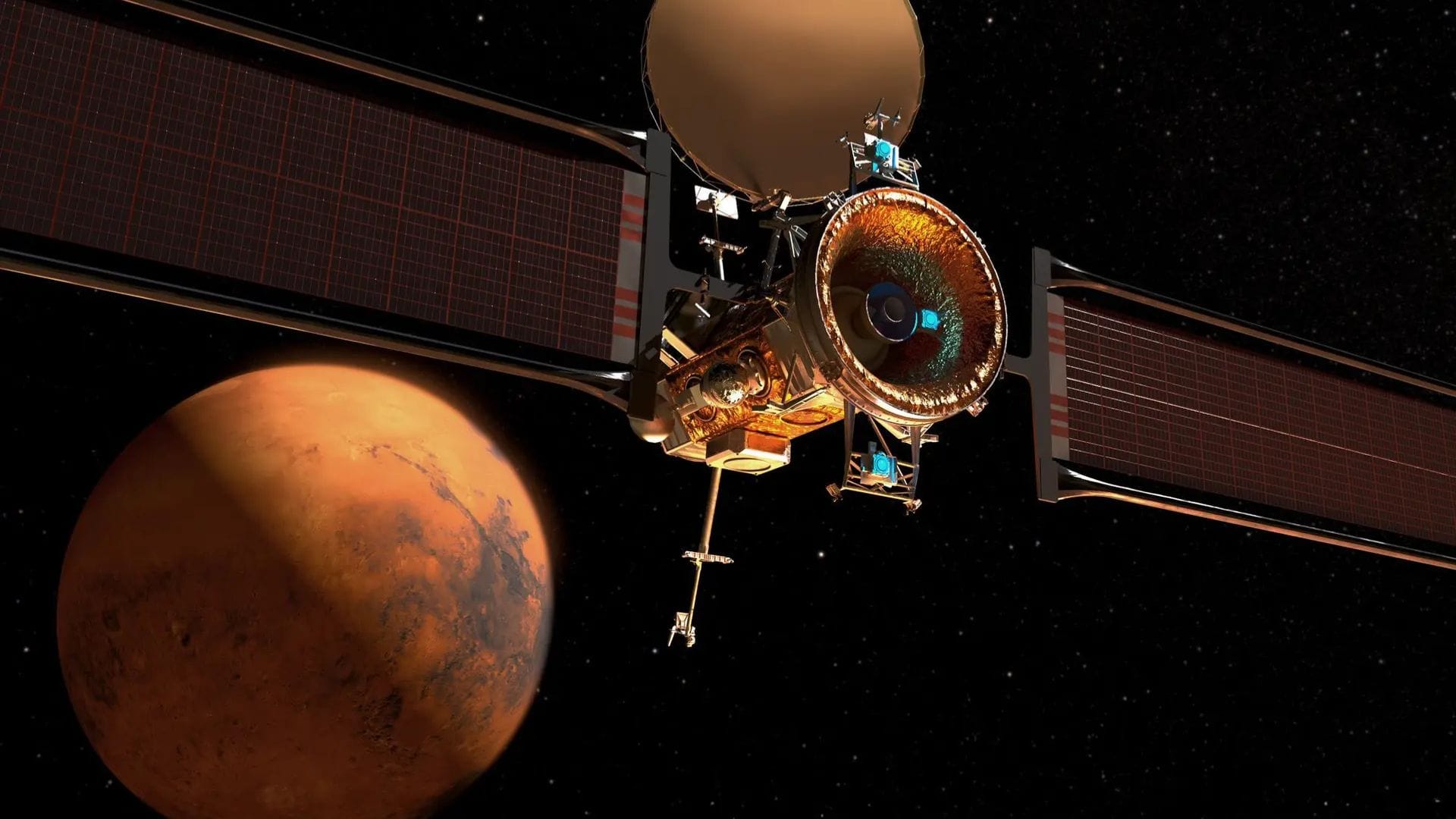
New Delhi: Blue Origin is positioning its Mars Telecommunications Orbiter (MTO), based on the Blue Ring platform as suitable for NASA’s planned Mars Telecommunications Relay mission, planned for 2028. The spacecraft was initially unveiled in August 2025, and aims to provide continuous, high-speed communications between Earth and Mars. It features multiple steerable high-rate links for a robust data relay platform, supplemented by deployable UHF relay satellites for broader coverage. The design includes a solar electric and chemical hybrid propulsion system to expand launch windows to Mars, and allow for precise orbital manoeuvres.
The spacecraft can carry over 1,000 kg of payload to Mars orbit, depending on the specifics of the mission. It incorporates edge processing, data storage and AI capabilities to enhance future Mars infrastructure, supporting both robotic and human exploration needs. Blue Origin has indicated that the MTO is production-ready, with the Blue Ring vehicles manufactured at a dedicated facility in Huntsville, Alabama. A Blue Ring pathfinder mission was successfully launched by a New Glenn rocket in January 2025. The Blue Ring spacecraft can be described as a tugboat in space. The spacecraft is launch vehicle agnostic, and is compatible with New Glenn and other rockets with five-meter fairings.
NASA still to finalise a contract
Blue Origin has positioned its MTO as building on its prior commercial proposals for next-generation Mars relay and sample return architectures. The company argues that multi-use, enduring platforms such as Blue Ring can accelerate exploration by enabling repeated delivery of communications and additional infrastructure. NASA’s Mars Telecommunications Orbiter effort was revived in 2025 via congressional funding under the One Big Beautiful Bill Act. The agency plans a fixed-price procurement from eligible commercial partners, with the delivery targeted by the end of 2028 to align with launch windows for Mars. NASA has not yet awarded the contract, and other companies such as Lockheed Martin and Rocket Lab are also potential bidders.