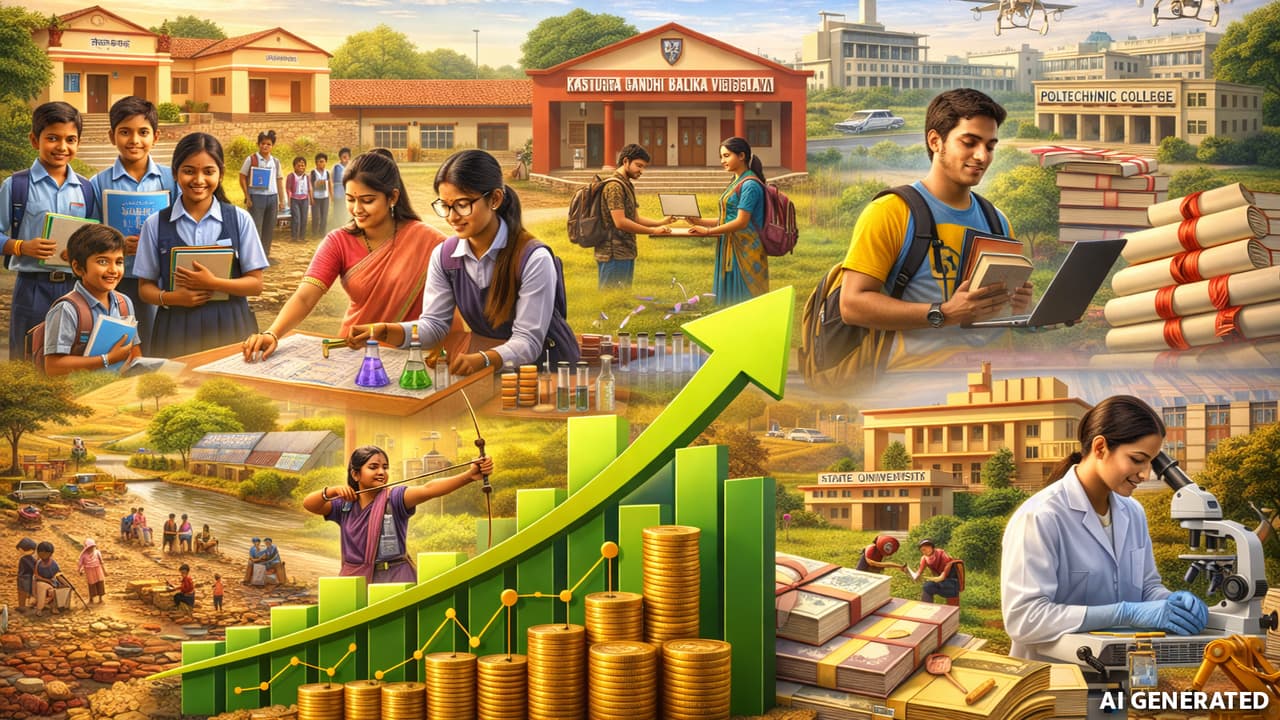
There have been major reforms in the education sector in Uttar Pradesh since 2017-18. The education system of the state has been strengthened by school network expansion, increase in literacy, digital education, girl empowerment and higher education development. The government is linking education with employment and development.
Lucknow. The Uttar Pradesh government has taken several visionary steps since the year 2017-18 to make education universally accessible, quality and employment-oriented. By connecting the youth with skill development, innovation and startup culture, education is being made a strong basis for the progress of the state. It is clear in the Economic Review that significant progress has been made in preventing dropouts in primary education and taking higher education to the global level.
School Education Network Expansion: Impact of National Education Policy 2020
By implementing the National Education Policy-2020, a large network of 2,62,358 schools has been created to increase access to education in Uttar Pradesh. These include 1,35,658 primary, 90,243 upper primary, 11,938 secondary and 24,519 higher secondary schools.
Under the PMShree scheme, 1,722 schools are being developed as “Green Schools”, creating a modern and eco-friendly education environment.
Improving literacy rates: increasing education availability and enrolment.
There has been significant improvement in education infrastructure, enrollment and community participation between 2017-18 to 2023-24.
- Male literacy rate increased from 80.6% to 86%.
- Female literacy rate increased from 62.9% to 70.4%.
This change reflects the expansion of education awareness and access in the state.
Increase in Primary Education Budget: Building a Strong Educational Base
To strengthen the education infrastructure, the government has continuously increased the budget.
- In 2016-17, Rs 32.91 thousand crore was spent on primary education.
- It increased to Rs 68.46 thousand crore in 2024-25 and Rs 82.34 thousand crore in 2025-26.
Under the Samagra Shiksha Abhiyan, Rs 6322.07 crore was spent in 2017-18, which increased to Rs 8263.37 crore in 2024-25. The Learning-by-Doing program has expanded from 2274 schools to 3288 schools in 2025-26.
Digital Education and Student Facilities: Smart Classes, DBT and ICT Lab
Free books and workbooks were given to 1.47 crore children of classes 1 to 8 in 2025-26. Through DBT, Rs 1200 per student is being given for uniform, bag, shoes, socks and stationery.
- Smart classes installed in 25,790 schools.
- 880 Block Resource Centers and ICT Labs in 4688 schools.
- In 2025-26, smart classes are being established in 5810 more schools and ICT labs are being established in 8291 schools.
Girl Child Education Empowerment: KGBV and Self Defense Training
87,700 girls are studying in 746 Kasturba Gandhi Girls Schools of the state. In collaboration with IIT Gandhinagar, programs are being run to increase interest in science among 68,000 girls. Sports promotion is being given under “One KGBV One Sports” scheme. Under the Rani Laxmibai Self Defense Programme, 10.22 lakh girls have received training.
Inclusive Education Initiative: Special Schemes for Students with Disabilities
- Samarth portal has been created for identification and tracking of disabled children aged 6-14 years.
- 2793 Braille books for visually handicapped children.
- 4438 Large print books for low vision children.
Assistive devices have also been provided to students with special needs.
Dropout Rate Reduction and Enrollment Increase: Positive Change in Education
According to the U-Dice Plus report:
- Upper primary gross enrollment rate increased from 75.3% to 83.9%.
- Primary level dropout reduced from 7.2% to almost zero.
- Upper primary dropout reduced from 7.4% to 3.0%.
- The retention rate has increased from 77.8% to 86.9%.
Secondary Education Reform: Digital Monitoring and Career Guidance
There are 29,532 secondary schools running in the state. Parikh, Pragyaan and Paach portals have been developed, while career guidance is being given from “Pankh Portal”. 8373 examination centers were monitored through CCTV and voice recorder. Under Project Alankar, the target is to build 500 science labs and 1084 ICT labs have been established.
Higher education expansion: universities, research and global cooperation
The number of colleges has increased from 6681 to 8030. There are 38 state universities and 52 private universities operating in the state. A budget of Rs 26916.03 lakh has been kept for research and innovation in 2025-26.
International academic cooperation and global ranking
The universities have signed 289 international MOUs, benefitting 97,197 students and 259 teachers. NAAC A++ universities have increased from zero to 6. NAAC accredited institutions increased from 95 to 155. The QS rankings now include 3 universities.
Technical and Vocational Education: Skill Development and Startup Culture
There are 184 government and aided polytechnic institutes in the state, which have a capacity of 55,127 seats. 21 women polytechnics are also operational. “Kalam Abhyudaya Yojana” is promoting startup culture. Modern trades like drone technology have been started in government ITIs, due to which skills are being developed in line with Industry 4.0.