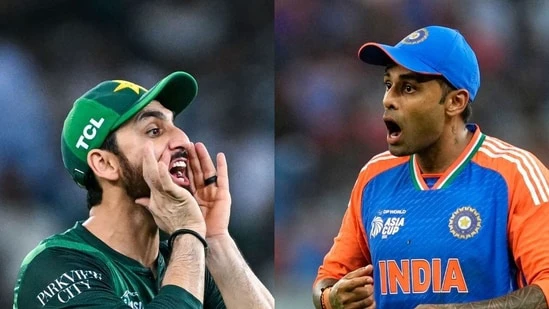
The much-anticipated India vs Pakistan T20 World Cup match, which was boycotted on February 1, is back on the table after the Government of Pakistan gave the green signal to the Salman Ali Agha-led side to take the field in the Group A clash against India.
The development came shortly after the International Cricket Council (ICC) agreed to some of the demands raised by the PCB and BCB during their three-way meeting in Lahore on Sunday.
Imran Khwaja, the deputy chair of the ICC and Singapore’s representative on the governing council, was selected by the board as the mediator on the controversial issue. He is an influential figure in the ICC and has voting rights on the board as an associate member director.Representing the PCB was Mohsin Naqvi, while former player Aminul Islam spoke for Bangladesh. Together, the three managed to find a solution, bringing an end to weeks of deadlock and uncertainty.
On late Monday evening, the ICC shared an official update on the “open, constructive and congenial” meeting with PCB chief Naqvi and his Bangladesh counterpart. The governing body acknowledged that Bangladesh’s absence from the T20 World Cup was unfortunate but would not affect their status.
“While reflecting on the Bangladesh cricket team’s unfortunate absence from the ICC Men’s T20 World Cup, the global governing body for cricket reaffirmed BCB’s position as a valued Full Member, with a proud cricketing history and a vital role in the growth of the global game. The ICC also reiterated its continued facilitation of growth in one of cricket’s most vibrant markets, with more than 200 million passionate fans to ensure that the national team’s non-participation in ICC Men’s T20 World Cup does not have any long-term effects on Cricket in the country,” read the media release.
The ICC also confirmed that there would be no punishment for the BCB and agreed to award Bangladesh hosting rights for a future ICC event. However, the Bangladesh board still has the right to approach ICC’s Dispute Resolution Committee (DRC) regarding the matter if it wants.
“It is agreed that no financial, sporting or administrative penalty will be imposed on Bangladesh Cricket Board in relation to the current matter.”
The ICC stood firm in its stance that Pakistan has no grounds to boycott the game, citing the Members Participation Agreement (MPA) and the pact signed in December 2024, which mandates a hybrid hosting model whenever India or Pakistan hosts an ICC event.
The PCB also came under pressure from the BCB and its counterparts in Sri Lanka and the Emirates, all of whom urged Pakistan to reconsider its decision to withdraw from the match against India. The mounting pressure left Naqvi with little choice but to return to Prime Minister Shehbaz Sharif to request a rollback of the boycott call. The two held an elaborate meeting on Monday.
Originally scheduled for February 15 in Colombo, tickets for the blockbuster game sold out within minutes when the ICC first opened the window for World Cup fixtures. Tasked with hosting the high-profile encounter, Sri Lanka had all arrangements in place, with Colombo buzzing amid a surge in hotel bookings and hospitality planning.
However, just over a fortnight before the start of the tournament, Pakistan threatened to withdraw from the World Cup in solidarity with Bangladesh. The latter were replaced by Scotland after refusing to travel to India for their group-stage matches, citing security concerns. Naqvi had accused the ICC of “double standards” and “unfair” treatment of the BCB.
PCB chairman Naqvi held an extended meeting with Pakistan Prime Minister Shehbaz Sharif on January 26 to discuss the board’s stance. With only days remaining before the team’s departure for Sri Lanka, the Government of Pakistan issued a social media statement last Sunday granting the Salman Ali Agha-led side permission to participate in the tournament, but made it clear that Pakistan would not take the field against India. Sharif reiterated the position during a press conference in Islamabad earlier this week, effectively confirming the boycott call.
The decision did not sit well with the ICC, other member boards, or Sri Lanka Cricket in particular. The Sri Lankan board wrote to Naqvi urging him to reconsider the move, warning of the massive economic fallout the decision could trigger for the co-host nation. The PCB, however, initially refused to budge.
Days before the start of the tournament, the PCB formally wrote to the ICC seeking to invoke the ‘Force Majeure’ clause to forfeit the Group A match against India. The apex body was unconvinced, instead seeking a detailed explanation of how the clause applied in this case and evidence that the PCB had taken all reasonable steps to mitigate the situation.
India and Pakistan both kicked off their T20 World Cup campaigns with a win. The defending champions overcame a shock batting collapse to beat the USA in Mumbai on Saturday evening. Earlier that same day, Pakistan secured a nervy three-wicket victory against the Netherlands.
Pakistan will play their next game against the USA at the SSC Stadium in Colombo on February 10, while India will face Namibia in their second Group A match on February 12 at the Arun Jaitley Stadium in New Delhi.