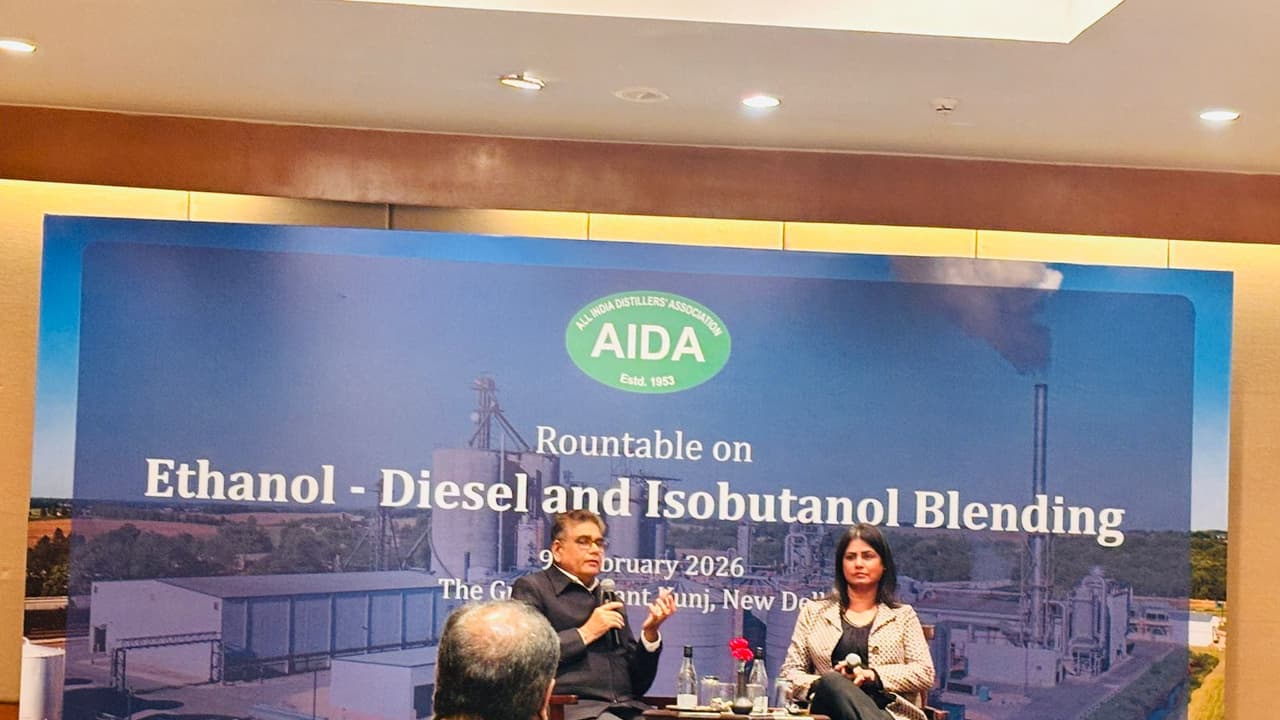
India’s distillery industry (AIDA) is urging the government to cut GST on flex-fuel vehicles. This move aims to boost ethanol consumption as the country faces a surplus after achieving its 20% blending (E20) target ahead of schedule.
AIDA Urges GST Cut on Flex-Fuel Vehicles
India’s distillery industry has urged the government to cut goods and services tax (GST) on flex-fuel vehicles to boost ethanol consumption, as the country faces a surplus of ethanol after achieving its 20% blending target well ahead of schedule, Bharati Balaji, Director of the All India Distillers’ Association (AIDA), said on Monday.
“Flex-fuel vehicles are significantly more expensive to produce compared with conventional internal combustion engine vehicles, and unless GST is rationalised it will be difficult for manufacturers to scale them up,” Bharati Balaji, Director of the All India Distillers Association (AIDA), told ANI on the sidelines of a roundtable on ethanol-diesel and isobutanol blending.
Balaji said AIDA has sought a reduction in GST on flex-fuel vehicles as an interim measure while the government works on a policy roadmap beyond E20 through an inter-ministerial committee (IMC). Under the current structure, GST on smaller two-wheelers and four-wheelers is 18%, while larger flex-fuel vehicles attract GST of up to 40%, she said. AIDA has proposed cutting the higher rate to 12% and lowering the 18% slab to 5%.
Push for Broader Adoption and Infrastructure
India achieved 20% ethanol blending, known as E20, in 2025, five years ahead of the government’s original 2030 deadline, supported by policy incentives that encouraged large investments in grain-based and molasses-based distilleries. As a result, the industry is now grappling with excess ethanol capacity and uncertainty over demand growth beyond E20. Balaji said the association has been engaging with multiple government bodies, including the Ministry of Petroleum and Natural Gas, the Department of Food and Public Distribution and the Prime Minister’s Office, seeking clarity and interim relief measures until a post-E20 policy is finalised. In addition to GST cuts, AIDA is pushing for exemptions on state-level road taxes for flex-fuel vehicles to encourage adoption. Balaji cited Sikkim as an example, where road tax exemptions have been extended to flex-fuel and hybrid vehicles as part of efforts to promote cleaner transport.
“The association is also seeking a rapid expansion of ethanol dispensing infrastructure. India currently has around 100 ethanol dispensing stations,” Balaji said, adding that AIDA wants the country to move towards a Brazil-style model where vehicles can use petrol, ethanol or blended fuels, with pricing reflecting the fuel choice. Such a system would require dual pricing for blended and unblended fuels.
Exploring Pathways Beyond E20 Blending
Balaji said the government has also indicated that the industry should explore additional green pathways beyond ethanol blending, noting that distilleries are increasingly functioning as bio-refineries. Products such as dried distillers grains with solubles (DDGS), ethanol, hydrogen, methanol and sustainable aviation fuel can all be derived from the same ecosystem, she said.
Ethanol-Diesel and Isobutanol
At the roundtable, AIDA discussed two emerging areas: ethanol-diesel blending and isobutanol blending with diesel. The meeting included domestic industry members, international experts with experience advising governments on ethanol blending, and former public transport officials. The discussions focused on technical feasibility, commercial viability and compatibility with existing systems, Balaji said, adding that the feedback was positive and further engagements with government stakeholders were planned.
Maritime Sector Application
Beyond road transport, AIDA is also exploring the use of ethanol in maritime fuels. Balaji said shipping remains heavily dependent on fossil fuels and accounts for a significant share of global fuel consumption, making it another potential avenue for biofuels, though the segment is still at an early stage.
Policy Urgency and Industry Outlook
Balaji said policy clarity has become increasingly urgent amid debates on pollution control and the future of mobility. She cited a Supreme Court order in January 2026 that acknowledged electric vehicles may be the future but said their impact on consumers and the economy still needs evaluation, while asking the Centre for Air Quality Management to examine alternative fuels such as flex-fuels and hydrogen.
“Ethanol is an indigenous fuel that supports farmers, reduces pollution and strengthens energy security,” she said, adding that the industry was seeking policy support to ensure it remains a central part of India’s transition to cleaner transport. Vijendra Singh, President of the All India Distillers Association (AIDA), said industry and policymakers are exploring ways to expand ethanol use beyond petrol blending as India has already achieved 20% ethanol blending (E20).
“We represented about 119 distilleries, and now the focus is on how to increase blending further,” Singh told ANI, adding that experts discussed ethanol-diesel and isobutanol-diesel blending as possible options. Singh said ethanol consumption is “defined at about 1,000 crore litres under E20,” and demand will rise proportionately if blending increases. He noted Brazil’s experience shows flex-fuel technology is proven, but its rollout in India will take time. (ANI)
(Except for the headline, this story has not been edited by Asianet Newsable English staff and is published from a syndicated feed.)