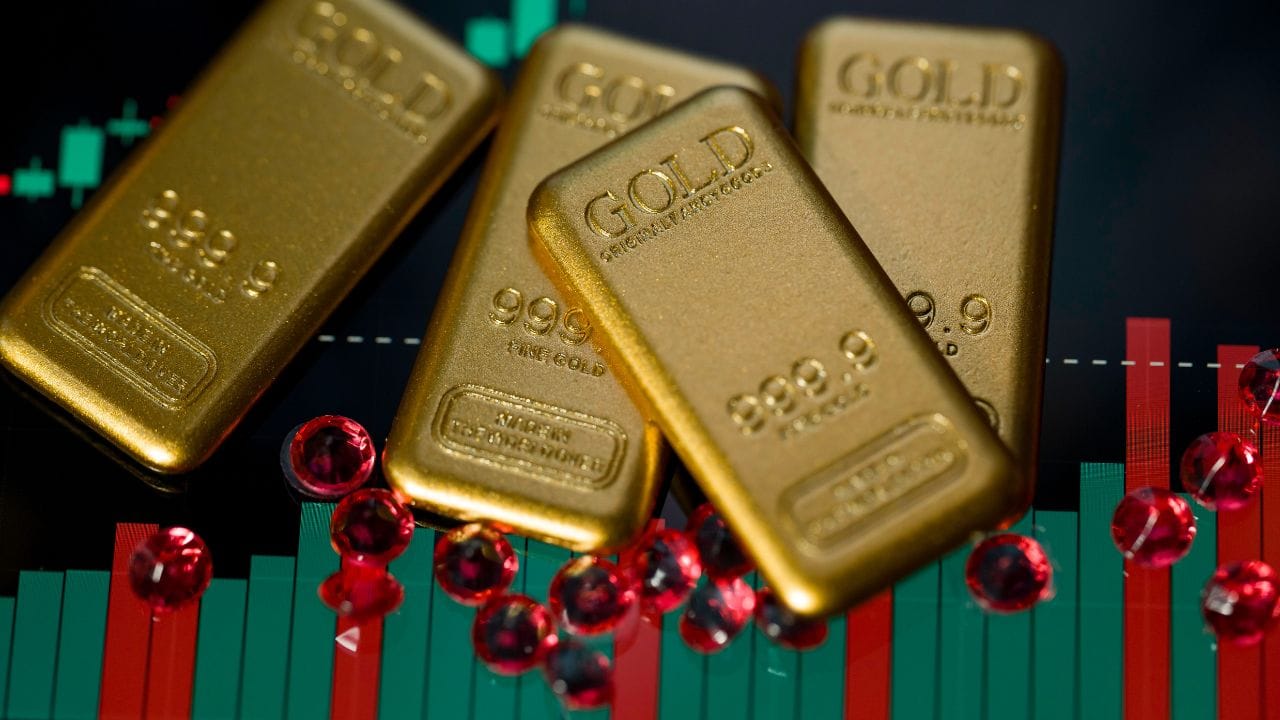
A fall of Rs 20 thousand may be seen in the prices of gold.Image Credit source: getty
After touching record highs in the beginning of 2026, gold prices are now under intense pressure. After touching the all-time high of $ 5,595 per ounce in January 2026, gold has already fallen by about 27 percent in the global markets and has entered the ‘Bear Market’ (recessionary phase). Now market analysts estimate that gold prices may fall further by 16 percent, bringing it down to the level of $3,400 to $3,500. This means that the price of gold in the country may also see a fall of up to Rs 20 thousand. Let us understand in simple language what is the real reason for this fall in gold and whether investors should take advantage of this big fall and buy.
How cheap can gold become?
Harish V, head of commodity research at Geojit Financial Services, said in the BS report that although the overall outlook is positive, there is every possibility of a technical correction as gold prices have almost doubled in the last one-two years. He estimated that before the next phase of the rally, prices may be seen around the level of 3,4003,500. This means that the price of gold in the futures market of India can be seen at the level of Rs 1.22 lakh.
Most of the decline in this precious metal this year has come due to the war in the Middle East. Due to this, a double blow was seen on the investors. One is the rising prices of crude oil, which has increased concerns about inflation and the Fed increasing interest rates. Second, the strong US dollar, which reduces the attractiveness of gold for buyers of other currencies. Since the end of February alone, there has been a 23 percent decline in gold prices in the international market.
If we talk about the current time, at 2:20 pm the price of gold in the international market fell by 1 percent to $4,075, whereas during the trading session the price of gold had also fallen to $4057 per ounce. Whereas after the new clash between America and Iran, there was a jump of more than 4 percent in oil prices.
If we talk about Indian markets, a decline is also being seen in the prices of gold on the Multi Commodity Exchange. If we look at the data, gold is trading at Rs 142445 with a fall of Rs 1033. In which it is estimated that a decline of up to Rs 20 thousand can be seen and can come up to Rs 1.22 lakh.
Apoorva Seth, head of research at Samco Securities, said in a Business Standard report that $4,000 is an important support level for gold, but in a worst-case scenario or in intraday panic situations, the price could fall to $3,500. However, he is positive about the movement of gold in the long run.
What should investors do next?
Samco analysts said in a media report that their target for gold in the long term of three years is around $7,000. Harish V of Geojit also shares the same opinion; Although he expects weakness in the near term, he views the broader outlook as positive as fundamentals remain supportive. Every fall in price can be seen as a buying opportunity.
Analysts believe geopolitical risks supported gold ahead of the US-Iran war and may continue to do so as risks still remain, outweighing the impact of higher yields and a stronger US dollar.
Global brokerage HSBC said in its recent report dated July 9 that in the event of a conflict with Iran, the world will face the same problems due to which gold prices had increased. The report said that although yields may be higher than before the conflict and the dollar may strengthen, other long-standing problems will support bullion. Additionally, HSBC also slightly reduced its long-term outlook for gold. HSBC reduced its estimate for gold to $4,560 an ounce from the earlier $4,864 an ounce.
Effect of buying by central banks
Another factor that can increase prices is purchasing by central banks. Harish V said that many central banks are continuously accumulating gold, which indicates that they also expect that global growth will remain under pressure. In such an environment, gold is seen as a preferred safe-haven asset.
HSBC also said that due to high prices, central banks had reduced purchases last year and in the first half of 2026, but they play an important role in setting the price floor and can support prices in the long run.
Global central banks are expected to increase their gold reserves over the next 12 months, according to a World Gold Council (WGC) survey in June 2026, highlighting the growing strategic role of gold in reserve portfolios. Gold’s performance in times of crisis, its ability to retain value over a long period of time and its ability to diversify portfolios make this precious metal an attractive investment option. WGC data shows that central banks have accumulated an average of 1,000 tonnes of gold over the past four years, much higher than the average of 500 tonnes over the past decade.