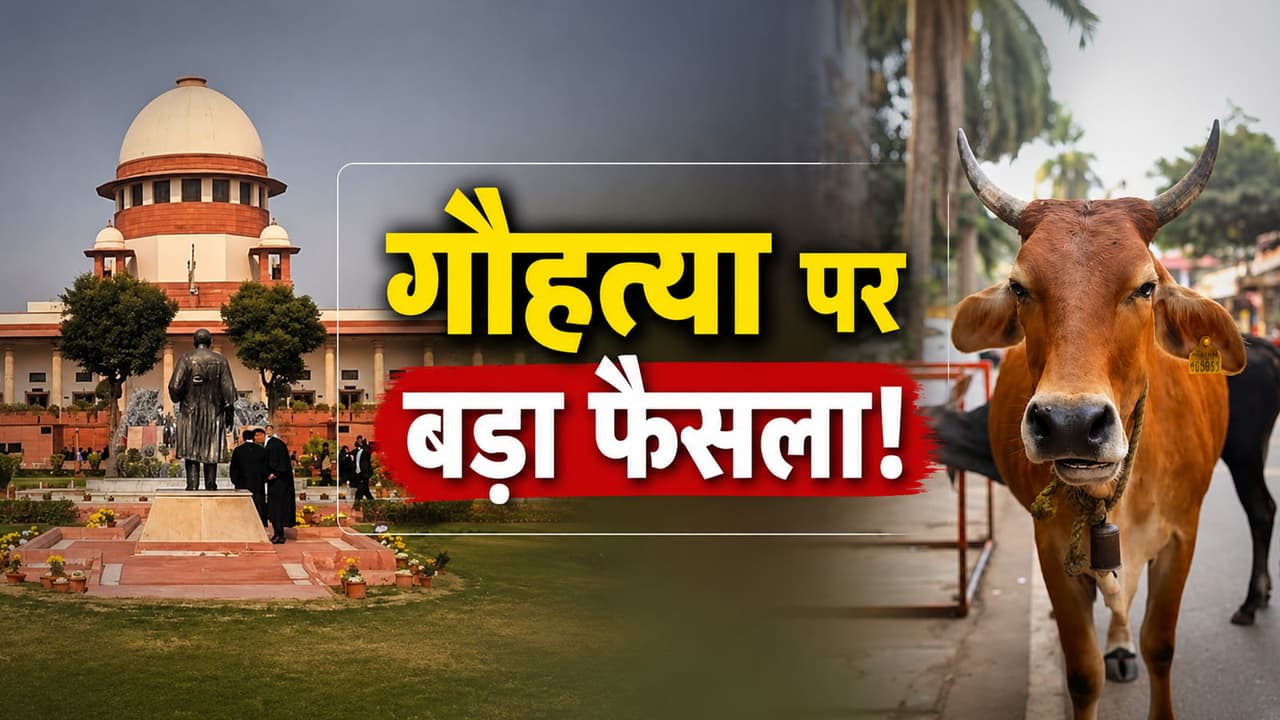
Supreme Court Cow Slaughter Case: Before Bakrid, the Supreme Court stayed the Madras High Court order imposing a complete ban on cow slaughter. Know the whole matter…
Cow Slaughter Case: Before Bakrid, a major legal twist has come to light regarding cow slaughter. The Supreme Court on Monday immediately put a stay on the order of the Madras High Court, in which the Tamil Nadu government was directed to completely stop the slaughter of cows or calves in the state on Bakrid or any other day. The bench of Justice Vikram Nath and Justice Sandeep Mehta gave this decision after hearing the matter and issued a notice to the respondents in this regard.
What did the Supreme Court say?
Seeing the seriousness of the matter, the Supreme Court said in clear words that this order of Madras High Court needs ‘correction’. Without any delay, the court put an interim stay on the implementation of this order of the High Court till further orders. This means that now things will continue as per the old law (1958 Act) until the next decision of the Supreme Court comes.
Where did the controversy start?
This whole matter started with an order of Madras High Court dated 27th May. Surya, the state general secretary of ‘Hindu Makkal Kashi’, had filed a petition, demanding a stop to illegal cow slaughter in public places. Hearing this petition, the bench of High Court Justice GR Swaminathan and Justice V Lakshmanan ordered that slaughter of animals can take place only in government approved slaughterhouses. Also, the court directed the Chief Secretary and senior police officers of the state that no cow or calf should be slaughtered in the state on the occasion of Bakrid or on any day thereafter.
Why did Tamil Nadu government reach Supreme Court?
Last week, the Tamil Nadu government approached the Supreme Court against this decision of the High Court. The state government argued that this order of the High Court is completely contrary to the old law of the state. There is a law of the year 1958 in force in Tamil Nadu, which is called ‘Tamil Nadu Animal Preservation Act, 1958’. Under Section 4 of this law, slaughter of animals has been allowed with certain conditions.
What are the conditions in the 1958 law?
The age of the animal should be more than 10 years. He is no longer fit for farming or breeding. For this, a certificate must be obtained from a government doctor or authority. The Tamil Nadu government told the Supreme Court that the High Court’s order to completely ban cattle slaughter in the entire state has gone beyond the scope of the 1958 law. This decision is contradictory in itself.
Constitutional rules and High Court’s arguments
During the hearing of this case, the Madras High Court had cited Article 48 of the Constitution. The article is part of the Constitution’s ‘Directive Principles of State Policy’ (DPSP), which directs governments to take steps to prevent the slaughter of cows, calves and other milk-yielding cattle. However, the directive principles of law cannot be enforced forcefully through the courts. The High Court believed that strictness on cattle slaughter was necessary to strengthen the rural economy and increase milk production, but the Supreme Court has currently banned it because it was violating the existing written law of the state.