India will not open up its markets for US soyabean, corn, meat and dairy, the biggest American commodities whose imports could hurt the country’s farmers, while deepening exchanges in a raft of agricultural items which the country doesn’t sufficiently grow, Union commerce minister Piyush Goyal said on Saturday.
A joint statement by the US and India on a framework for an interim trade deal said New Delhi will “eliminate or reduce” tariffs on a “wide range” of farm produce.
India will grant access to American distiller’s dried grains with solubles (DDGS) — a nutrient-rich poultry feed derived from ethanol leftovers — soyabean oil, red sorghum for animal feed, tree nuts, fresh and processed fruits, wine and spirits, according to the joint statement. The framework also refers to “additional products” in agriculture, but did not specify them.
A trade agreement, likely to be firmed up soon based on the framework, will safeguard farmers’ interests by “completely protecting sensitive agricultural and dairy products”, Goyal said, briefing reporters.
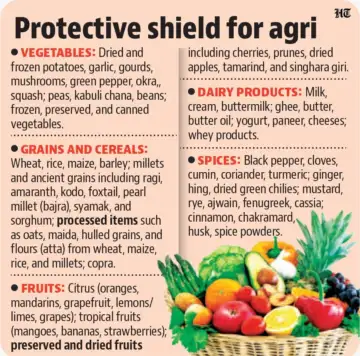 India will import produce that are not adequately grown domestically while there will be zero US tariffs on a slew of agricultural commodities, which will benefit domestic growers, the minister announced. These include Indian spices, tea, coffee, copra, areca, cashew, chestnuts, specified fruits and vegetables, avocadoes, bananas, guava, mango, papaya and pineapples, the minister said.
Overall, lower tariffs of 18%, down from a punitive rate of 50%, will boost exports of marine produce, rice, honey and processed foods. The US is the largest market for Indian seafood and accounts for 36% of total marine product exports. India exported seafood valued at $2.78 billion in 2024-25.
Goyal said there will be “no concessions” on genetically modified or GM produce, meat, soyabean, dairy, maize and cereals, a key concern among Indian producers. Soya and corn, two of the US’s biggest farm exports, are dominated by GM crops.
Experts said the agriculture component of the trade deal still needed clarity on key issues, including GM foods. While soyabean oil will be imported, Goyal said when crops are processed, the effects of GM are no longer present. Moreover, there will be an import quota on soyabean oil, the minister said.
“We needed a very clear statement agriculture, like in the EU-India free trade deal. On these things, what is finally put on paper matters. The joint statement isn’t very categorical,” said Biswajit Dhar, a trade economist and former Indian negotiator at the WTO.
The interim framework said India “agrees to address long-standing non-tariff barriers to trade in US food and agricultural products”.
India’s ban on import of GM produce could potentially be taken to be a “non-tariff barrier” in agriculture, according to Dhar. “Elimination of non-tariff barriers mentioned in the joint statement could be a codeword for GM, even though there are other kinds of barriers,” said Kiran Kumar Vissa of the Rythu Swaraj Vedika, an anti-GM advocacy group, said.
India will open up import quota on extra long staple cotton and India apple growers will be protected with a higher minimum import price, Goyal said.
“In both these items (cotton and apples), even today there are heavy imports. In cotton, we import large quantities of the extra long-staple variety grown in the America because we grow very little of this variety. We have opened quota in cotton. In apples, whatever is imported today, America has been given a lower quota than that, and at a concessional tariff.”