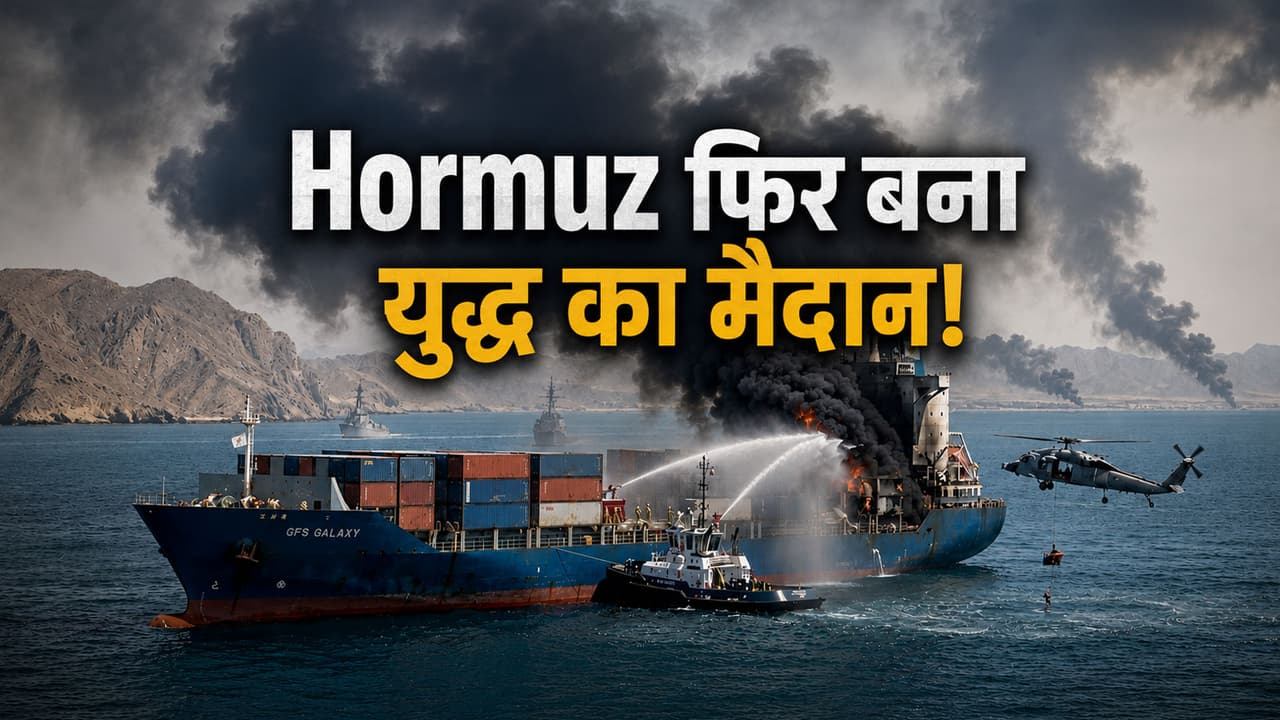
US-Iran Conflict: America attacked Iran’s missile system near Hormuz. In response, Iran claimed to target American bases in several Gulf countries.
US-Iran War: The ongoing conflict between America and Iran has once again increased. On Sunday, the US military carried out airstrikes on several Iranian military bases around the Strait of Hormuz. Shortly after this, Iran also claimed to target several bases and military facilities associated with America in the Gulf region. Continuous attacks and counter-attacks have again increased tensions in the Middle East.
Which Iranian targets did America target?
American media outlet Axios quoted a senior American official as saying that action was taken at several targets with the aim of weakening Iran’s military capability around the Strait of Hormuz. According to the US Defense Ministry, Iran’s missile systems, air defense sites, speed boats of the Islamic Revolutionary Guard Corps (IRGC) were targeted in these attacks. US Central Command (CENTCOM) says that the purpose of this operation is to ensure the safe movement of commercial ships and reduce any kind of military threat in Hormuz.
Iran’s southern port city also attacked
10 to 11 rockets have been confirmed to have fallen on Iran’s southern port city of Bandar Abbas and nearby Qeshm Island. According to Qeshm Governor Hussein Amir Taimuri, all targets were military targets and no civilian casualties were reported. However, according to Iran’s state news agency IRNA, one maintenance worker has died and two others have been injured in Hormozgan province.
Action started after Donald Trump’s order
According to CENTCOM, this military operation was launched on the instructions of US President Donald Trump. The US says that due to Iranian activities the security of the Strait of Hormuz, one of the world’s most important maritime trade routes, was being endangered. The US military claimed that it was taking action to ensure the safe movement of ships on international sea routes.
Iran counterattacks, targets Gulf countries
Iran claimed retaliation shortly after the US action. According to the Iranian Revolutionary Guard (IRGC), it targeted several US-linked military bases and facilities, including command and control centers in Jordan, HIMARS missile systems and military facilities in Kuwait, aircraft carrier support facilities in Oman, aircraft maintenance centers and drone operations in Qatar. However, these claims could not be confirmed.
Which Gulf countries were harmed by the Iranian attack?
Kuwait
According to Iran’s Fars News Agency, American HIMARS missile launchers and ammunition depots in Kuwait were targeted. Kuwait’s Defense Ministry confirmed that three of its border centers and an offshore oil drilling platform were damaged.
Queue
Three people, including a child, were injured when missile debris fell on a jet maintenance center and command facility here. Qatar has held Iran fully legally responsible for this attack.
Jordan, Oman UAE and Bahrain
US radar sites and drone hangars were targeted in Jordan, while aircraft carrier support and refueling platforms in Oman were hit by drone strikes. The United Arab Emirates (UAE) and Bahrain have claimed that their air defense systems have shot down several Iranian missiles and air threats outside their borders.
Why did Hormuz become the center of war?
The Strait of Hormuz is one of the world’s busiest and most important maritime trade routes. A large part of global crude oil passes through this narrow path. Iran had formed the ‘Persian Gulf Strait Authority’ earlier this year. After the American attacks, this authority has announced that due to the ‘illegal activities’ of the American military, no ship will now be allowed to pass through this waterway. This decision will not be reconsidered until there is stability in the region. On the other hand, America has completely rejected this claim of Iran. CENTCOM issued a statement saying, ‘Iran has no control over this strait. The movement of ships continues and the US military is ready to protect freedom of navigation under international rules.
Trump said, ‘Ceasefire is over’
This military confrontation has derailed the ongoing 60-day interim peace agreement between the two countries. President Donald Trump has made it clear that he now considers the ceasefire effectively over, although he has said that he will keep the door open to talks in the future. The attack came just a day after the meeting in which Iranian Foreign Minister Abbas Araqchi spoke with the Omani Foreign Minister in Muscat on the issue of Hormuz. But Iran’s official stance is still tough. Iran’s chief negotiator Mohammad Bakar Qalibaf wrote on social media platform X, warning, ‘The era of unilateral agreements is now over. We told you to stick to your word or pay the price. The reality is now in front of you.