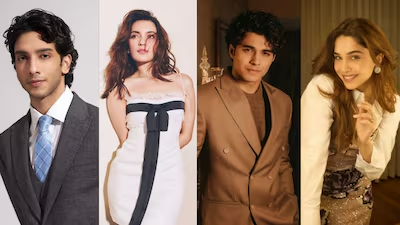
This shift has created space for a strikingly diverse generation of performers: trained outsiders, theatre actors, digital discoveries, television breakthroughs, and carefully groomed industry heirs, all competing within the same ecosystem. Some arrive with surnames that open doors. Others arrive with performances that force them open. Together, they offer a revealing snapshot of what Hindi cinema increasingly values in 2026: authenticity, adaptability and emotional intelligence.
Few launches have been watched as closely as Ahaan Panday’s. For years, Panday existed on the periphery of Bollywood curiosity — known more as Ananya Panday’s cousin and a social media presence than as a working actor. That changed with , Mohit Suri’s 2025 romantic drama produced by Yash Raj Films, which officially launched him out of the stratosphere along with Aneet Padda.
The film’s commercial success— ₹570.33 crore (worldwide gross)— immediately repositioned him from “star kid in waiting” to a legitimate commercial prospect. What worked in Panday’s favour was not just the YRF sheen alone but emotional transparency. Suri’s cinema traditionally demands performers who can project longing without irony, and Panday leaned into that vulnerability headfirst rather than skirting around it. His challenge now will be range: it will be fascinating to see whether he can move beyond the wounded-romantic mould that made audiences swoon in a way they hadn’t in a long time.
Aneet Padda emerged from Saiyaara as an equally important discovery. Before the film, she had appeared in smaller roles, including a part in Salaam Venky (2022), before gaining attention in the 2024 Prime Video series Big Girls Don’t Cry. But it was Saiyaara that transformed her visibility. Padda’s performance carried a quality Hindi cinema often undervalues in young actors: stillness. She resisted the performative hyperactivity that frequently accompanies debut performances and instead built her character through restraint and emotional clarity. That instinct could serve her well in an industry increasingly interested in actors who can move fluidly between theatrical films and streaming dramas.
If Panday and Padda represent Bollywood’s newest romantic leads, Vishal Jethwa stands for something rarer: a young actor with the intensity of a seasoned character performer. Jethwa first gained broad recognition with Mardaani 2 (2019), where his chilling turn as a violent antagonist revealed an actor unafraid of discomfort. Since then, he has steadily built a reputation for emotionally volatile performances that resist easy categorisation. Unlike many young actors being shaped into polished urban leads, Jethwa thrives in unpredictability. Hindi cinema has historically rewarded actors capable of unsettling audiences while retaining empathy; Jethwa belongs firmly in that lineage.
Vedang Raina, meanwhile, has quietly become one of the more intriguing crossover prospects of his generation. He debuted in Zoya Akhtar’s (2023) before appearing in Jigra (2024) opposite Alia Bhatt. It would have been easy for Raina to remain boxed into the aesthetic world of carefully curated nostalgia after The Archies. Instead, Jigra revealed a more grounded performer beneath the polished surface. Raina’s appeal lies in his rare balance of accessibility and poise. He looks contemporary without appearing inaccessible — a quality Bollywood has always been eager to cultivate in young male actors. Having already worked with Zoya Akhtar and Vasan Bala, he will next be seen alongside Sharvari Wagh in Imtiaz Ali’s partition-romance Main Vaapas Aaunga which is slated for a June 12 release.
But it is Sharvari’s rise that has arguably been the most commercially assured among the actors on this list. After debuting with in 2021, she broke through with the 2024 horror-comedy hit . Her carefully curated filmography reflects a broader industry recalibration. Hindi cinema is once again searching for young female stars who can command mainstream attention while also fitting comfortably within the tonal demands of post-streaming storytelling. Sharvari’s screen presence and agility make her especially valuable in that environment. Along with Main Vaapas Aaunga, she will also star with Alia Bhatt in YRF’s first female-led spy actioner, Alpha.
Agastya Nanda’s trajectory remains more complicated — and therefore more interesting. As Amitabh Bachchan’s grandson, he played the titular role in
The Archies carrying enormous scrutiny. The performance itself divided viewers, but what has become increasingly visible since then is Nanda’s apparent awareness that legacy alone no longer sustains careers.
Contemporary Hindi audiences are often harsher on industry heirs than on outsiders precisely because expectations are higher. After a career-defining turn as the precocious Param Vir Chakra awardee in Sriram Raghavan’s gentle war-drama earlier this year, it’s evident that he has all the trappings of a star in the making.
Abhay Verma has taken a more organic route to recognition. After supporting turns across several streaming projects such The Family Man Season 2 (2021) and (2024), it was the lead role in Munjya that brought him widespread recognition. Made on an estimated production budget of ₹30 crore, the Maddock horror-comedy earned a whopping ₹126.04 crore (worldwide gross).
Verma’s strength lies in familiarity. He resembles the contemporary Hindi-film everyman rather than an untouchable star figure, and modern audiences increasingly respond to that relatability. At 27 years old, he possesses an instinctive, natural conversational quality that makes scenes feel lived-in rather than performed. In several ways, he reflects the industry’s larger shift away from exaggerated heroism toward emotional immediacy.
One of the most impressive breakthroughs of the past two years came from Pratibha Ranta in Kiran Rao’s social drama (2024). In a sea of great performances, Ranta stood out simply because it didn’t mean to. She captured the confusion, her character’s resilience and self-discovery with extraordinary subtlety, grounding the film’s gender commentary in emotional realism. At a time when “content-driven cinema” often rewards understatement for its own sake, Ranta demonstrated the difference between minimalism and precision, a distinction that changes everything.
A similar sensitivity defines Preeti Panigrahi, whose acclaimed work in Shuchi Talati’s (2024) marked her as one of the strongest young performers to emerge from India’s independent cinema ecosystem in recent years. Panigrahi belongs to a generation shaped as much by global arthouse storytelling as by mainstream Bollywood grammar. In the film, which also stars a terrific Kani Kusruti, her performance feels deeply observational, almost documentary-like in its emotional detail. If Hindi cinema continues investing in intimate, character-driven storytelling, Panigrahi could become central to that movement.
Then there is Zahan Kapoor, whose emergence has been refreshingly unconventional for a member of the Kapoor-Sippi clan. Rather than pursuing an aggressively commercial launch, Kapoor built credibility through theatre before gaining wider recognition through projects such as Hansal Mehta’s social thriller Faraaz (2022) and Netflix’s crime-drama series (2025). His cinema-rich upbringing and lineage shows in his performances. He approaches scenes with the patience and discipline of a stage actor rather than the anxious self-consciousness common among young screen performers today.
Sparsh Shrivastava, another standout from Laapataa Ladies, represents perhaps the clearest example of how dramatically Bollywood’s talent pipeline has changed. Having worked extensively in television and on streaming in shows such as Balika Vadhu and Jamtara before transitioning into films, Srivastava arrived without the mythology of a conventional launch. What he brought instead was technique. His performance in Laapataa Ladies balanced sensitivity, insecurity and tenderness without ever tipping into caricature. Actors with television backgrounds were once dismissed by mainstream Hindi cinema. Today, they are increasingly becoming some of its most reliable performers.
What unites these actors is not a single style of performance or a shared idea of stardom. It is the fact that they arrive at a moment when Hindi cinema itself is uncertain about what a star should look like. That uncertainty may ultimately benefit them. The industry no longer reveres perfection as it once did. It has begun to reward specificity instead— and this up-and-coming generation, in sharply different ways, has plenty of it.