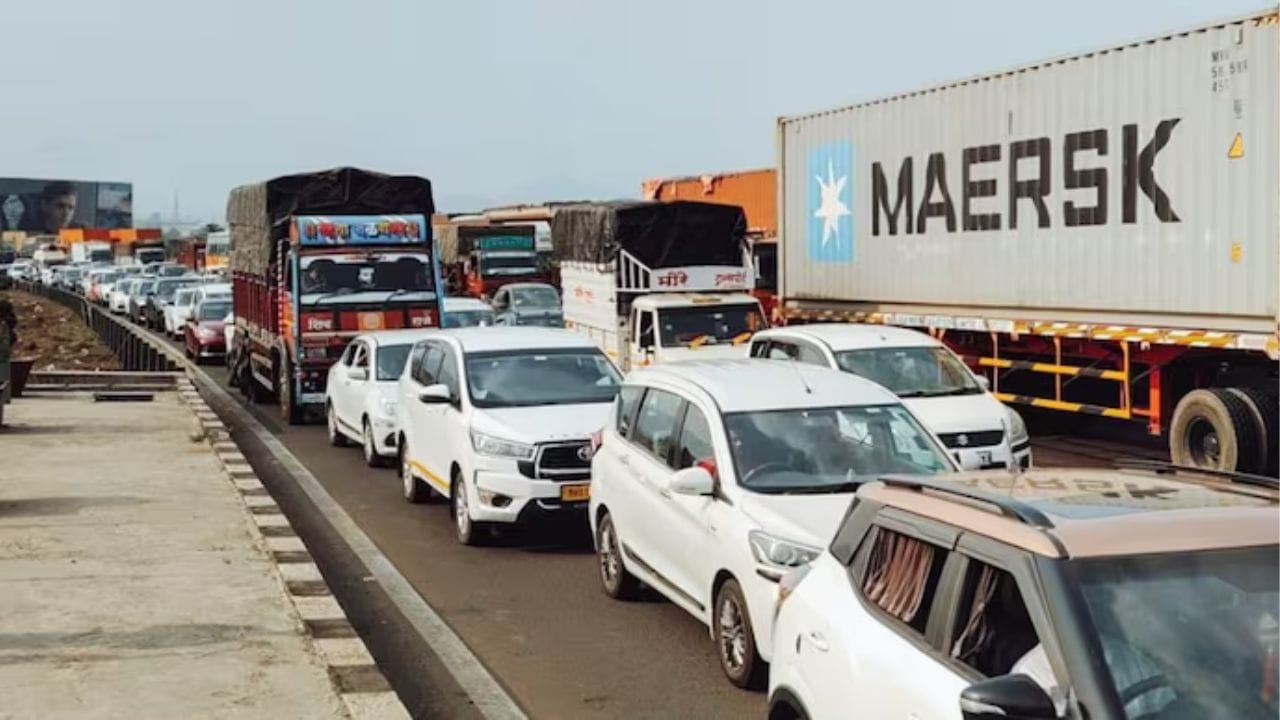
People who drive regularly between Mumbai and Pune know that the famed Expressway has two faces. When it works, the journey is smooth. When it doesn’t, it can be miserable. You can spend hours staring at the back of a truck, barely moving.
Mumbai-Pune Expressway: A road that works — until it suddenly doesn’t
A road can turn on you. One moment it feels safe and predictable; the next, everything changes. That is what drivers mean when they say a road can “turn”. It stops being your friend.
And that is more or less what happened this week.
A tanker carrying propylene gas overturned near the Adoshi tunnel in the Khandala ghat. Once officials realised the tanker was leaking, they acted cautiously. Traffic was slowed, then halted, and eventually diverted. No one wants to take chances with a highly flammable gas spill on a hillside.
Mumbai-bound vehicles were restricted to a single lane. Others were diverted to the old highway. Recovery teams worked carefully. By night, social media was full of stranded travellers sharing locations, ETAs and frustration. Some said they spent eight to 13 hours on what is normally a two-to-three-hour trip.
The Expressway reopened after 32 hours. Seasoned commuters were not surprised. Many have lived through versions of this before.
The ‘beautiful’ bottleneck: Lonavala–Khandala ghat is scenic but sensitive
The Lonavala–Khandala ghat stretch is easily the most delicate part of the route. The road threads through the Western Ghats with steep climbs, sharp bends and multiple tunnels. On a clear weekday, it can feel scenic. On a busy weekend, it feels very different.
Mist, rain, tourist traffic and heavy trucks can quickly complicate matters. During the monsoon, visibility can drop quickly. On weekends and holidays, tourist traffic swells. Heavy trucks add to the load. It does not take a major accident to cause delays. One broken-down vehicle at the wrong spot can create queues stretching for kilometres.
Add all these factors together, and the sum you get is the buffer for mistakes that keeps getting thinner. A stalled vehicle can slow traffic. A serious crash can freeze it. And the deeper issue is that there is no true high-capacity alternative close by. When the Expressway clogs, the traffic spills onto the old Mumbai-Pune Highway, which unsuccessfully tries to absorb the overflow — and it clogs too. The Old Highway, afterall, was never designed or built to handle the volume of vehicles of 2026.
Marvel in 2000; Nightmare in 2026
When it opened in the early 2000s, the Expressway was a milestone. It cut travel time sharply and reshaped movement between the two cities. It also boosted tourism and development along the corridor.
But it was designed for the traffic of its time. Two decades later, the volume and mix of vehicles have changed dramatically. There are more private cars, more freight carriers and more tankers transporting fuel or chemicals. The ghat stretch, with its winding alignment, has remained the bottleneck.
Planners eventually reached a practical conclusion: instead of endlessly tweaking this section, it would be better to bypass it.
The ‘Missing Link’
The Missing Link project is meant to get around this problem, quite literally. It is a 13.3-km new alignment between Khopoli and Kusgaon that replaces a longer ghat drive. Instead of winding through Lonavala and Khandala, vehicles will pass through tunnels and over a high bridge across Tiger Valley.
Work on the Missing Link began in 2019. Since then, there has been a global pandemic, engineering challenges, the complexity of construction and the question of who heads the government in Maharashtra. As civic it might sound, the issue has more political overtones to it than Expressway’s hairpin bends!
Needless to say, the progress is snail-paced. The current expectation is an opening around May 2026.
Will it solve everything?
No. But it should help.
The new route will be about six kilometres shorter, saving roughly 30 minutes. More importantly, it will move through-traffic away from the sharpest curves. The tunnels will include fire systems, cameras and electronic alerts to manage emergencies.
The Missing Link will not make the journey flawless. Nor will it end accidents or congestion entirely. But for commuters used to sudden standstills, even a more reliable run would be a welcome change. The Missing Link holds the promise of making the gridlock the exception rather than the routine — and restoring some faith in a road that millions rely on every year.
The bigger takeaway
No highway can promise zero jams. Neither can the Mumbai-Pune Expressway. However, highways are built with an inherent promise to reduce how often one incident paralyses the entire corridor.
Right now, too much depends on one tricky mountain stretch. Until an alternative is ready, a single crash can still derail thousands of journeys. For regular commuters, the hope is simple: fewer surprises, fewer standstills, and a road that behaves like the Expressway it was meant to be.