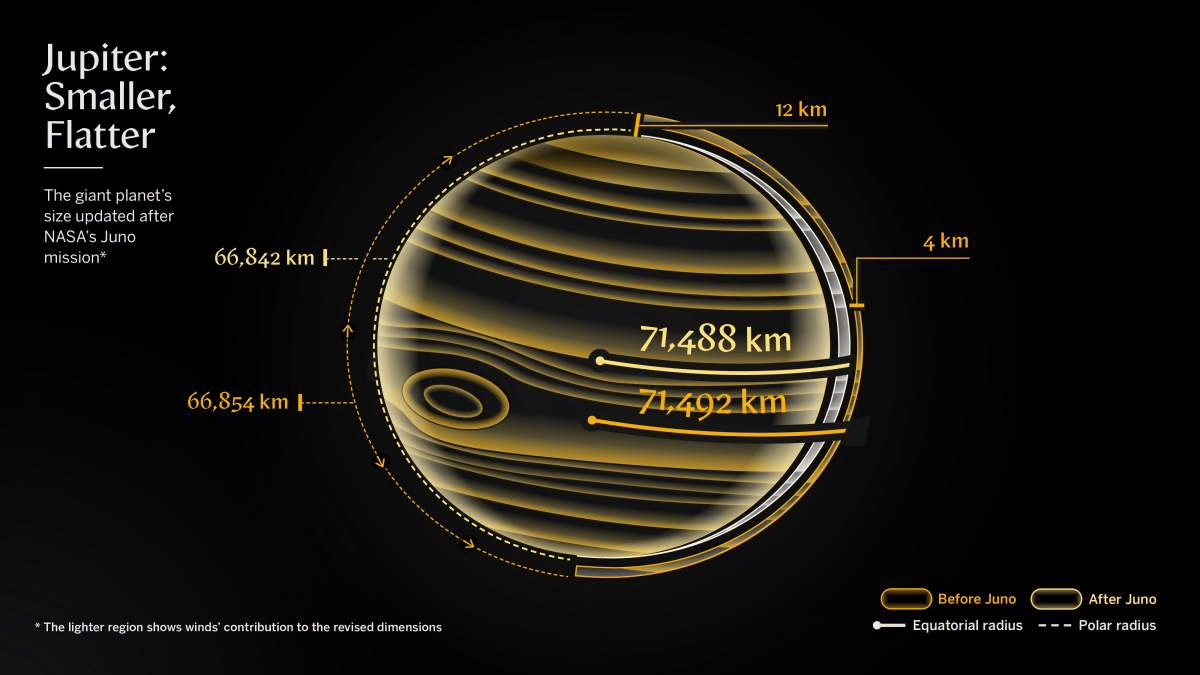
New Delhi: New measurements by NASA’s Juno spacecraft indicate that Jupiter is slightly smaller and more flattened than previously thought. Scientists used high-precision radio data from the mission to update the size and shape of the gas giant at the one bar pressure level, which is the standard reference for the ‘surface’ of the planet. The new value gives Jupiter a polar radius of 66,842 km and an equatorial radius of 71,488 km with a mean radius of 69,886 km. These figures are smaller than earlier estimates by 12 km at the poles, four km at the equator, and eight km for the mean radius. The uncertainty is now about 0.4 km, which is much better than the previous uncertainty of four or more km.
The older estimates came from just six radio measurements by the Voyager and Pioneer missions nearly 50 years ago. Those did not account for the effects of the strong winds on Jupiter. Juno provided many more accurate measurements over recent years, allowing scientists to properly factor in the winds. These winds blow in zones around the planet and affect the shape of Jupiter by changing the outward push from the rotation, especially near the equator. Including them explains most of the differences from the old values. The winds show little change with altitude above the clouds, staying mostly steady.
A better fit for models
The precise measurement of the size helps improve models of the interior of Jupiter It allows for a cooler atmosphere with more heavy elements, which better matches data captured by the Galileo probe, and measurements of temperatures by Voyager. Earlier models struggled to reconcile gravity measurements, probe results and wind effects. The updated shape also provides a better reference for mapping atmospheric features and pressure levels, and serves as a more accurate standard for studying other gas giants, including exoplanets. The findings come from an international team working with Juno’s radio occultation data and has been published in Nature Astronomy.