Two things can be true in T20s: boundaries feel like the headline act… and yet tournaments are often won in the quiet minutes between them.
So we pulled a simple, telling split from the last three men’s T20 World Cups: how much of the champion’s scoring came from fours and sixes versus everything else.
What the last three champions tell us
Let us start with the cleanest possible scoreboard.
T20 World Cup 2021: Australia
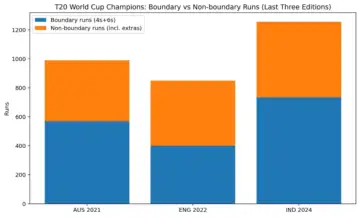
- Total runs scored: 990
- Boundary runs: 570 (57.6%)
- Non-boundary runs: 420 (42.4%)
- Knockouts (semi+final): boundary share 60.6%
Australia were boundary-led overall – but still banked 420 runs that didn’t come in 4s or 6s. That is basically two full competitive T20 total built out of strike rotation.
 T20 World Cup 2022: England
- Total runs scored: 849
- Boundary runs: 400 (47.1%)
- Non-boundary runs: 449 (52.9%)
- Knockouts (semi+final): boundary share 58.4%
England are the perfect counterpunch to the only boundaries that win you a T20 World Cup claim. They won a World Cup while scoring more runs in non-boundaries than boundaries across the tournament – and then flipped the switch in the knockouts when the moment demanded finishing power.
T20 World Cup 2024: India
- Total runs scored: 1256
- Boundary runs: 734 (58.4%)
- Non-boundary runs: 420 (41.6%)
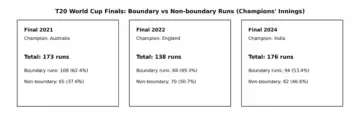
- Final: boundary share (53.4%)
India’s title run looks boundary heavy on the surface – and yes, the six-hitting volume mattered. But even in the final, more than 80 runs came from the non-highlight part of the innings. Under pressure, you don’t win with only fireworks. You win a functioning engine.
So… are single and double more important?
Not on their own. But here is what the numbers tell us:
1) Boundaries are the accelerator – not the steering wheel
Across 2021 and 2024, the boundary share of the champions is basically identical (58%). That tells you boundary-hitting is still the main scoring currency when conditions allow it.
But 2022 is the warning label. England won with a non-boundary majority. If your entire identity is “we only win when we clear the ropes”, you are betting your World Cup on the playing conditions.
 2) The champion skill is gear-shifting
The strongest pattern in this dataset isn’t “boundaries good” or “running good”. It is this:
- Survive the tournament with strike rotation
- Win the tournament with impact
England 2022 is the loudest case. Their group stage boundary share sat around 41% – then it jumped to 58% in knockouts. Translation: they qualified without needing constant rope-a-dope hitting, then produced the boundary surge when it mattered most.
Australia 2021 and India 2024 were more consistently boundary-loaded – but even they carried huge non-boundary tallies. That is the base layer that keeps innings alive when boundaries don’t come in clusters.
3) Non-boundary runs are where pressure gets managed
Here is why single and double matter more in World Cups:
- Knockouts reduce risk appetite. Teams protect their wickets here.
- Bowling improves. Match-ups are planned, fields are smarter.
- One bad over becomes fatal. So you cannot afford three dead overs before the late surge
That is when striker rotation stops being a nice-to-have and becomes a survival tool. Non-boundary runs aren’t just 1s and 2s – they are momentum protection. They stop the required rate from turning into panic.
A practical conclusion for World Cup 2026
For ICC Men’s T20 World Cup 2026, the winning template isn’t a philosophical debate. It is a roster question:
- Do you have enough boundary hitters to create 55-60% boundary share when the game opens up?
- Do you have enough connectors to avoid the England 2022 group-stage trap for teams that can’t clear the ropes every over?
If you are building a team to win the title, you don’t pick between the two. You build a side that can win in two different systems: rope-a-dope nights and grind-it-out nights.