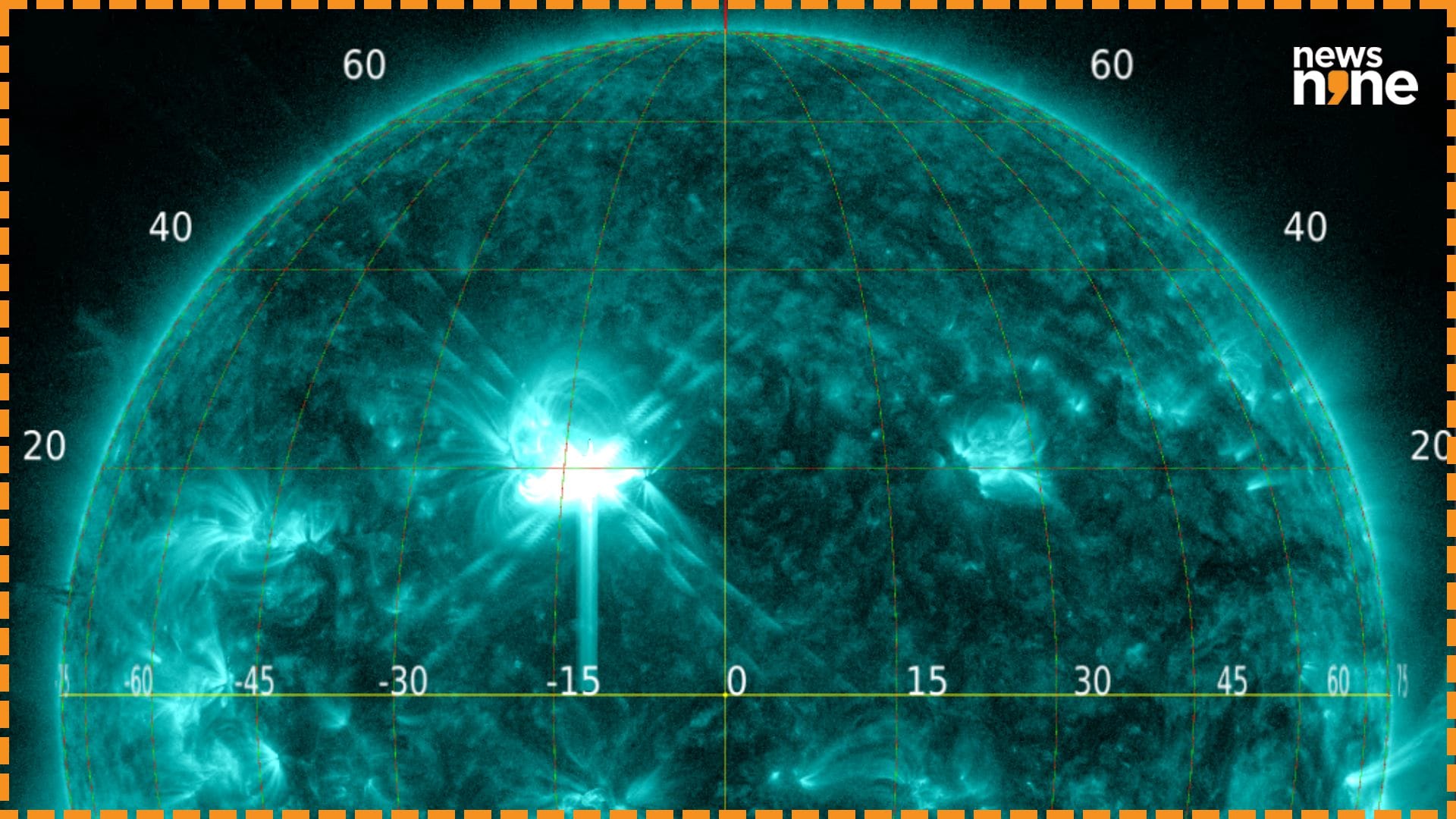
New Delhi: A cluster of sunspots designated as Active Region (AR) 4366 by the Space Weather Prediction Centre (SWPC) operated by the US National Oceanic and Atmospheric Administration (NOAA), and Sunspot Group 784 by the Solar Influences Data Analysis Centre (SIDC) operated by the Royal Observatory of Belgium has erupted in six X-class flares in three days. On 1 February, an X1.0 flare and an X8.1 flare erupted at 12:33 UTC and 25:57 UTC. The second of these was the third strongest solar flare of the ongoing solar cycle, solar cycle 25, and was associated with a CME that is forecasted to induce a minor geomagnetic storm between 5 and 6 February.
Region 4366 fired off three X-class flares on 02 February. The first two, an X1.5 and an X2.8 followed the X8.1 flare in rapid sucession, erupting at 00:22 UTC and 00:36 UTC. Subsequently, an X1.6 flare erupted at 08:14 UTC on 2 February. Four M-class flares erupted from Region 4366 on 3 February, and an X1.5 flare at 14:08 UTC. The active region is about ten times the size of the Earth, but has reduced slightly in complexity as well as size. The flare potential continues to be high, because of close clustering of sunspots with opposite polarities, a configuration termed as ‘delta’. The X1.5 flare caused a brief loss of radio communications on the sunlit side of the Earth, with the impact mostly in South America and Africa.
Space Weather Forecast
According to the latest forecast by the SWPC, “Activity is likely to increase from unsettled to G1 (Minor) storm levels on 05 Feb due to the anticipated arrival of the CME associated with the X8.1 flare from Region 4366. Active to G1 (Minor) conditions are expected to continue through 06 Feb.” According to the forecast of the SIDC, “After compiling the latest observations and simulation results, the arrival time to the Earth of the CME from 2 February has been recalculated to 5 February around 6:00 UT.”
Increased risk of proton storm
Group 4366 is crossing the central meridian of the Sun, which means that it is aimed straight at the Earth. If it erupts in an energetic flare, then it can cause a proton storm. According to SIDC, “SIDC Sunspot Group 784 (NOAA Active Region 4366) will cross the central meridian after that, becoming better magnetically connected with the Earth and increasing the risk of a proton storm.”