The real breakthrough comes when AI application builders share learnings, coordinate approaches, and build upon each other’s work.
By Nidhi Singh
The global AI landscape has become a tale of two trajectories. While the United States and China engage in a high-stakes race for frontier model supremacy, nations across the Global South face a fundamentally different challenge, one that won’t be solved by competing in the same arena, but by forging a collaborative path toward practical AI applications that transform lives.
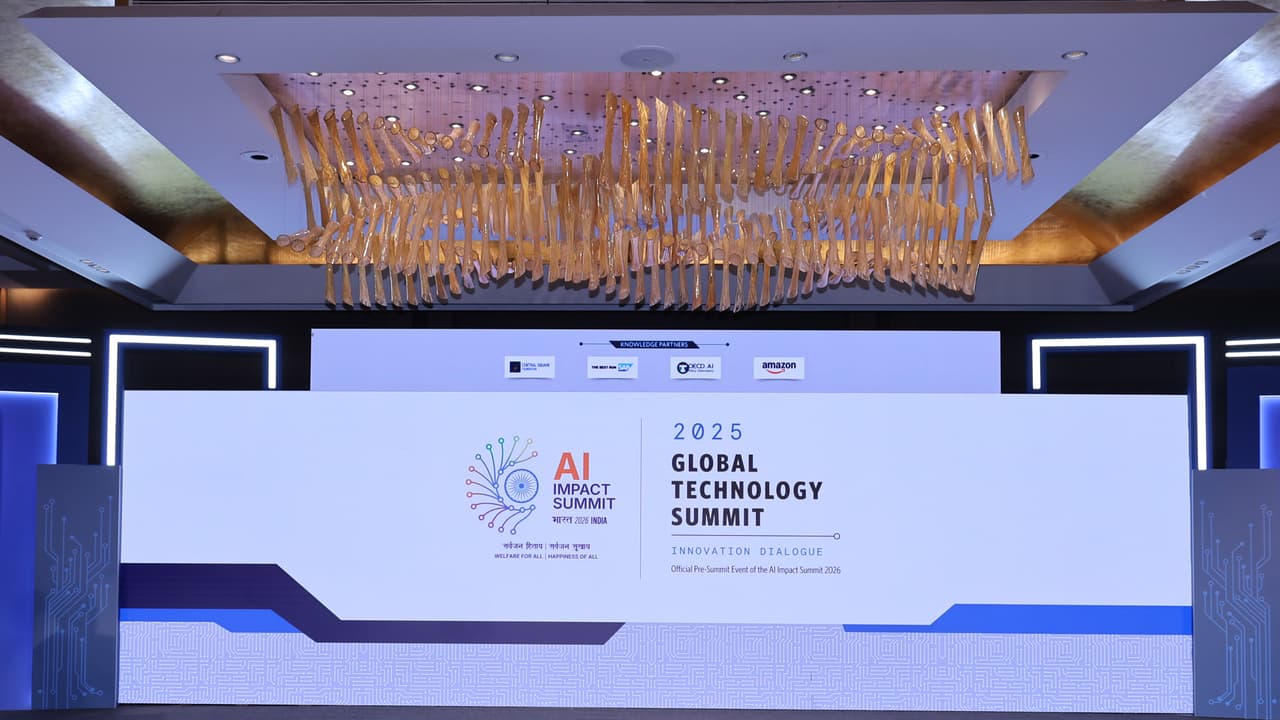
Insights from the GTS Innovation Dialogue hosted by Carnegie India in collaboration with the Ministry of External Affairs in December 2025 revealed a striking finding: collaboration, not compute, is the number one barrier identified by AI builders when it comes to scaling AI solutions. This insight should fundamentally reshape how we think about AI development in emerging economies.
Collaboration Deficit
Today’s AI ecosystem suffers from fragmentation at multiple levels. Application builders work in silos, often duplicating efforts and reinventing solutions that already exist elsewhere. A maternal health AI tool developed in Kenya may address the same challenges as one built in rural India, yet the two teams may never connect. This isn’t just inefficient; it’s a waste of limited resources that Global South innovators cannot afford.
The real breakthrough comes when AI application builders share learnings, coordinate approaches, and build upon each other’s work. When developers in agricultural AI collaborate across borders, they create solutions that are more robust, contextually aware, and scalable across diverse environments. The alternative, isolated development, condemns us to fragmented pilots that rarely achieve population-scale impact.
Creator-Compute Divide
Equally critical is the gap between those building AI applications and those providing computational infrastructure. Hyperscalers and compute providers often operate with a limited understanding of what beneficial AI applications actually require in practice. Meanwhile, application developers often lack visibility into the available infrastructure and the technical know-how to best leverage this to build their specific AI use cases.
This misalignment has real consequences. India’s most impactful AI applications primarily rely on Small Language Models and specialized models, not compute-hungry frontier LLMs. Hybrid architectures combining edge computing with cloud infrastructure match actual deployment needs far better than one-size-fits-all approaches. Yet this knowledge rarely informs infrastructure planning.
What is needed is genuine partnership: compute providers working alongside application builders to understand real-world requirements, optimize architectures, and co-create deployment strategies. No single stakeholder can deliver the horizontal enablers (data infrastructure, multilingual capabilities, safety mechanisms, financing models) needed for sustainable AI deployment. Only coordinated engagement across the entire ecosystem makes this possible.
Strategic Imperative (Middle Powers)
For developing nations, the choice is clear: they cannot and should not attempt to compete in the frontier model race dominated by the United States and China. The capital requirements, technical talent concentration, and computational resources needed for that competition are simply beyond reach for most countries.
But this isn’t a disadvantage; it’s an opportunity to chart a different course. The Global South’s comparative advantage lies in application building: creating AI solutions tailored to local languages, contexts, and challenges that frontier models often overlook. The focus here is on applying technology and AI solutions to solve problems for its massive population, rather than just focusing on building foundational AI models. The path forward requires Global South nations to collaborate intensively with each other.
Imagine a coordinated network where agricultural AI innovations from Sub-Saharan Africa inform deployments in Southeast Asia. Where healthcare solutions developed in Latin America accelerate progress in South Asia. Where education applications tested in one region provide blueprints for another. This isn’t just theoretical; the building blocks exist in initiatives like India’s Bhashini platform for multilingual AI, which demonstrates how digital public infrastructure can democratize access.
From Credits to Contracts
Current AI deployment models, heavily reliant on compute credits from hyperscalers, cannot sustain the scaling of beneficial use cases. The Global South needs alternative financing mechanisms: service contracts that pay for outcomes, public-private partnerships that share risk and reward, and output-based models that align incentives with impact.
These alternatives only work at scale through collaboration: pooled procurement, shared infrastructure, and coordinated policy frameworks that create markets large enough to attract sustainable investment.
The India AI Impact Summit
The AI Impact Summit represents a critical moment to solidify this collaborative approach. The Global South must move beyond competing in a race it cannot win and instead focus on winning the race that matters: deploying AI that genuinely improves lives at scale.
This requires breaking down silos between application builders, forging true partnerships between creators and compute providers, and establishing deep collaboration networks across Global South nations. The technical challenges are real, but the collaboration deficit is what truly stands between pilots and population-scale impact.
The choice is ours: fragment and stagnate or collaborate and scale. For the Global South, collaboration isn’t just good practice; it’s the only viable strategy for ensuring AI serves the billions who need it most.
About the Author
Nidhi Singh is a senior research analyst and program manager at Carnegie India. Her current research interests include data governance, artificial intelligence, and emerging technologies. Her work focuses on the implications of information technology law and policy from a Global Majority and Asian perspective. She has previously contributed to The Indian Express, The Secretariat, Medianama, and the Hindu Business Line.