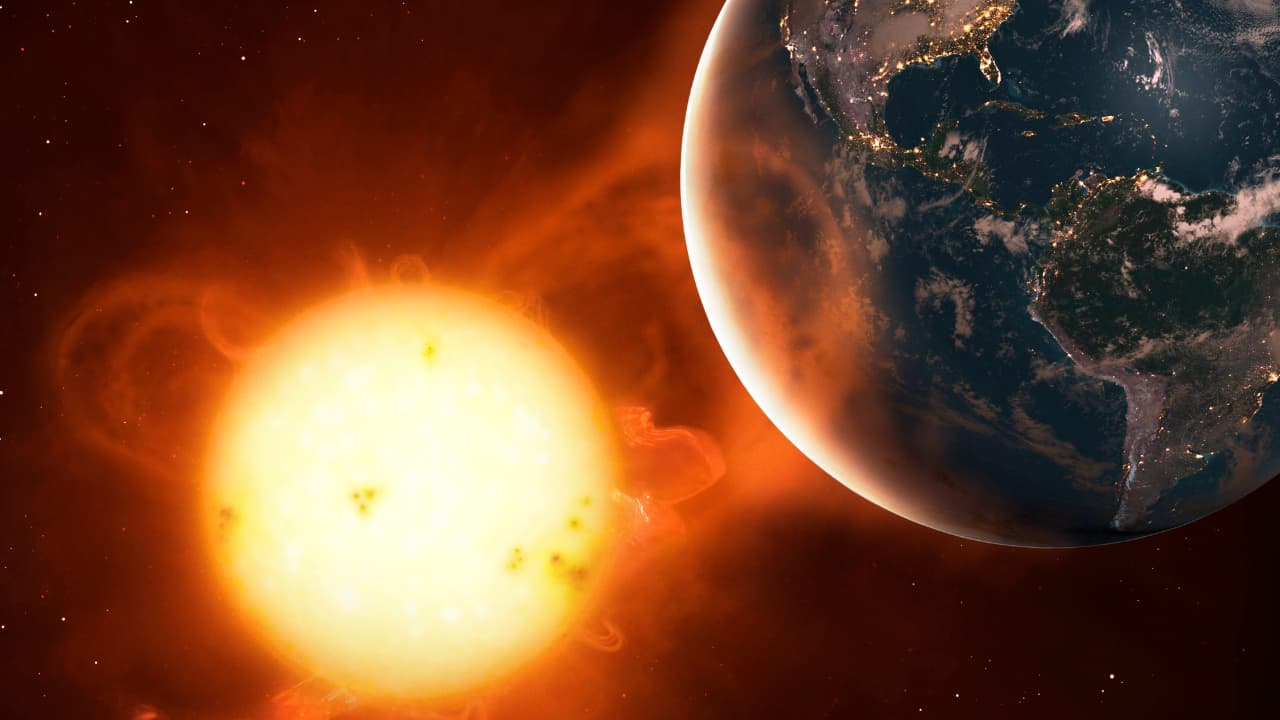
The Sun has unleashed powerful X-class solar flares, threatening GPS and radio signals on Earth. Learn about the recent radio blackouts and the risk to satellites.
Scientists are closely monitoring the Sun after it emitted a powerful burst of solar flares directed towards Earth, which has caused concerns about potential problems with radio signals and GPS systems.
The activity started on February 1, when the Sun released an X-class solar flare just after midday GMT. X-class flares are the most intense type of solar eruption, much stronger than the more common M-class flares. Later that same day, the Sun produced an even more powerful flare, rated X8.1, which is the biggest solar flare observed since October 2024 and one of the strongest ever recorded.
The next day saw more flaring, with two additional X-class flares occurring just after midnight and again in the morning. These events sent bursts of energy toward Earth, affecting the upper atmosphere.
Signal Disruption
When light and energy from a solar flare reach Earth, they interact with gases in the upper atmosphere. This interaction can disrupt radio waves, especially on the side of Earth facing the Sun. As a result, short-term radio blackouts can happen, sometimes lasting over an hour. During these periods, satellite navigation systems, satellite communications, and high-frequency radio signals may become unreliable.
So far, experts have not detected any direct damage to satellites or ground-based systems. The main effect has been temporary signal disruption as radio waves struggled to pass through the disturbed atmosphere.
Northern Lights
Solar flares are often mistaken for coronal mass ejections, which are massive clouds of charged particles expelled by the Sun. These eruptions can have more severe consequences. When they reach Earth, the particles are directed towards the poles by Earth’s magnetic field, leading to bright auroras. That is why the Northern Lights can sometimes be seen further south than usual during intense solar activity.
Coronal mass ejections can also cause the upper atmosphere to expand slightly. This increases drag on satellites in low Earth orbit, making them use more fuel to stay in position and reducing their operational lifespan. In extreme cases, a direct hit could significantly disrupt global communication and navigation networks.
Satellite Risks
Only one of the recent flares was associated with such an eruption, and it seems to have been mostly directed away from Earth. At most, scientists expect only a minor impact, with a possibility of stronger auroras visible in the northern parts of the UK, especially in Scotland.
Experts have warned that there is still a roughly 30 per cent chance of more powerful flares in the coming days which means further radio and GPS disturbances remain a possibility as the Sun’s active region continues to face Earth.