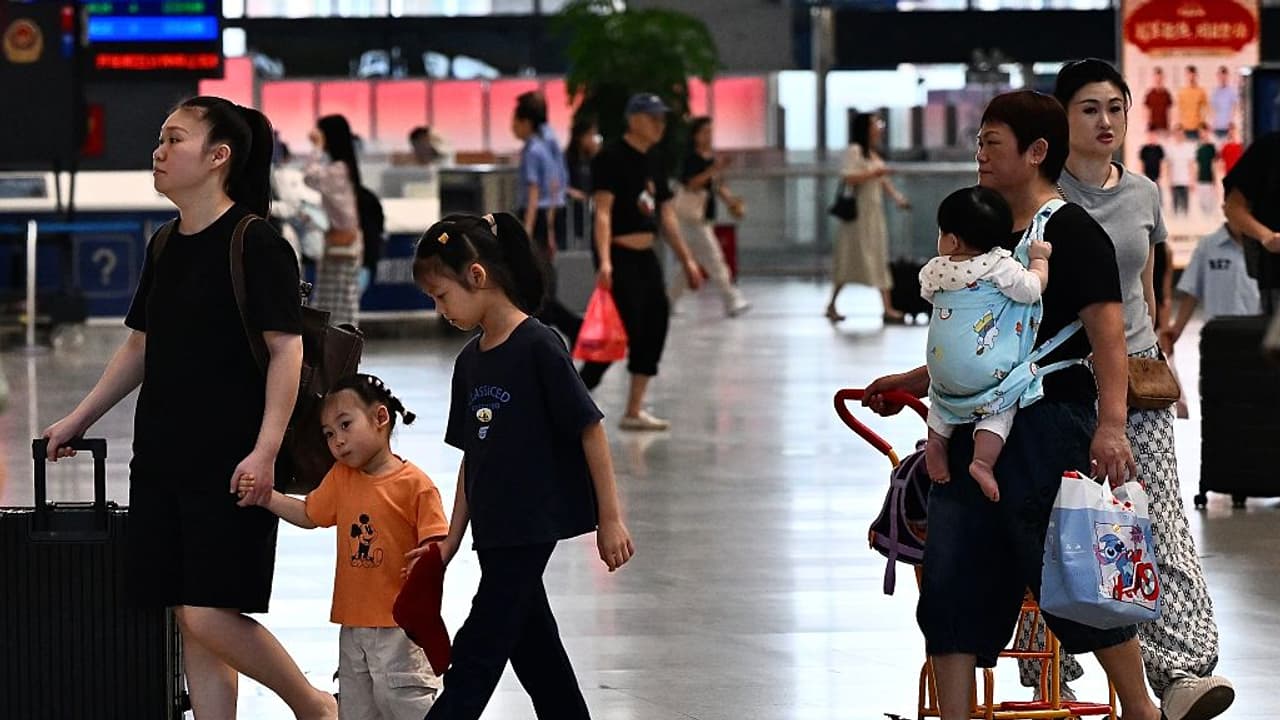
A Chinese man explains China’s hukou household registration system, which many describe as “caste-like” for creating a rural-urban divide. The policy affects access to healthcare, education, and welfare, while the article compares it with India’s hereditary caste system.
A Chinese man provided insights into China’s often-misunderstood social structure, despite the country being one of the fastest-growing economies in the world. China, which is the second-largest country by population with over 141 crore (1.41 billion) people, operates under a complex household registration system known as hukou.
Every Asian nation, including India, Nepal, Pakistan, Sri Lanka, Maldives, and Bangladesh, grapples with its own unique history of social hierarchy, but China follows a rigid yet distinctive administrative policy that formalizes inequality between its rural and urban populations, leading many to label the system as ‘caste-like.’
Established in 1958, China’s ‘hukou’ system was designed to manage population distribution and control migration, but over the years, it has appeared to have become a persistent barrier that anchors an individual’s rights and access to social welfare to their place of birth.
Also Read: Viral Video: Chinese Humanoid Robot Performs Ballet, Then Pulls Off A Stunning Surprise Move | WATCH
Chinese Man Simplifies China’s Caste System
Since China’s system is often complicated by the vast economic disparities and bureaucratic red tape inherent in the country’s development, the Chinese man breaks it down to its most tangible impact: how it restricts a person’s daily life based solely on their paperwork.
In a video that went viral on social media, especially Instagram, a Chinese man asked whether China has a caste system like in India, to which he admitted, stating that city and rural households are fundamentally separated, creating a two-tiered system where your origin dictates your access to opportunity.
“In China, we have like a different system. We distinguish households. If you’re from a rural area, you have restricted access to healthcare. We also have different levels of access to jobs. For example, if someone is from rural China, they can’t easily get certain jobs, such as in the tech sector, although they can still work,” the Chinese man said.
“Because they are from a rural area, their kids would not have access to local education. They can work, but they don’t have access to their children. It’s because of their household.
“If you buy a house in the city, then you can move your household to the city. But it’s only one-way. But for a city guy, you can never go back to the rural area. Unless you marry someone from the rural area, then you change your household register to the rural area,” he added.
Scroll to load tweet…
The Chinese man’s demystifying of China’s ‘hukou’ system has provided a rare, candid glimpse into the bureaucratic realities that define modern Chinese life, turning complex administrative policies into a relatable human narrative, which often highlights the stark, birth-based disparities that persist despite China’s rapid economic ascent.
How is China’s Caste System Different from India’s Social Hierarchy?
Though India and China are the world’s two most populous countries, each with over 1.4 billion people, the nature of their social stratification arises from completely different roots. While both systems result in systematic inequality and restricted social mobility, they function through fundamentally different mechanisms.
While in India, the caste system is ancient and deeply rooted in religious and social traditions, China’s ‘hukou’ system is a bureaucratic and administrative tool designed to control population distribution and manage social welfare access. The foundation of both countries’ caste systems is laid by distinctly different pillars, one by the weight of historical, ritualistic identity and the other by the reach of state-mandated geographic policy.
The primary driver of India’s caste system is hereditary identity and lineage, which has historically functioned as a fixed social status, while in China, the hukou system is a geographic and administrative registration that functions as a state-controlled mechanism to regulate residency rights.
The nature of mobility between India’s and China’s caste systems differs significantly. While India’s social hierarchy is traditionally rigid and identity-bound based on caste and social status, China’s hukou system is a bureaucratic framework that can be navigated or changed through state-sanctioned economic and administrative pathways.
Therefore, India and China’s caste systems may produce similar outcomes in terms of unequal access to opportunities and social mobility, but they differ fundamentally in their origins and operations.
Also Read: Nearly 900 Snakes Escape Flooded China Breeding Farm After Typhoon Maysak | Watch Viral Videos