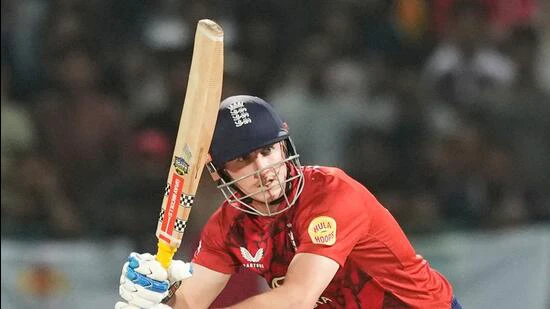
Kolkata: The lie still hangs heavy over Harry Brook, one that he apparently said to protect his teammates from the repercussions of the night he was punched by a nightclub bouncer in Wellington in October.
Brook was already on notice, his newly-earned white-ball captaincy on the line even before he could ease into it.
Cut to this week though and Brook wouldn’t mind how things are turning out for him. A one-day hundred in Colombo and a 12-ball 36 in the Pallekele T20I, and suddenly England’s white-ball identity seems to be resonating with Brook’s batting again.
It is no coincidence that England’s white-ball future is now tethered to Brook. In handing him captaincy, the selectors have not just chosen a player, they have reaffirmed a philosophy that has defined England’s modern limited-overs cricket. The latest Ashes setback notwithstanding, as long as Brendon McCullum stays coach, England are expected to pursue their idea of aggressive, entertaining cricket.
England’s white-ball revolution dates back to 2015, under Eoin Morgan’s leadership. Brook has grown in its slipstream, absorbing a culture that valued bravery over caution and ceiling over safety. But as captain, his form matters more than it ever did before. Not because England lack talent, far from it, but because Brook’s batting sets the emotional quotient of the side. When he is fluent, England look unstoppable. When he is searching for the ball, the team can appear to be caught between identities.
There is a subtle but important distinction between Brook the young talent and Brook the leader. As a batter, he has thrived on freedom, instinct and feel and was allowed his way too because he could get away with it. As captain though, he must balance that instinct with nuanced stewardship of younger players, of game situations, and of a dressing room that has known extraordinary success but now simmers in a transitional phase.
Jos Buttler, Ben Stokes and Morgan shaped an era that redefined what was possible. But Brook has inherited something looser – a squad rich in T20 nous and athleticism, but still searching for hierarchy. His role then is not just to score runs, but provide coherence in chaos.
That is where form becomes inseparable from leadership. Which in turn is why this recent spate of scores in Sri Lanka is promising. Brook’s batting is expressive, it signifies permission. When he attacks early, others follow. Like in the second T20I where Brook’s onslaught set up Tom Banton to finish the chase with an unbeaten 33-ball 54. England’s white-ball cricket has always been less about accumulation and more about momentum, Brook now being its primary generator.
Unfair but obvious is the pressure Brook shoulders when he walks out to reinforce England’s white-ball identity. A shuffle across the crease, a trigger movement that seems to invite the fast bowler to pitch it fuller. Then, often a shot that appears outrageous for the situation but utterly logical for the man playing it. Reverse-scooped pace. Picked-up spin over midwicket. Intent, immediately.
But leadership also demands adaptability, an area that will define Brook’s captaincy. This T20 World Cup will not be played to England’s strengths alone. Slower pitches, deeper bowling attacks and data-driven opposition plans will force recalibration. Brook’s challenge will be to prove that aggression can be intelligent – that England can remain fearless without being predictable.
Crucially, Brook’s approach to failure too may matter a lot. He has never been a low-variance player, and nor should he become one. Crucial, thus, will be his experience in IPL – he was banned last year for pulling out of the league at the last moment – that had formed the first mould of Brook. Younger players will take the cue from Brook since his leadership style is more conversational than commanding. That can be a strength in modern cricket where heavy buy-in matters as much as instruction. But it also places extra load on him to perform. In the England dressing room, credibility is always earned in the middle.
England’s position in world cricket again heavily depends on a blockbuster white-ball performance. This isn’t to say their trajectory in Tests hasn’t been positive. But failure in the Ashes, against India and the inability to win the World Test Championship has again put the onus on the limited-overs team to keep England relevant. If Brook flourishes, he could carry through those hopes. If he struggles, England risk slipping through the cracks that have appeared in the aftermath of the Ashes loss.