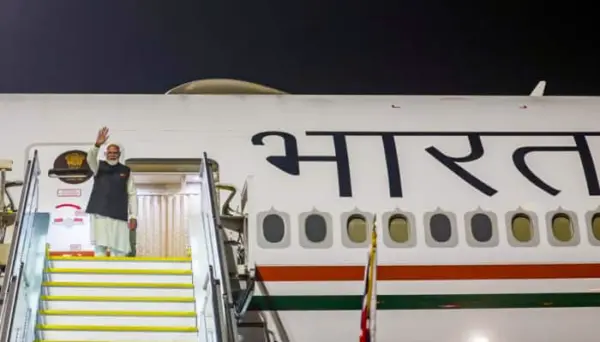
The six-day tour (6th to 11th July 2026) has significantly consolidated Indias Act East policy and expanded its MAHASAGAR vision across the Eastern and Southern Indian Ocean.
The visit has re-anchored New Delhis position as a reliable economic and security partner in a changing Indo-Pacific landscape through a mix of high-level strategic pacts and warm cultural diplomacy.
Deeper maritime and defence boost in Jakarta
The visit began in Indonesia, where Prime Minister Modi engaged in extensive bilateral discussions with President Prabowo Subianto. Building on the Comprehensive Strategic Partnership established in 2018, the two leaders oversaw the signing of fourteen major agreements focusing heavily on critical minerals, maritime security, and defence.
A major highlight was the signing of landmark deals for India to supply BrahMos cruise missiles and beyond-visual-range Astra air-to-air missiles to Indonesia. Recalling the shared past of the two nations, Prime Minister Modi said India and Indonesia share strong civilisational and people-to-people ties. The leaders also visited the historic Prambanan Temple compound in Yogyakarta, visually reinforcing the deep cultural ties underpinning their modern strategic alignments.
Nuclear energy and critical minerals talks in Melbourne
During his second leg, Prime Minister Modi met his Australian counterpart, Anthony Albanese, in Melbourne for the third India-Australia Annual Summit.
The talks yielded a host of major deals, chief among them a historic civil nuclear energy deal opening the door to the commercial supply of Australian uranium to power Indias nuclear reactors. The two nations also agreed on frameworks for cooperation on critical minerals and stepped up maritime domain awareness.
Prime Minister Albanese said the partnership is crucial to securing a peaceful, open and prosperous Indo-Pacific, reflecting on the growing camaraderie. Before departing, Prime Minister Modi expressed his deep gratitude and said that the results of the visit have further strengthened the partnership and opened new avenues for cooperation that will benefit the entire planet.
New era of relations with Auckland
In the final leg of the visit, the Prime Minister visited Auckland, marking the first official visit by an Indian Prime Minister to New Zealand in four decades.
Welcomed by Prime Minister Christopher Luxon, the visit effectively capitalised on the momentum generated by the newly signed Free Trade Agreement. During the visit, both nations upgraded their relations to a Strategic Partnership.
The two leaders also reviewed their entire bilateral framework, committing to a bold target of doubling two-way commerce in goods and services by 2030, alongside a long-term investment plan of twenty billion dollars in India over the next fifteen years.
New Zealand also showed an eagerness to diversify its trade dependencies, with Prime Minister Luxon praising the vibrant Indian diaspora, adding that the community is a living bridge and is excellent in all spheres of life. Prime Minister Modis deft navigation of the packed economic agenda was complemented by his interactions with well-known local business and sports personalities, a reminder that Indias geopolitical relations are as much rooted in human ties as they are in state treaties.
New Zealand Prime Minister Christopher Luxon also congratulated India on its progress under Prime Minister Narendra Modi, describing him as one of the most important leaders of our time and saying the 21st century will be shaped by India.