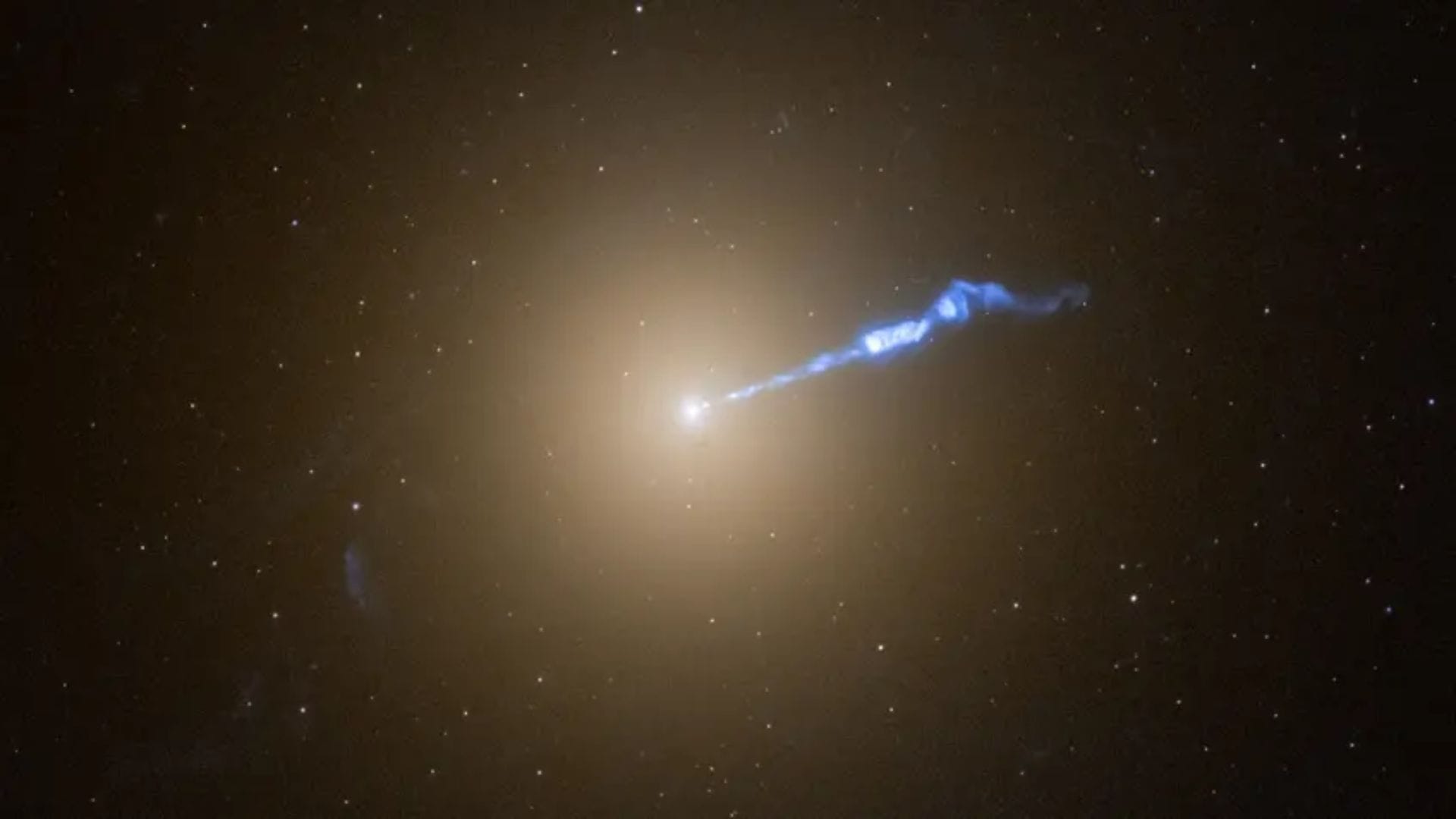
New Delhi: Astronomers using the Earth-sized virtual astronomical instrument called the Event Horizon Telescope (EHT) have obtained new evidence on the origin of the relativistic jet being blasted by supermassive black hole that occupies the core of the M87 galaxy. The EHT is a global network of radio telescopes that combine the observations through a process known as Long Baseline Interferometry. M87* is a black hole that contains about six billion solar masses, and is located at a distance of 55 million lightyears. The data was captured during the 2021 campaign. The research was published in Astronomy and Astrophysics.
Previous images of the central black hole and its shadow in 2019, showed a bright ring of hot gas around the extremely dense object. The region from which the jet originated remained unclear. The 2021 observations incorporated additional radio observatories, and provided the critical intermediate baselines of several hundred to thousands of kilometres. These baselines bridged small-scale ring emissions with the larger structure of the jet. Analysis of radio wave intensity across spatial scales revealed higher emission on short to intermediate baselines, than long baselines alone could explain from the ring. Sophisticated modelling identified a compact feature, consistent with the emission of the jet, positioned about 0.09 lightyears from the black hole, or about 5,500 astronomical units (AU), where a single AU is the distance between the Earth and the Sun.
Why do black holes spout jets?
The identified base aligns with the southern arm of the jet observed in 2018. The discovery links the black hole shadow directly to the mechanism launching the jet. The magnetic fields of the infalling gas and dust being consumed by the black hole channel some of the material into polar jets, that are then propelled outwards at speeds close to that of light. Follow-up observations with expanded baselines, adding more radio observatories around the world are expected to refine the morphology of the jet, and test various theories on the extreme physics of black holes.